

On this page
The wait between writing an entrance exam—like JEE Main or NEET-UG—and the final result is a notoriously anxious time. The exams are over, but the outcome is entirely out of reach. For a 16-year-old, this gap often feels like their entire future is hanging in the balance, leading to sleepless nights, endless scrolling through social media, and constant second-guessing of their answers. As a parent, your reaction during this limbo period shapes how they carry this burden. You cannot change their score, but you can change how they experience the wait.
How do you talk to a child worried about entrance results?
The most crucial rule is to decouple their self-worth from their expected score. Children often internalize the idea that lower marks mean they are a disappointment. You have to explicitly tell them otherwise.
A 2025 NIMHANS study analyzing a state helpline for 10th-standard students (Manikappa et al., 2025) found that 36% of the 532 callers reported emotional and behavioral disturbances linked to their exams. When their identity is tied strictly to passing, the prospect of a low score becomes intolerable.
To counter this, shift the conversation from predicting marks to praising their effort. Avoid asking, "How much do you think you will score?" Instead, ask, "How do you feel about the effort you put in over the last two years?" Remind them: "No matter what the cut-off is, we are proud of the work you put in. The result tells us what to do next; it doesn't tell us who you are."
What should you say when the wait becomes overwhelming?
When panic sets in, avoid dismissive reassurances. To a child, "Don't worry about it" feels like you aren't listening to their genuine fears. Acknowledge the uncertainty, and then pivot to constructive action.
If their anxiety comes from knowing they had concept gaps or made wrong-method mistakes in their preparation, shift the focus to active learning for their next step. Remind them that exams are just assessments of where their learning is right now, not where it stops. If they need to review concepts but feel paralyzed by a blank page, they can use the Fermi Problem Library, a step-by-step solver that explains the reasoning rather than just printing an answer.
If they are struggling with the confidence to try again, Fermi's AI tutor can work out what they already know and build a plan for the session, so they sit down to a clear next step. Reframing the post-exam period as a time to evaluate study habits, rather than just wait for a verdict, gives them a sense of agency. For more specific advice on the day the scores arrive, read our guide on results day as a parent: what to say and what not to say.
The Circle of Control: a framework for parents
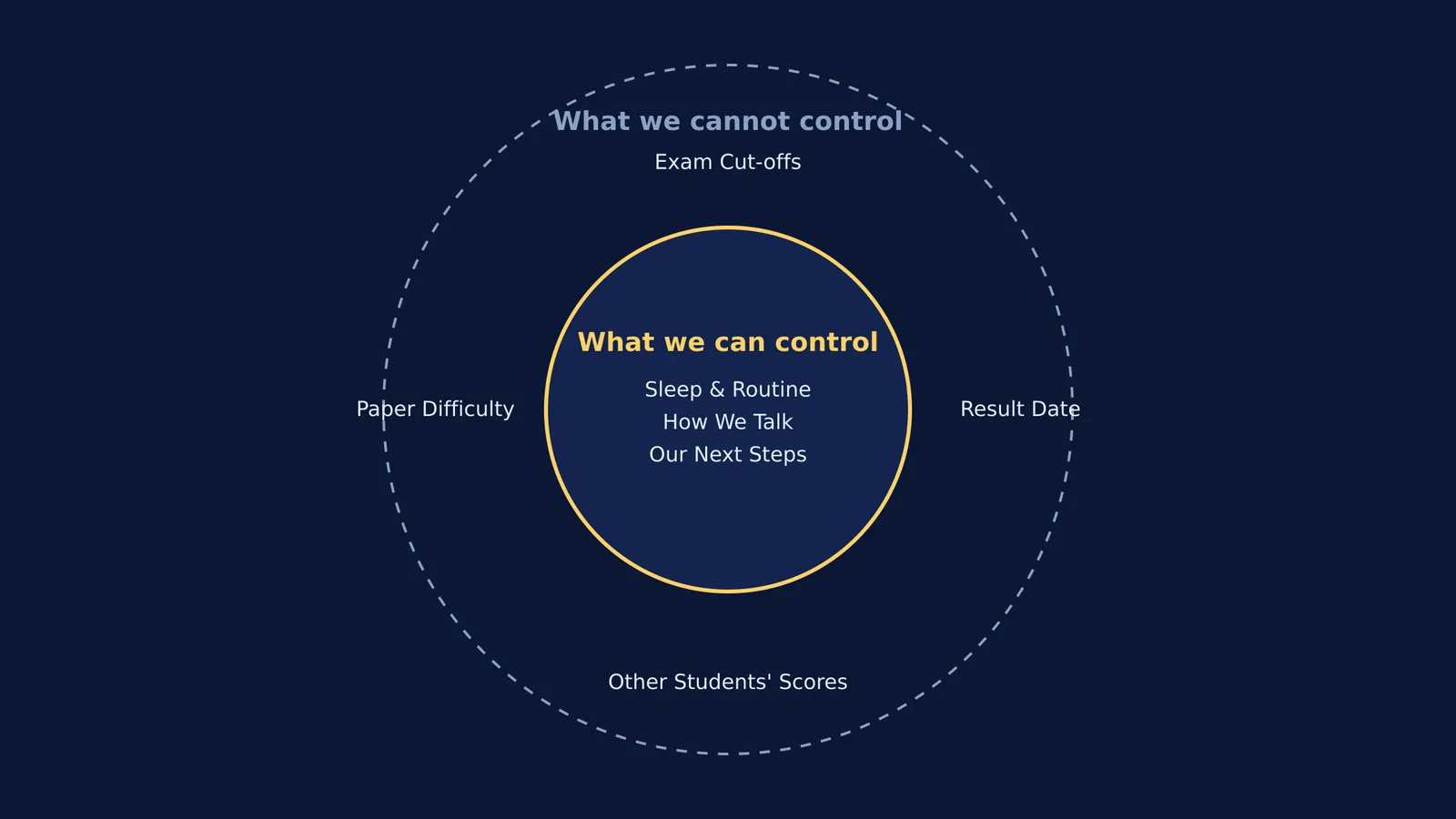
Anxiety thrives on uncertainty. The "Circle of Control" is a simple, visual framework to help separate productive action from useless worry. Sit down and draw two circles on a piece of paper with your child:
Inside the circle (what you can control): Sleep schedules, daily routines, how you speak to each other, and your immediate next steps (such as researching alternative colleges, planning a backup strategy, or simply taking a well-deserved rest).
Outside the circle (what you cannot control): Exam cut-offs, the difficulty of the paper, other students' scores, and the exact result date. Constantly checking news websites or discussing these factors only feeds anxiety because you cannot change them.
Whenever the family conversation drifts to the outer circle—such as speculating about the NEET qualifying marks—gently guide it back to the inner circle. Ask, "Is this something we can control today?" If the answer is no, move to something inside the circle, like going for a walk or watching a film.
When should you seek help from a school counsellor?
Exam anxiety is normal, but acute distress requires professional support. Look for physical and behavioral changes that disrupt daily life. Are they pulling away from family, locking themselves in their room, or showing extreme changes in appetite and sleep?
If you notice these warning signs, do not wait for the results to be declared. Reach out to a school counsellor or a professional mental health service immediately. The national Tele-MANAS helpline (14416) is available 24/7 for psychosocial support in India.
Your child's well-being always comes before their academic timeline. You can find more strategies in our guide on exam stress in teenagers: everyday support, and when to get help.


