On this page
For decades, high school students choosing Physics, Chemistry, and Mathematics (PCM) have faced a single default expectation: crack entrance tests for a computer science or mechanical seat and graduate with a B.Tech degree. Yet equating Class 12 PCM solely with engineering overlooks the breadth of scientific and analytical disciplines built upon foundational mathematics and physical science. According to the Ministry of Education's All India Survey on Higher Education (AISHE 2021-22), undergraduate Science programs enroll 14.8% of all college students in India, surpassing Engineering and Technology at 11.8%. When families begin talking about STEM careers beyond engineering, they uncover established disciplines that value mathematical modeling, spatial thinking, and deductive logic just as much as engineering faculties do.
Which career options after PCM exist other than engineering?
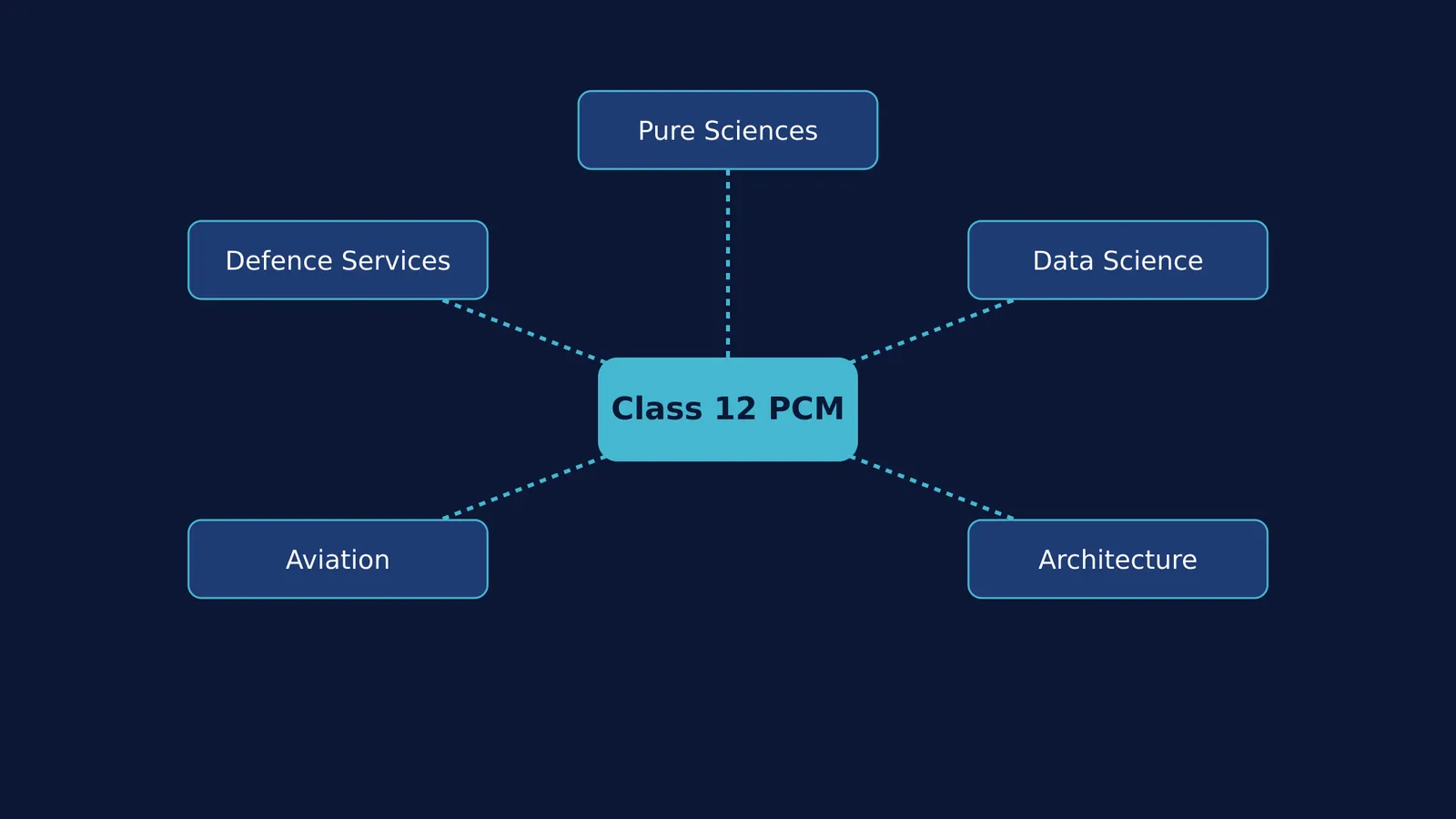
A rigorous PCM background builds core analytical competencies that transfer directly into six primary professional domains outside traditional engineering colleges:
Pure Sciences and Fundamental Research: Theoretical and experimental inquiry in physics, chemistry, and mathematics leading to academic fellowships and corporate laboratory careers.
Data Science, Statistics, and Quantitative Finance: Advanced mathematical modeling, probability theory, and algorithmic problem solving applied to artificial intelligence, market analysis, and operations research.
Architecture and Spatial Planning: Licensed five-year professional practice combining structural physics, environmental mechanics, and aesthetic drafting.
Commercial Aviation: Professional flight operations, navigation, and aerospace technical management as a commercial airline pilot.
Defence Services: Commissioned technical and tactical command roles in the Indian Air Force and Indian Navy through specialized military academies.
Industrial and Interaction Design: Product design, ergonomics, and human-computer interaction rooted in physical geometry and user psychology.
How do pure sciences and data science compare to B.Tech?
Students drawn to first-principles thinking rather than routine industrial application often find deeper satisfaction in pure sciences. Admission to the seven Indian Institutes of Science Education and Research (IISERs) and the Indian Institute of Science (IISc Bangalore) runs primarily through the centralized IISER Aptitude Test (IAT). The computer-based examination features 60 questions across Biology, Chemistry, Mathematics, and Physics over 180 minutes. Eligibility requires at least 60% aggregate marks in Class 12 Science (55% for SC, ST, and PwD candidates). IISER graduates typically proceed directly to fully funded doctoral programs, scientific research institutions, or specialized industry research and development roles.
In data science and statistics, India's most prestigious undergraduate degrees are hosted not by engineering departments, but by dedicated mathematical academies. The Indian Statistical Institute (ISI) offers the Bachelor of Statistics (B.Stat Hons) in Kolkata and Bachelor of Mathematics (B.Math Hons) in Bengaluru. The Government of India fully covers tuition for admitted students and provides a monthly stipend of ₹5,000 alongside an annual contingency grant of ₹5,000. Entry requires clearing the two-part ISI Admission Test—comprising objective mathematical problems (UGA) and rigorous subjective proofs (UGB)—or holding an Indian National Mathematical Olympiad (INMO) award. Because mathematical and scientific disciplines demand conceptual mastery rather than rote memorization, students can use the Fermi Concept Library to explore every concept in physics, chemistry, biology, mathematics, and computing. For multi-step problem solving, the Fermi Problem Library provides worked problems with a step-by-step solver that explains the reasoning rather than printing an answer.
What does it take to enter aviation, architecture, or defence?
Professional careers outside standard college lecture halls require strict compliance with statutory regulations and specialized aptitude testing:
Architecture: The Council of Architecture (CoA) regulates the five-year B.Arch degree under the Architects Act, 1972. Candidates must pass 10+2 with Physics and Mathematics as compulsory subjects and score a minimum of 45% aggregate marks. Admissions rely on the National Aptitude Test in Architecture (NATA) or JEE Main Paper 2A, testing spatial visualization, perspective drawing, and geometry.
Commercial Aviation: The Directorate General of Civil Aviation (DGCA) mandates Class 12 with Physics and Mathematics alongside a Class 1 Medical assessment for issuing a Commercial Pilot License (CPL). Under Civil Aviation Requirements Section 7 Series B Part I, trainees must log 200 flight hours within five years—including 100 hours as Pilot-in-Command, 20 hours cross-country, 10 hours instrument flying, and 5 hours night flying—before clearing written exams in navigation, meteorology, and regulations.
Defence: The Union Public Service Commission (UPSC) administers the National Defence Academy (NDA) and Naval Academy examination twice each year. While the Army wing accepts candidates from any stream, entering the Air Force and Naval wings strictly requires 10+2 with Physics and Mathematics for unmarried candidates aged 16.5 to 19.5 years.
Design: Administered by IIT Bombay, the UCEED examination selects candidates for Bachelor of Design (B.Des) programs. While several institutes accept candidates from any stream, specialized programs at IIT Guwahati and IIT Roorkee specifically mandate Class 12 Science with Physics, Chemistry, and Mathematics.
How can families decide on the right career path?
Families navigating the transition after Class 12 can evaluate options through a systematic four-step framework:
Identify cognitive problem-solving style: Observe whether the student thrives on formal mathematical proofs (ISI), laboratory experimentation (IISER), spatial and aesthetic construction (architecture and design), or operational discipline under pressure (aviation and defence).
Verify statutory and physical criteria early: Age boundaries like the NDA 16.5 to 19.5 window and medical certifications such as the DGCA Class 1 assessment should be validated before committing extensive time to preparation.
Harness syllabus overlap: High school PCM curricula align closely across competitive entrance exams. Mastering Class 12 calculus, algebra, and classical mechanics establishes the base needed for NDA Paper 1, NATA mathematics, and the IISER Aptitude Test.
Maintain open, supportive discussions: When a student's curiosity diverges from the standard engineering path, understanding when your child's career choice differs from yours and reflecting on decisions made while choosing a stream after Class 10 keeps communication constructive. A student pursuing an intellectual direction aligned with their natural talents builds a more resilient career than one drifting through an uninspiring engineering seat.