On this page
Your child's coaching institute sends a test portal login, and your teenager has changed the password or won't hand it over. It can feel like hiding, but the reason is usually more ordinary, and you can get what you need without a fight.
Why does my teenager refuse to share the coaching portal password?
For a JEE or NEET aspirant, the portal is not a report card that arrives twice a year. It shows every test, every rank and every wrong answer, often within hours. A teen who knows a parent can open it at any time feels watched after each bad weekly test, before they have had a chance to understand it themselves.
Some common reasons:
They want to see a bad score first and come to you with an explanation.
Ranks jump around from test to test, and they fear each dip will start an argument.
They are behind on a module and hope to catch up before anyone notices.
The login is their identity at the institute, and handing it over feels like being treated as younger than they are.
The third is the one to watch, and even that is better found through conversation than through the password.
Does checking the portal yourself actually help?
Research on parental monitoring suggests that what parents know comes mostly from what teens choose to tell them. In a study of 1,186 14-year-olds in Sweden and their parents, Margaret Kerr and Håkan Stattin found that children's spontaneous disclosure explained more of the link between parental knowledge and good adjustment than parents' tracking and surveillance did (Developmental Psychology, 2000).
Pushing past a teen's boundary can shrink what you know. A three-year study of 497 Dutch adolescents and both their parents found that teens who felt their parents invaded their privacy reported more secrecy, and parents reported knowing less about them one year later (Hawk and colleagues, Developmental Psychology, 2013). An earlier study by the same group found that perceived privacy invasion and conflict fed each other over time (Journal of Family Psychology, 2009).
None of this means you should stop paying attention. A review of research on parents' involvement in children's schooling, subtitled "More is not always better", argues that how parents get involved matters, not just how much (Pomerantz, Moorman and Litwack, Review of Educational Research, 2007).
What do parents actually need from coaching test reports?
Most portals show far more than a parent can use. Strip it down to four questions:
Is my child taking the tests, or skipping them?
Over the last four to six tests, is the trend rising, flat or falling?
Which two or three chapters keep costing marks?
Does my child have a plan for those chapters, and do they need anything from me?
Daily rank, percentile and question-by-question timing are tools for your teen and their teachers; watching them closely mostly adds pressure.
How does a weekly shared review work?
Propose this plan:
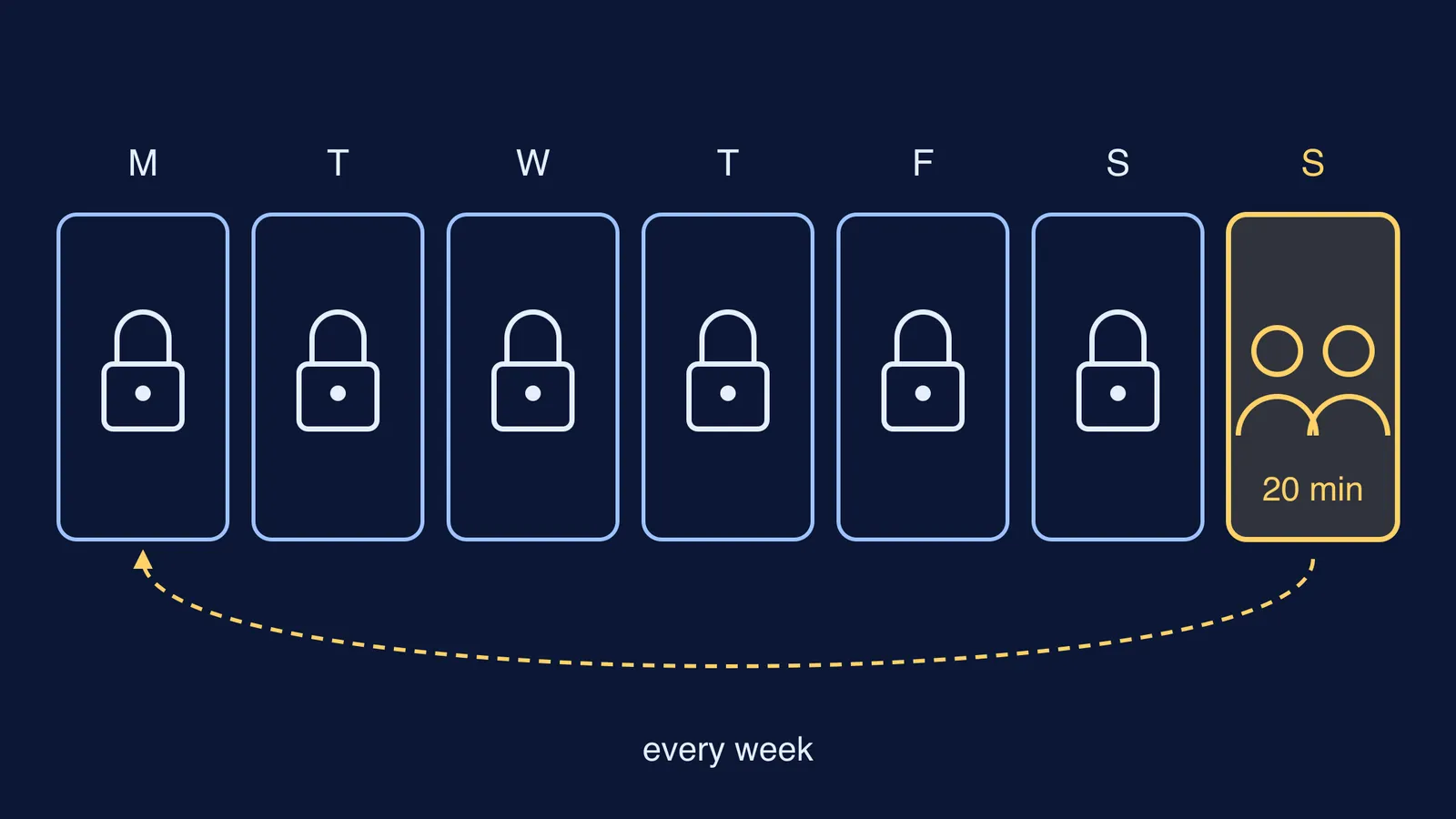
Pick one fixed slot, say Sunday evening after the weekly test, for 20 minutes, so neither of you has to ask.
Your teen drives. They open the portal on their own device and show you the latest results. You don't touch the screen or the password.
They answer the four questions above. Ask follow-ups about the trend, not single scores.
Agree on one action for the week: a chapter to redo, a doubt to take to a teacher, a test they won't skip.
End with something that is not about marks.
Agree on the exceptions in advance: if two reviews are missed in a row, or tests are skipped, you both talk to the institute's mentor. A rule known up front won't feel like a trap.
To start the conversation, try: "I'm not going to ask for your password. I do want to know how the tests are going, so I can help if something slips. Can we sit for 20 minutes every Sunday where you show me the trend and what you're working on?" If they push back, ask what they would be comfortable showing you, and start there.
If the review keeps landing on the same chapter, the fix is usually teaching, not more tests. Fermi's AI tutor can work out what your teen already knows and build a plan for the session, and the Fermi Problem Library has worked problems with a step-by-step solver that explains the reasoning, which helps when marks are lost to the wrong method.
When should a parent step in anyway?
If scores have dropped sharply and your teen won't talk, if they are skipping classes, or if you notice withdrawal, poor sleep or hopeless talk, contact the institute's mentor and consider professional support. Tele MANAS, the Indian government's 24x7 tele-mental health helpline, can be reached on 14416 or 1800-89-14416 (Directorate General of Health Services).
For your teen's side, share our guide on sending your own note before coaching sends marks home. See also agreeing on check-ins with a JEE aspirant who doesn't want to discuss scores and whether parents should check a teenager's phone secretly.