On this page
A WhatsApp or Telegram message offers money for liking videos or rating places on a map. To a 16-year-old saving for a phone, it looks like an easy part-time job. Usually it's the start of a task scam, and it works because the first payouts are real.
How do task and part-time job scams hook teenagers?
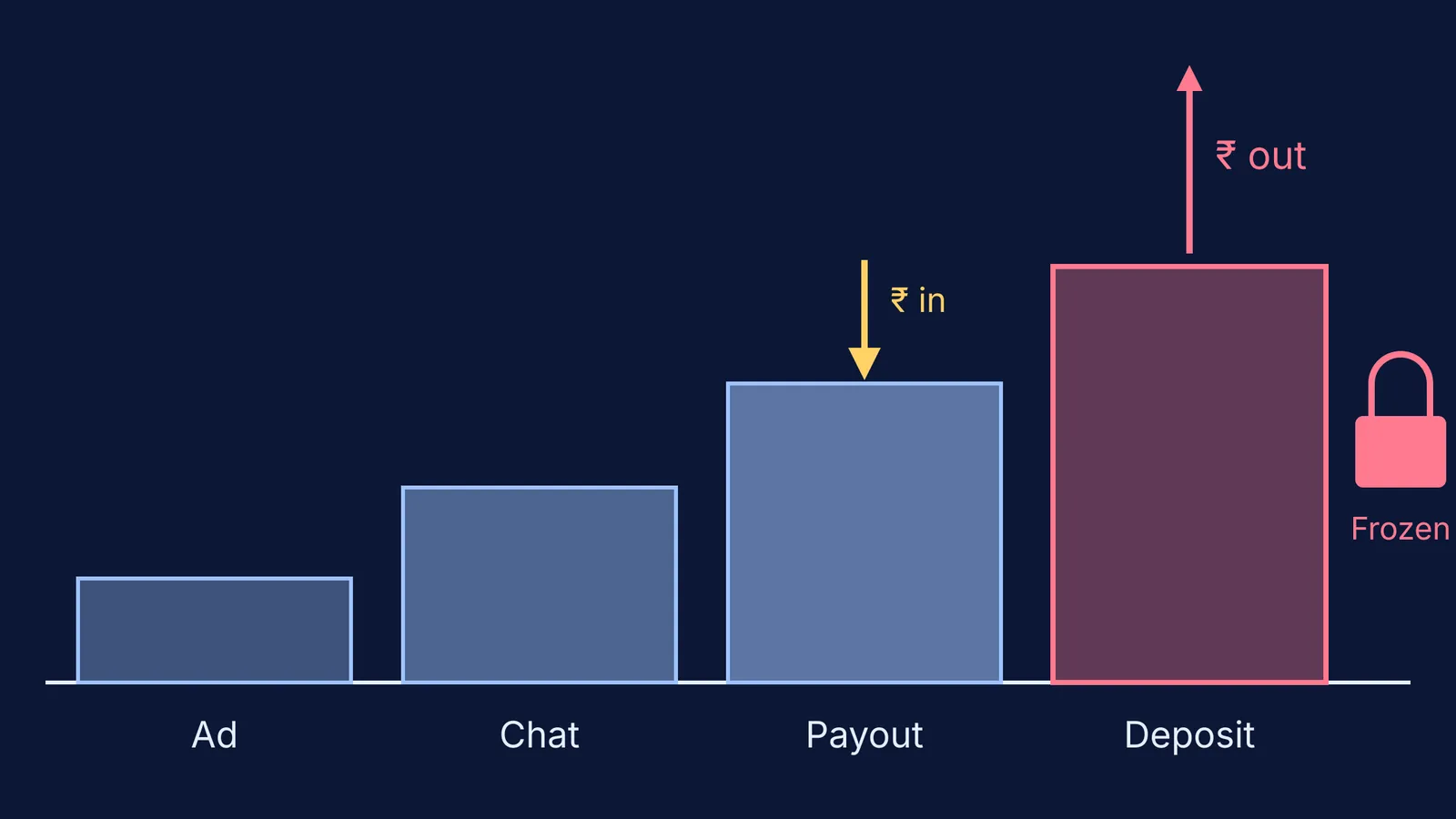
The Ministry of Home Affairs described the pattern in a December 2023 press release. It came after its Indian Cybercrime Coordination Centre (I4C) flagged more than 100 websites running task-based and investment frauds, which MeitY then blocked. The release lists four steps:
Targeted ads on Google and Meta use phrases such as "Ghar baithe job" and are aimed mostly at retired employees, women and unemployed young people looking for part-time work.
An agent on WhatsApp or Telegram asks you to do small tasks, such as liking and subscribing to videos or rating places on maps.
You get a small commission, then you're asked to invest more to earn more per task.
Once you trust them and deposit a larger sum, the deposits are frozen.
Teenagers fit this pattern closely. They want their own money, they're comfortable on chat apps, and step 3 feels like proof because the money really arrived. The same release says the money was moved out of India through card networks, cryptocurrency, overseas ATM withdrawals and international fintech companies.
What are the warning signs of a fake online job offer?
Any one of these is a reason to stop:
The "employer" found you, through an ad, a random message or a group you were added to.
There is no interview, no written offer and no company you can check outside the chat.
The work is liking, subscribing, rating or reviewing, and the pay is far more than the work is worth.
You have to pay, "top up", "recharge" or buy a task bundle before you can withdraw.
Payments go to a UPI ID or account in a random person's name. The ministry advises checking the receiver's name in your UPI app, because a random individual may be a mule account (PIB, MHA).
They ask for photos of your Aadhaar, PAN or bank passbook, or for an OTP.
Some teens are asked to "lend" their bank account or UPI ID so someone else can receive money through it. The answer is no. The ministry says these gangs use mule or rented accounts, and warns that transactions with unknown accounts can be linked to money laundering and lead to police blocking accounts (PIB, MHA). For safe set-up, see our guide to UPI rules and scam limits for teenagers.
My teen already paid or shared details: what should we do now?
Act today, calmly, in this order:
Stop paying. Don't send any "release fee", "tax" or "penalty" to get the earnings out, because it only adds to the loss. Don't delete the chats.
Call 1930 or report on cybercrime.gov.in. 1930 is the national toll-free helpline for help lodging online cyber complaints, including financial fraud. According to a Ministry of Home Affairs reply in the Lok Sabha, the I4C's financial fraud reporting system had saved more than Rs 11,158 crore across more than 32.80 lakh complaints by 30 June 2026. Report quickly, because scammers move money on fast.
Call your bank's fraud line with the transaction IDs. For any payment your teen did not make, note that under the RBI's rules on unauthorised electronic transactions, how much of the loss a customer bears depends partly on how fast they report it. A customer can have zero liability in some cases if they tell the bank within three working days.
Save the evidence. Take screenshots of the chat, phone numbers, UPI IDs, transaction IDs and links, and report the numbers and handles too, as the ministry asks.
Secure the accounts. Change the passwords for email, UPI apps and social media, and turn on two-step verification. If ID documents were shared, or your teen's account received money, say so in the complaint and tell the bank.
What should parents say to a teen who fell for a scam?
Shame keeps teenagers quiet, and silence costs time. Try:
"Thank you for telling me. You're not in trouble. Let's fix this together."
"Organised gangs run these scams. Being tricked doesn't make you stupid."
"Show me the chat from the beginning, and we'll report it now."
Our plan on whether your teenager should take a part-time job lists genuine options. The same checks work for fake scholarship messages made with AI.
If your teen seems very low, can't sleep or talks about harming themselves, call Tele MANAS on 14416. It's a toll-free, 24/7 mental health helpline from the Ministry of Health and Family Welfare (PIB). You can also see a doctor.
Once things settle and it's time to get back to studies, Fermi's AI tutor can work out what your teen already knows and build a plan for the session, so the first evening back starts with a clear next step.