
On this page
Your 15-year-old drops a word at the dinner table you never thought they knew. Most parents either explode or pretend not to hear. Neither works for long. A short, calm response works better.
Why do teenagers start swearing at home?
Your teen did not learn these words last month. Using observations of children aged 1 to 12, Kristin Jay and Timothy Jay (2013) reported that by the time children enter school they already have the rudiments of adult swearing. What changes in the teen years is how often the words come out, where, and in front of whom.
Three things push them out.
Swearing carries feeling. In a review of swearing research, Timothy Jay (2009) argued that taboo words communicate emotion such as anger and frustration more readily than ordinary words. A teenager dealing with a bad test, a fight in the group chat or a long coaching day has plenty of both.
It can actually take the edge off. In a cold-water experiment, Stephens, Atkins and Kingston (2009) found that swearing increased pain tolerance and decreased perceived pain compared with not swearing. That study tested adults, not teenagers, but it suggests a swear after a stubbed toe can be partly a way of coping.
Friends and screens set the norm. In an experiment with 306 participants, Gardner and Steinberg (2005) found that peers had a stronger effect on risk taking in adolescents and young adults than in adults. That study measured risk taking, not swearing, but it suggests the pull of the group is especially strong in the teen years. A survey of 223 middle-school students by Coyne and colleagues (2011) found that more exposure to profanity in media was linked to more accepting attitudes toward it and more use of it. That study shows a link, not proof that media causes swearing.
So a word that is normal with friends slips out at home, often when your teen is tired or upset.
What should you do the moment your teen swears?
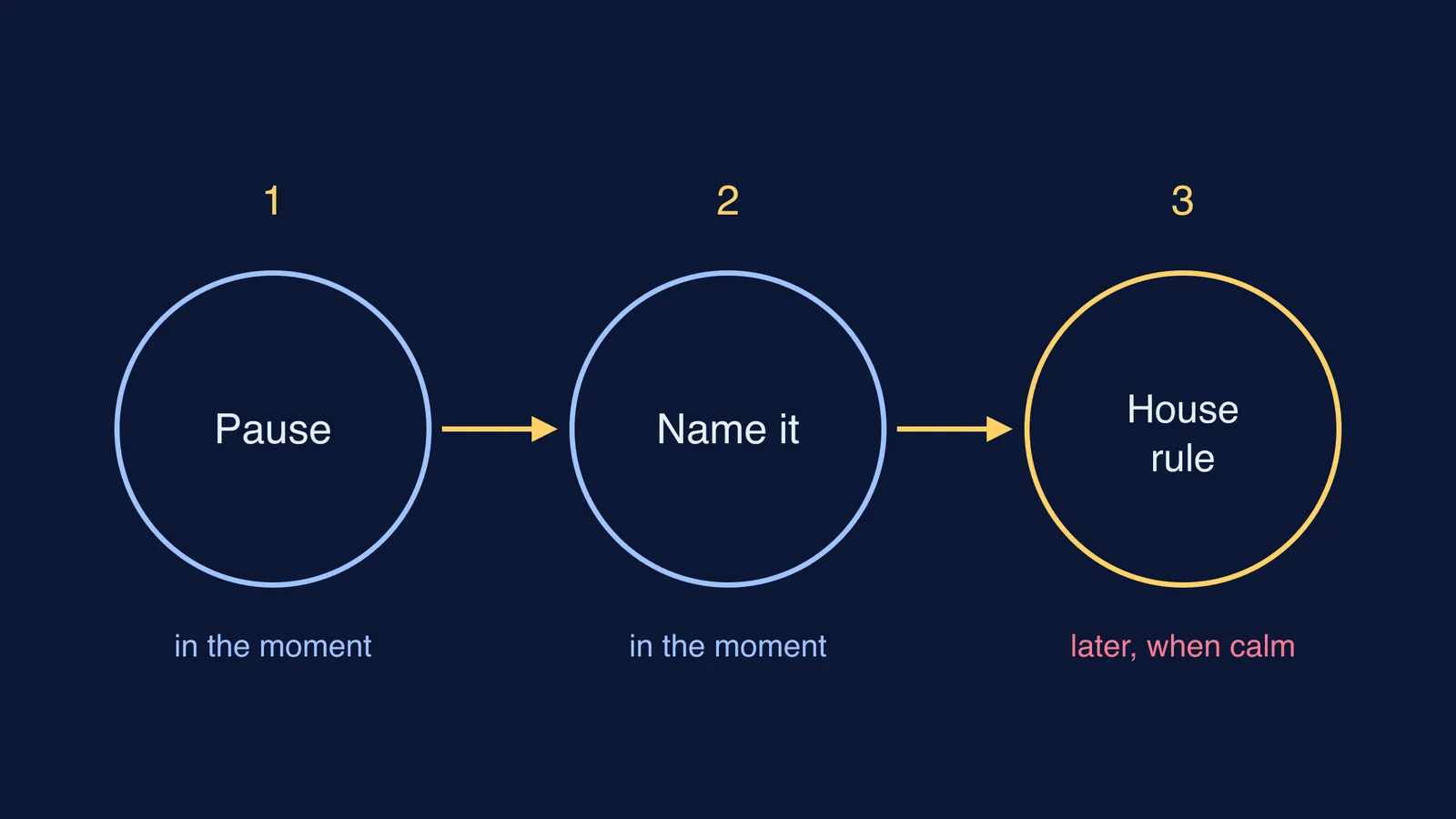
Use three steps: pause, name it, set the house rule.
Step 1: Pause
Take one breath before you speak. If the word came out in anger, a lecture now becomes a shouting match. If you need to, say, "I'll answer that in a minute," and step away.
Step 2: Name it
Describe the word and the feeling, not your child's character. Try: "That was a strong word. Sounds like that test really got to you." This tells your teen you noticed, and it points at what is often the real issue: frustration.
Step 3: Set the house rule
Later, at a calm moment, agree on one rule. One clear rule is easier to keep than a long list. For example: "No swearing at people in this house, and none in front of Dadi or your younger brother." Agree on a fair consequence together. A regular weekly family meeting with your teenager is a good place to do this.
What does this look like in real life?
Riya, in Class 11, gets her physics test back and says, "This chapter is f***ing useless," in the kitchen.
Pause: her mother keeps chopping vegetables for ten seconds and does not react straight away.
Name it: "That was a strong word. Rotational motion has been rough this week, hasn't it?"
Set the rule (that evening): "Swearing about a chapter is one thing, but not at us and not in front of Nani. If it happens, you do the dishes. Fair?"
Notice what she did not do. She did not call Riya badly brought up, and she did not bring up the marks.
If the swearing mostly happens over homework that will not come out right, the frustration is the real target. The Fermi Problem Library has worked problems with a step-by-step solver that explains the reasoning rather than printing an answer, so a stuck problem can turn into a next step.
What mistakes make teen swearing worse?
Swearing back. A rule against swearing is hard to defend if your teen hears you break it.
Shaming in front of others. Correcting your teen in front of cousins or siblings turns a word into a fight about pride.
Overreacting to a mild slip. If every word gets the same response, your teen stops listening about the words that really hurt.
Making rules you will not keep. A consequence you drop after two days teaches your teen that rules can be ignored.
Treating it as a moral emergency. You will get further by staying calm, as in our guide to talking with your teen without an argument.
A word muttered at a laptop is different from a word aimed at you. For insults directed at parents, see our post on when your child talks back.
When is swearing a sign of something bigger?
Look at the pattern, not one word. Talk to your teen's school counsellor or a doctor if the swearing comes with threats, breaking things, a sudden change in sleep or friends, or talk of hopelessness. India's free mental-health helpline, Tele MANAS, can be reached on 14416 or 1800-89-14416, for you or your teen.
Most of the time, though, swearing is a stressed teenager borrowing their friends' words. Pause, name it, and agree on one rule this week.