

On this page
Class WhatsApp groups often begin as helpful spaces for sharing timetables, project deadlines, and homework notes. Yet they frequently turn into high-pressure social arenas where a stray remark or misinterpreted sticker spirals into a feud. When an argument erupts in front of dozens of classmates, adolescents experience an acute surge of social threat. Understanding digital peer dynamics helps parents guide teenagers through conflict without worsening tensions.
Why do class WhatsApp group arguments escalate so quickly?
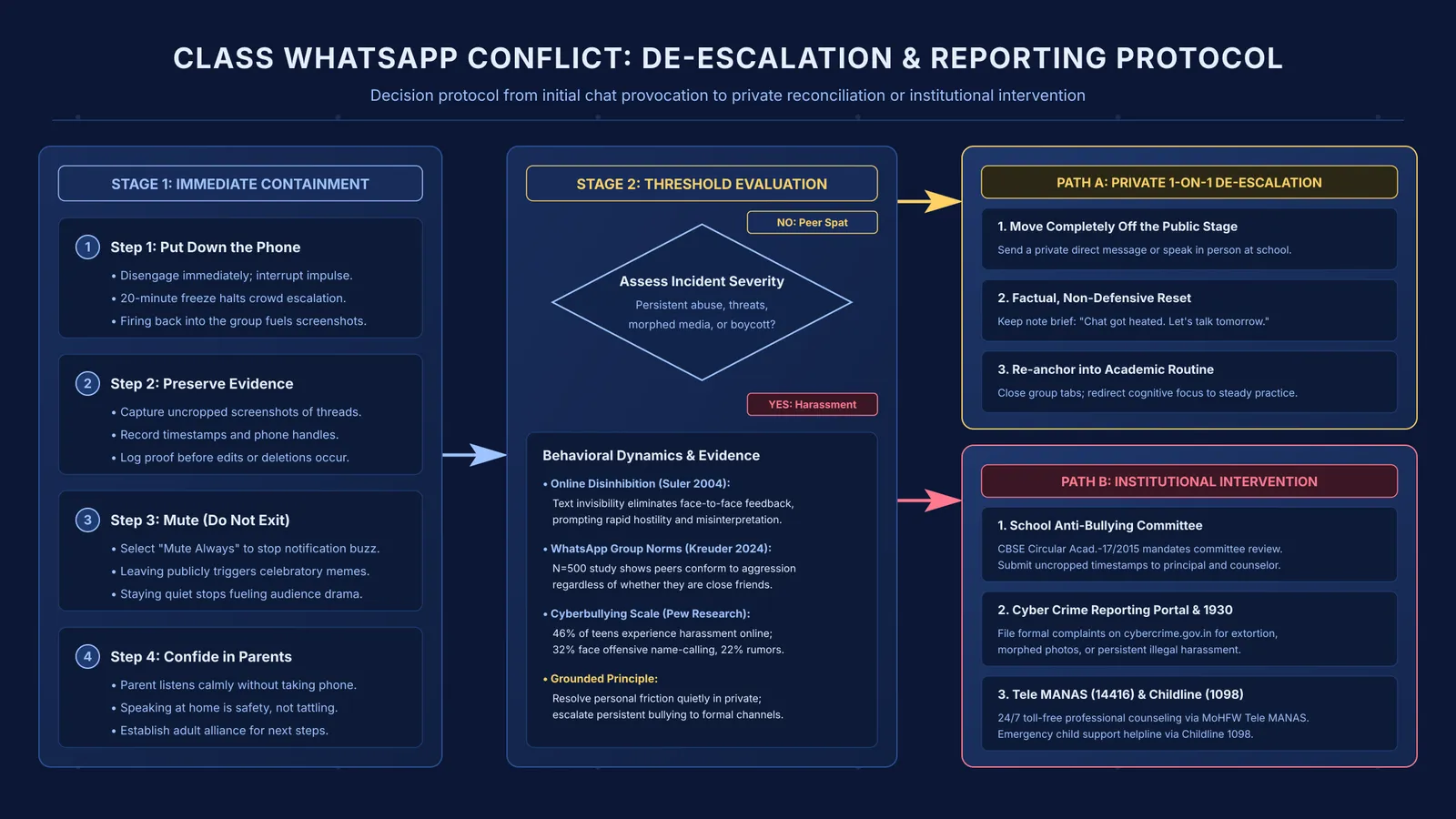
Text-based group chats lack the subtle feedback loops of face-to-face interaction. In a hallway dispute, tone of voice, posture, and facial expressions signal when someone is genuinely hurt, prompting natural restraint. Online, these brakes vanish. Psychologist John Suler analysed this phenomenon in *CyberPsychology & Behavior*, defining the online disinhibition effect through factors such as invisibility and asynchronicity. Without direct visual cues, young people often read hostile intent into ambiguous words and launch aggressive counter-attacks they would never utter in person.
The presence of a silent peer audience accelerates this friction. According to the Pew Research Center report on teens and cyberbullying, 46% of teens aged 13 to 17 have experienced online harassment. The most common forms are offensive name-calling (32%) and spreading false rumours (22%). In a class group, bystanders rarely intervene to calm tensions. Instead, peers pile on with memes, emojis, or forwarded reactions.
In a 2024 experiment published in *Scientific Reports*, researcher Annika Kreuder and her team tested 500 participants across simulated WhatsApp chats. They demonstrated that once an aggressive group norm is displayed by initial responses, young members are significantly more likely to conform and expect hostile replies, regardless of whether the group consists of close friends or general classmates. The urge to prove a point publicly makes stepping back feel like surrender, especially when notifications keep buzzing while managing teenagers texting friends while studying.
What should a teenager do the moment a group chat fight starts?
The natural reaction to a group attack is an immediate counter-strike. However, firing back into a group thread only supplies ammunition to peers waiting to take screenshots. Walk your teenager through a disciplined immediate protocol:
Put down the phone: Disengage from the screen for several minutes to break the emotional reflex.
Preserve digital evidence: Take uncropped screenshots showing contact handles, timestamps, and full threads before messages are edited or deleted.
Mute rather than exit: Tapping "Leave Group" announces an exit publicly, often prompting peers to spin new rumours. Choosing "Mute Always" removes incoming alerts without creating a scene.
Confide in an adult: Remind your teen that sharing what happened at home is protecting their safety, not tattling.
Parents should listen without seizing the phone in anger or threatening to confiscate devices permanently. If teenagers fear their phone will be taken away whenever conflict occurs, they will hide future online troubles until an emergency forces exposure.
How should a teen apologise or clear up misunderstandings?
If your teenager made a mistake or sent a hasty comment that offended someone, the remedy must never take place inside the main class group. Group apologies invite public commentary, mockery, and bad-faith dissection from onlookers.
Instead, shift the interaction entirely off the public stage:
Move to a one-to-one channel: Send a private direct message or speak face-to-face during recess.
Keep the message brief and clear: A direct private note states facts without defensiveness. For example: "Yesterday's chat got out of hand. If what I typed sounded rude, I am sorry. Let us sort this out in person tomorrow rather than on the class group."
Avoid screenshot wars: Do not forward private chat histories or share side-group comments to justify actions. Leaking "receipts" destroys peer trust, a dynamic discussed in handling friendship fall-outs during exam season.
When peer friction disrupts focus, regular academic routines suffer. Helping your child pivot attention away from phone drama and into steady academic practice—such as working through problems in the Fermi Problem Library, where worked problems feature a step-by-step solver that explains the reasoning rather than printing an answer—provides a constructive, calm outlet that rebuilds confidence.
When is it necessary to involve the school or authorities?
Most minor spats dissolve within forty-eight hours once the audience stops engaging. However, parents must recognize when a dispute crosses into systematic bullying or harassment.
Under Circular Acad.-17/2015 from CBSE Academic, all affiliated schools must operate an Anti-Bullying Committee comprising administrators, counselors, parent representatives, and teachers. If an online conflict involves persistent abuse, campus exclusion, intimidation, or unauthorized sharing of photos, parents should bring the preserved evidence directly to the school principal. For advice on administrative inquiries, see how to respond when school reports a child misbehaving online.
If an incident involves serious cyber offences, such as extortion, morphed photographs, or non-consensual image sharing, file a complaint on the official National Cyber Crime Reporting Portal or call helpline 1930. For students experiencing severe emotional distress or panic from online hostility, free, round-the-clock professional counseling is available through the Ministry of Health and Family Welfare's toll-free Tele MANAS helpline at 14416 or Childline at 1098. Stepping in early with the right institutional channels ensures your teenager stays safe, supported, and grounded.


