

On this page
You walk past your teenager's room, and they are bent over their textbooks. An hour later, they are still there. It looks like a solid study session, until you notice the phone lighting up next to their notebook. They read a message, send a quick reply, and return to their work.
They will probably tell you it only took ten seconds and they can easily multitask. But cognitive science paints a different picture. That quick message is quietly doubling the time they need to finish their work, turning a simple assignment into a marathon session.
Why is texting while studying a problem?
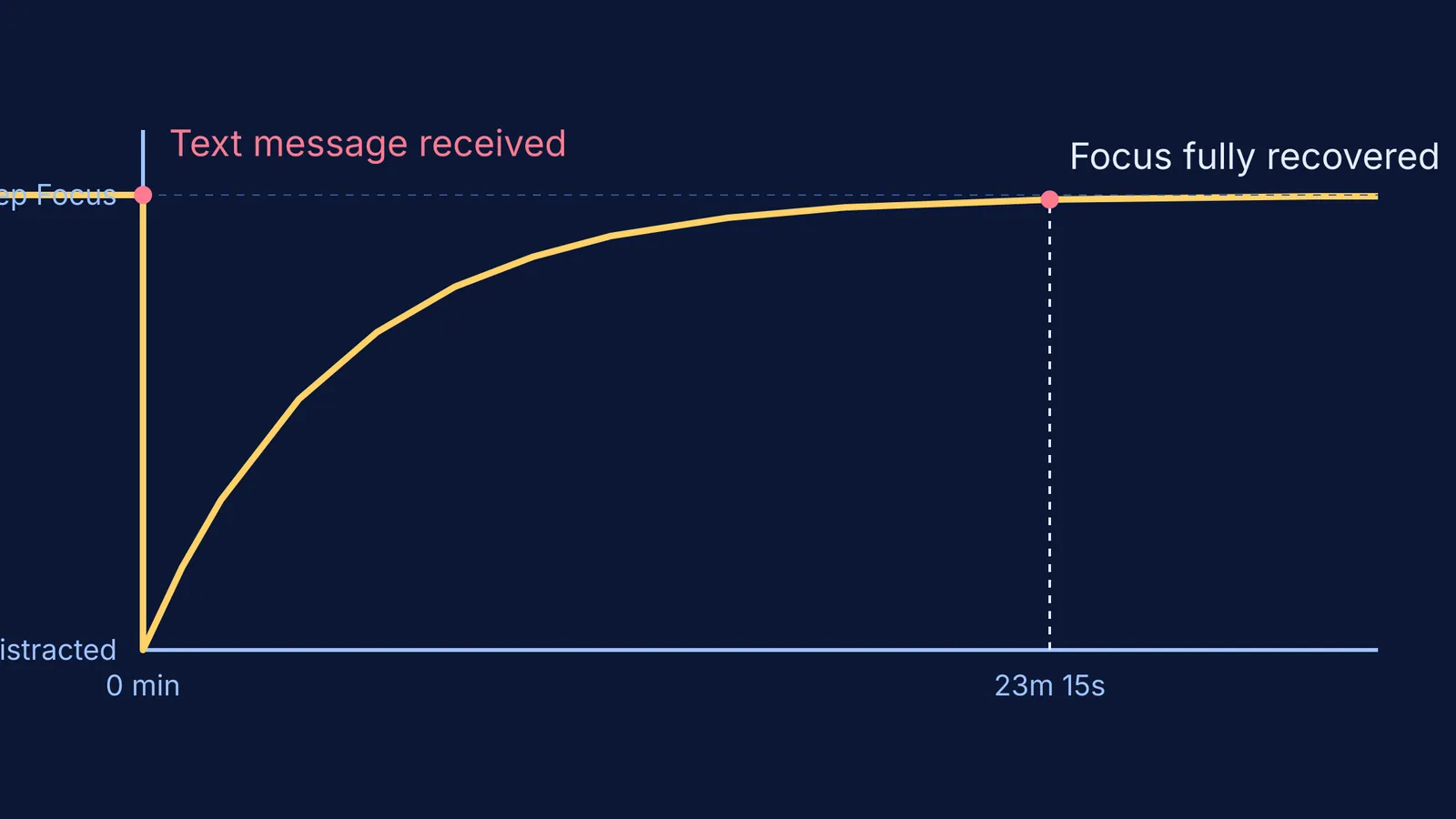
A text message feels brief, but its effect on the brain lingers long after the phone is put down. Dr. Gloria Mark, an informatics researcher at the University of California, Irvine, found that it takes an average of 23 minutes and 15 seconds to regain deep focus after a digital interruption.
When your teen reads a message, part of their working memory holds onto the conversation—a phenomenon known as "attention residue." Even as they look back at a physics problem or an essay, their brain is still partially engaged with what their friend said. This split focus means they are not fully processing the academic material. The mental clutter makes complex problem-solving much harder and far more exhausting than it needs to be.
How long do they actually study before switching tasks?
Most students overestimate how long they stay focused when their phone is nearby. A 2013 observational study by Dr. Larry Rosen, published in *Computers in Human Behavior*, watched students studying in their natural home environment. On average, the students managed to stay on task for less than six minutes before switching to a technological distraction like texting.
This rapid task-switching is often mistakenly defended as multitasking. However, the human brain does not process two complex cognitive tasks at once; it simply switches rapidly back and forth between them. This constant shifting creates a high cognitive load, draining the student's mental energy and leading to careless mistakes. You can read more about what task-switching research shows in our guide to the science of studying.
Does texting while studying hurt grades?
The impact of this constant switching predictably shows up in academic results. The same 2013 study found that students who frequently interrupted their studying with messaging had lower GPAs. Beyond marks, texting prevents information from moving efficiently from short-term into long-term memory.
Furthermore, even the mere presence of a phone on a desk reduces available cognitive capacity. The brain has to actively work to ignore the device, which is why the brain drain study recommends keeping phones completely out of sight during deep work.
If the studying itself is frustrating, the phone becomes an easy escape. If your child often loses momentum when stuck and reaches for their phone out of frustration, Fermi's AI tutor can help. Most learning tools answer questions, but Fermi teaches — it holds a line of reasoning across a whole session, notices where a student is stuck, and decides whether to explain, ask, or show, bringing their attention back to the problem at hand without breaking their focus.
Why do teens keep doing it if it makes studying harder?
If texting prolongs homework and hurts grades, why is the habit so difficult to break? A 2019 study from Ohio State University found that media multitasking makes studying feel more emotionally rewarding in the short term. The quick dopamine hit from a text message temporarily relieves the boredom or stress of homework.
However, this is a trap. The same researchers noted that while the distraction felt pleasant in the moment, students ultimately reported that the work felt more tiring, difficult, and stressful overall because of the constant interruptions. They are trading long-term academic ease for short-term emotional relief.
How can I stop my teen texting while studying?
Banning the phone entirely can lead to arguments and anxiety. Instead, you can help your teenager build better digital habits using structured "tech breaks."
The out-of-sight block: For deep work, the phone should be in another room. If it is face down on the desk, the brain is still anticipating a notification, draining cognitive resources.
Time-blocked study: Encourage them to study in focused 25-minute bursts (the Pomodoro technique), followed by a 5-minute break. This makes the period of sustained focus feel manageable.
Batch messaging: Teach them to check and reply to all messages during that 5-minute break, rather than responding immediately to every ping. This changes them from reactive text-responders to proactive communicators.
The 'available later' status: They can let close friends know they study between certain hours and will reply afterward. Peer pressure drives much of the urgency to reply; setting a status removes the guilt of ignoring a friend.
Setting these boundaries can be difficult at first. For a practical approach on how to agree on these boundaries together, explore the family rules that research supports. Once your teen experiences how much faster they finish their homework without the drag of the 23-minute focus penalty, they are often the first to admit the new system works better.


