

On this page
You can teach phonics at home without a course or expensive kit: you need a short daily slot, a fixed order of sounds and some paper.
What is phonics, and does it actually work?
Phonics teaches children that letters stand for sounds, and that those sounds blend together to make words. A child who knows that s, a and t say /s/, /a/ and /t/ can work out "sat" without having seen it before.
A meta-analysis by Linnea Ehri and colleagues combined 66 comparisons from 38 experiments and found that systematic phonics had a moderate overall effect on reading (d = 0.41) compared with unsystematic or no phonics teaching. The effect was larger when phonics began early (d = 0.55) than when it began after first grade (d = 0.27), and in many readers it helped decoding, word reading, comprehension and spelling.
A 2018 review by Anne Castles, Kathleen Rastle and Kate Nation explains why phonics is so central to learning to read English.
Which sounds should I teach first?
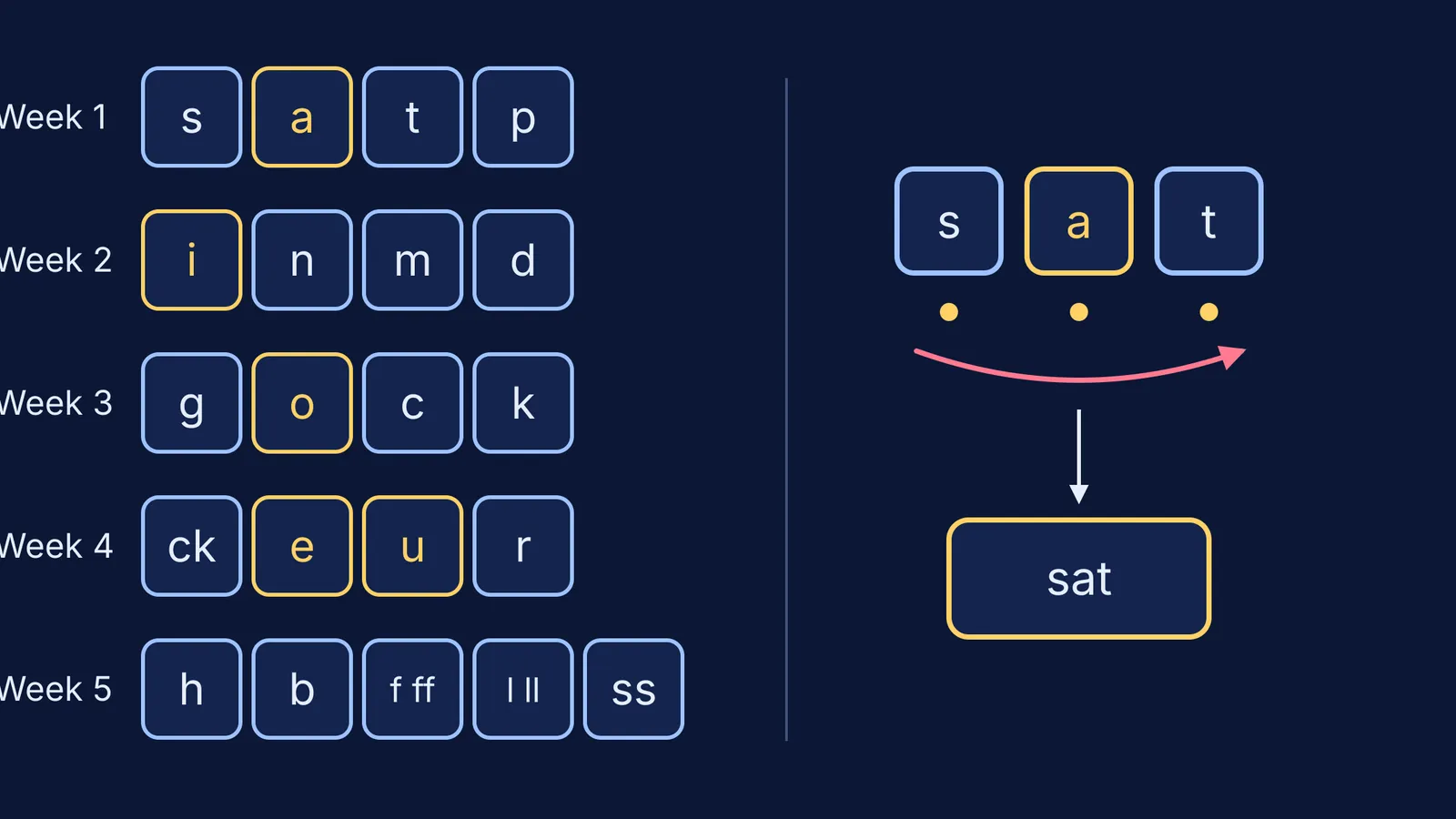
Use the order from the UK government's Letters and Sounds programme (2007). It teaches one set of letters a week:
Week 1: s, a, t, p
Week 2: i, n, m, d
Week 3: g, o, c, k
Week 4: ck, e, u, r
Week 5: h, b, f and ff, l and ll, ss
Week 6: revise everything
The order is useful because the first four letters already make real words: sat, pat, tap, at. The same document says the next phase adds another 25 graphemes, mostly two-letter ones such as sh, ch, th, ng, ai, ee and oa. With these, children can represent each of about 42 sounds in English with a letter or letter group.
Say the pure sound, not the letter name. "S" should be a hissing "sss", not "ess" and not "suh". Sounds without an extra "uh" on the end are easier to blend.
How do I teach my child to blend sounds into words?
Blending is the step many children find hardest. Three games build it up:
Robot talk. Say a word in sounds, "c-a-t", and your child shouts "cat!" Letters and Sounds practises this oral blending before children are expected to learn letters.
Sound buttons. Write a word and put a dot under each letter. Your child touches each dot, says the sound, then sweeps a finger under the word and says it fast.
Change one letter. With magnetic letters or paper squares, make "sat". Swap the s for a p: "pat". Swap the t for an n: "pan".
What does a ten-minute phonics session look like?
Letters and Sounds suggests the same shape for each daily session: revisit and review, teach, practise, apply. In ten minutes:
Revisit (2 minutes): flash the letters learned so far; your child says each sound.
Teach (2 minutes): show one new letter, say its sound and find it in a word.
Practise (3 minutes): one blending game using the new letter.
Apply (3 minutes): read a short caption you have written.
A worked example for Tuesday of week 2, teaching "n":
You: "Yesterday we learned i. Today's sound is nnn, like at the start of nose. Can you say nnn?"
Write "in", "tin", "pin" and "nap" with sound buttons. Your child blends each one.
Write the caption "a pin in a tin" on a strip of paper. Your child reads it, then draws it.
Stop on a success, even if the timer has a minute left.
What are decodable books, and how do I make them?
A decodable text uses only the sounds your child has been taught, plus a handful of tricky words. Letters and Sounds expects many children, by the end of these first weeks of letters, to read some two- and three-letter words, to start on simple captions, and to read the tricky words the, to, go and no.
You do not need to buy a set. Fold an A4 sheet into a little book and write one line per page: "Sam sat." "Pam sat on a mat." "Sam and Pam nap." Your child reads it all week.
Early reading is still a gap in India: ASER 2024, a survey of rural households, found that 23.4% of Std III children in government schools could read at least a Std II level text. For your home language, see how to get your child to read in their mother tongue.
When should I talk to the school?
Talk to the class teacher if your child still cannot blend three-sound words after several weeks of steady practice, or seems upset by reading. Ask what sounds the class is on so that home and school match. Our guides on a child who cannot read in Class 1 and mixing up b and d cover what is typical. If worries persist, ask the school about an assessment by a qualified professional.
Later, when reading turns into science and maths homework, Fermi's AI tutor can work out what a student already knows and build a plan for the session.
Start tonight with s, a, t and p, and ten minutes.


