

On this page
If your child writes 'bog' for 'dog' or reads 'bad' as 'dab', you are in large company. Here is what the research says, practice tricks that help, and the signs that mean it is time to ask for help.
Is it normal for a child to mix up b and d?
For most children in the early school years, yes. In a study of 130 children aged 5 to 6, most of whom had a history of speech-sound difficulties (a risk factor for reading problems), published in Scientific Studies of Reading in 2014, Rebecca Treiman and colleagues found that children who later became poorer readers made more letter-writing errors overall, but were no more likely to make reversal errors. Reversals did not predict reading skill 2¾ years later.
The authors put it plainly: "Educators and clinicians, therefore, should not assume that reversal errors in writing are indicative of dyslexia."
The NHS list of signs of dyslexia in children does not mention reversed letters at all.
Why do children reverse letters?
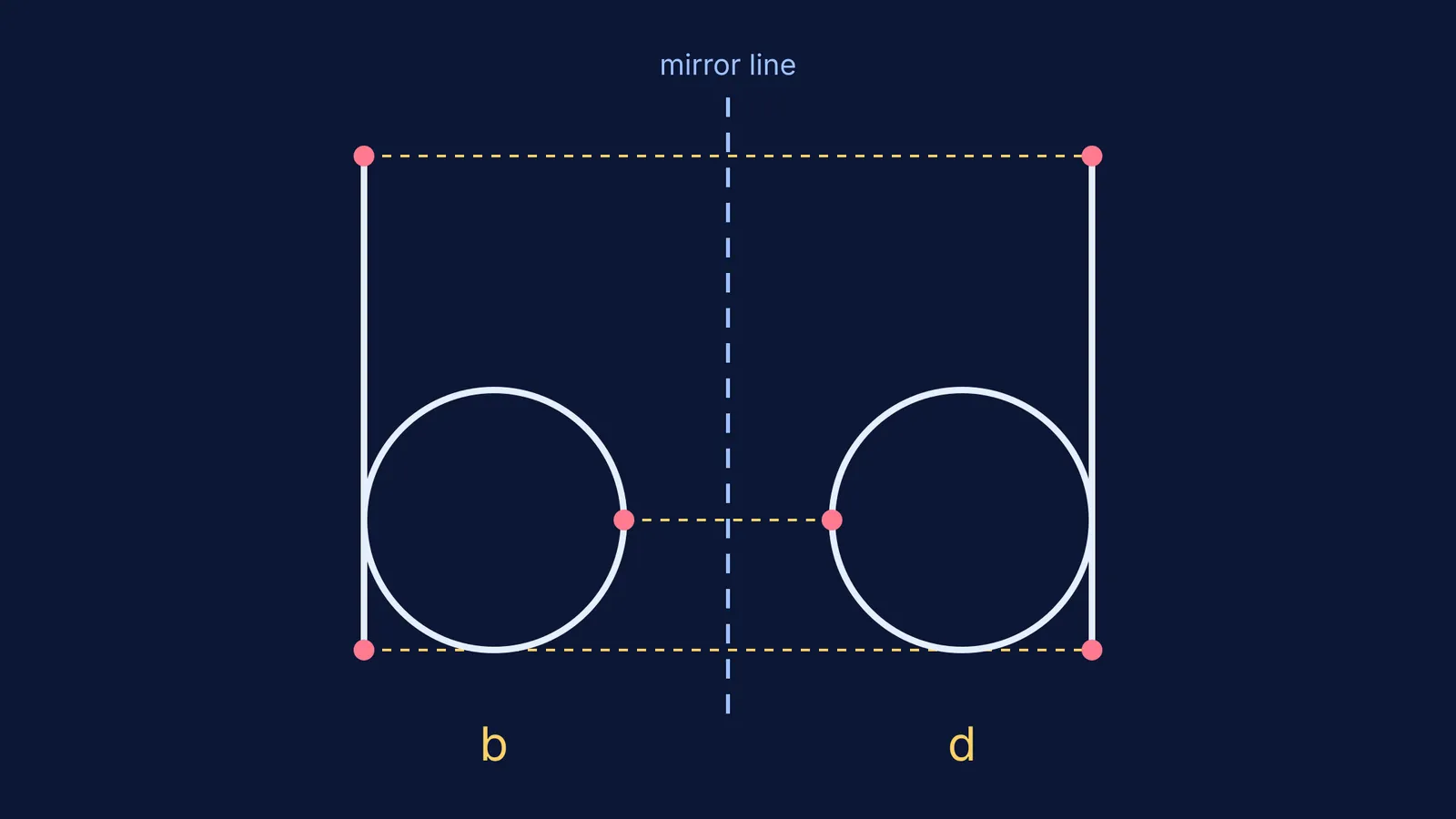
Our visual system tends to treat mirror images as the same object: a cup is a cup whether its handle points left or right. Reading asks children to switch this off for a few letters, and that takes time.
A 2014 brain-imaging study in PLoS One by Liwei King Blackburne, John Gabrieli and colleagues found that adults' brains responded differently to normal and reversed letters early in processing, while children aged 5 to 12 did not show a clear difference. The authors discuss one explanation: that learning to read adapts object-recognition processes that are "insensitive to right-left orientation". They also note that reversal errors decrease as children become more skilled readers.
Treiman's team also found that children reversed left-facing letters such as d and J more often than right-facing ones such as b and C. They propose that this is because most Latin letters face right and children pick up that regularity.
What helps a child stop mixing up b and d?
Handwriting practice may help. In a 2005 study in Acta Psychologica, Marieke Longcamp and colleagues trained two groups of 38 children aged 3 to 5 to copy letters either by hand or by typing; after three weeks, the older children who practised by hand recognised letters better. The study measured letter recognition in general, not reversals.
These tricks are practical tips rather than methods tested one by one in trials:
Teach b and d on different days, not side by side. Make one letter secure first.
Tie each letter to its stroke order. For b: 'stick down, then bounce round', starting at the top of the stick. For d: 'round like c, then up the stick', because d begins as a c.
Use the 'bed' picture. Write the word bed and draw a bed over it: the stick of b is the headboard, the stick of d is the footboard.
Link each letter to its sound and a key word, such as 'b for bat' and 'd for drum'.
Correct lightly and once: point to the bed card and let your child fix it.
A simple two-week plan: spend a few minutes a day on b only in week one, then d in week two, then circle every b and d on a page of print. Shared reading with young children gives natural moments to point at letters without turning it into a drill.
When should you ask the school or a specialist?
Reversals matter less than the company they keep. Talk to the class teacher if b and d mix-ups carry on alongside several of these signs from the NHS list of dyslexia signs in children:
reading at a level below what is expected for their age
little interest in language activities such as saying the alphabet
difficulty with numbers, telling the time, or remembering the order of things such as days of the week
written work that looks messy and has many spelling mistakes
slow, hesitant reading aloud
learning to speak later than other children
You could open with something like: 'My child still mixes up b and d at home. Do you see that in class? How is their reading compared with what you'd expect now? What should we practise, and when shall we check in again?' Our parent-teacher meeting questions that lead to follow-up help keep that conversation going.
If the teacher shares your concern, ask about an assessment. In India, the schedule of the Rights of Persons with Disabilities Act, 2016 lists dyslexia among specific learning disabilities, which it describes as a deficit in processing spoken or written language that may show up as difficulty to read, write, spell or calculate. A diagnosis comes from a qualified professional, not from a checklist. Our guide to dyslexia and dyscalculia signs and how assessment works explains the steps.
Later, as your child moves into school maths and science, Fermi's AI tutor notices where a student is stuck and decides whether to explain, ask or show, so a child who needs a different route to an idea gets one.
For now, keep the bed card on the desk, keep practice short, and watch the whole picture.


