

On this page
Teenagers love online shopping, and they actively look for deals. In fact, a 2026 global survey by TGM Research found that finding the best overall price is the number one priority for 67% of Gen Z shoppers. But wanting a good deal and knowing how to actually find the best price are two different things.
Without a structured approach, a teenager can easily be drawn in by a crossed-out "original" price or a cheap product that carries a heavy delivery fee at checkout. Teaching your teenager how to compare prices online is a practical way to build their mathematical reasoning, patience, and financial literacy.
How can we tell if a discount is real?
Retailers often use "reference pricing"—crossing out a high original price next to a lower sale price—to create a sudden sense of urgency. But these sales are not always what they seem. A 2025 study by Consumers' Checkbook tracked 25 major retailers and found that for 21 of them, items were listed as being on "sale" more than half the time. Because the "regular" price was almost never charged, the discount was effectively an illusion.
Explain to your teenager that a crossed-out number is a marketing tactic, not a mathematical baseline. Have them ignore the supposed discount percentage and focus entirely on the final selling price. If they want to know if a deal is genuinely good, they can use online price-tracking tools or simply wait 24 hours before buying. Often, the desire to buy fades when the "sale ends in two hours" timer runs out, saving money in the process.
What is drip pricing, and how does it change the cost?
Another common online shopping trap is "drip pricing," where an item is initially advertised at a very low price, but mandatory fees (such as service charges, platform fees, or processing fees) are dripped in slowly during the checkout process. Research published by the UK Government found that drip pricing costs consumers up to £3.5 billion annually and can increase the average price paid by 10% to 13%.
Delivery costs are a major part of this pricing strategy. A cheap item with high shipping is never a good deal. According to a study by McKinsey, over 90% of consumers are likely to abandon a shopping cart if they encounter unexpectedly high shipping costs at the end of the process.
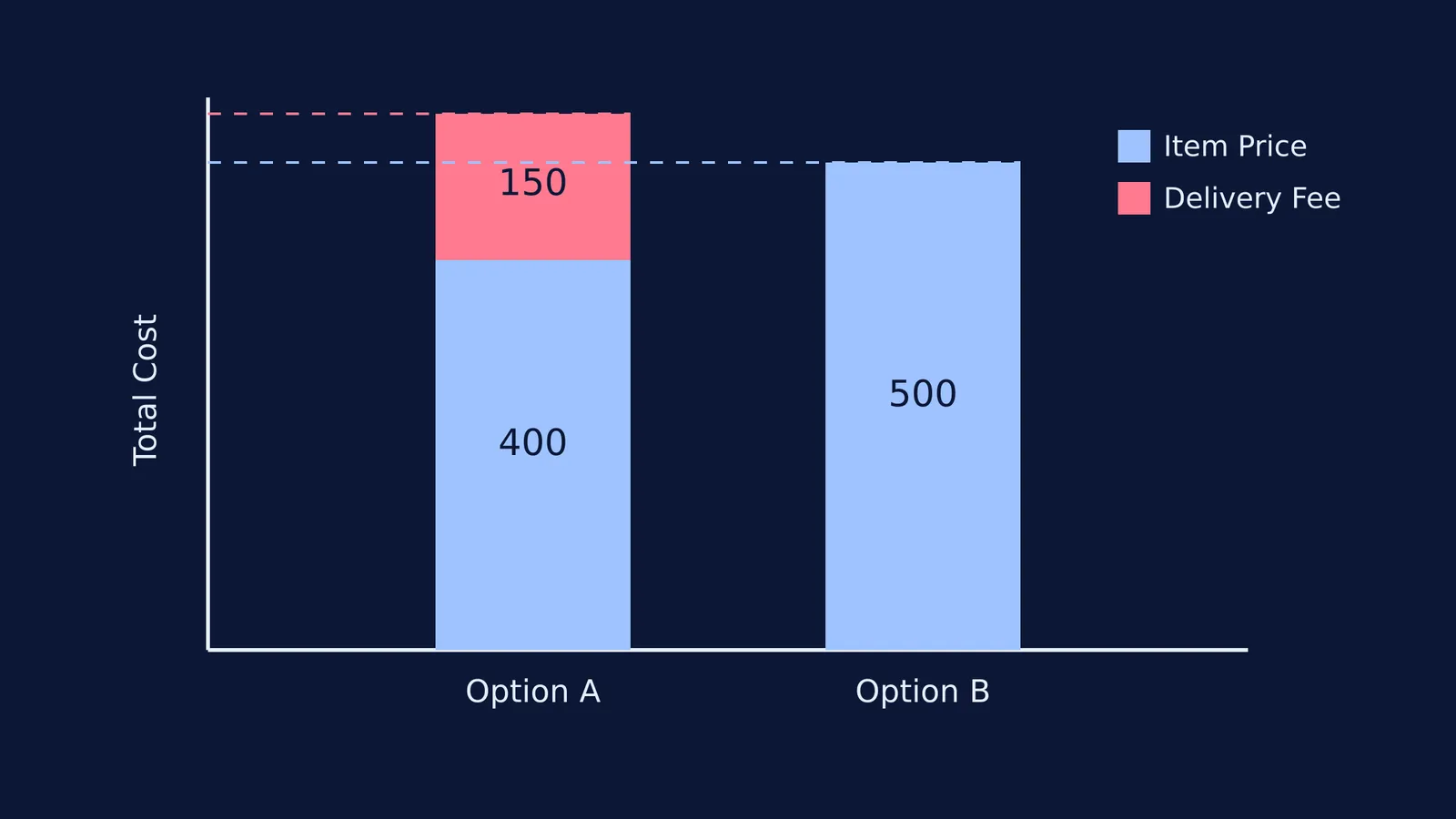
Teach your teenager to always calculate the final landed cost. For instance, a ₹400 shirt with a ₹150 delivery fee is ultimately more expensive than a ₹500 shirt with free delivery.
How do you compare prices using unit costs?
When comparing two different sizes of the same product—such as a 500g bottle of shampoo and a 750g bottle—comparing the total price does not work. The larger bottle usually costs more overall, but it might be cheaper per gram. This is where unit pricing becomes an essential skill.
Show your teenager how to divide the total price by the total weight or volume. This simple division gives the price per 100g or per millilitre, making it easy to calculate which pack is better value using unit price calculations.
If your teenager struggles with the percentage mathematics behind discounts or unit conversions, Fermi's AI tutor can work out what they already know and build a plan for the session, teaching through it by writing on a board and checking understanding as it goes. Working through real-world math builds confidence for both academic exams and daily life.
What is a step-by-step price comparison framework?
Next time your teenager asks to buy something online, or requests an advance on their allowance, you can use a simple system for children's pocket money planning to set limits, and walk them through this shopping framework:
Ignore the crossed-out price: Look only at the current selling price and ignore the artificial discount percentage.
Calculate the unit cost: If comparing different sizes or multi-packs, divide the final price by the quantity to find the cost per unit.
Find the final "drip" price: Proceed all the way to the checkout screen to see the absolute total cost with delivery and taxes included.
Compare across two platforms: Check one other app or store to see if the final delivered price is lower elsewhere.
Teaching these habits takes time, but it transforms your teenager from a passive consumer into an analytical thinker who understands the basics of financial literacy and budgeting for teens.


