

On this page
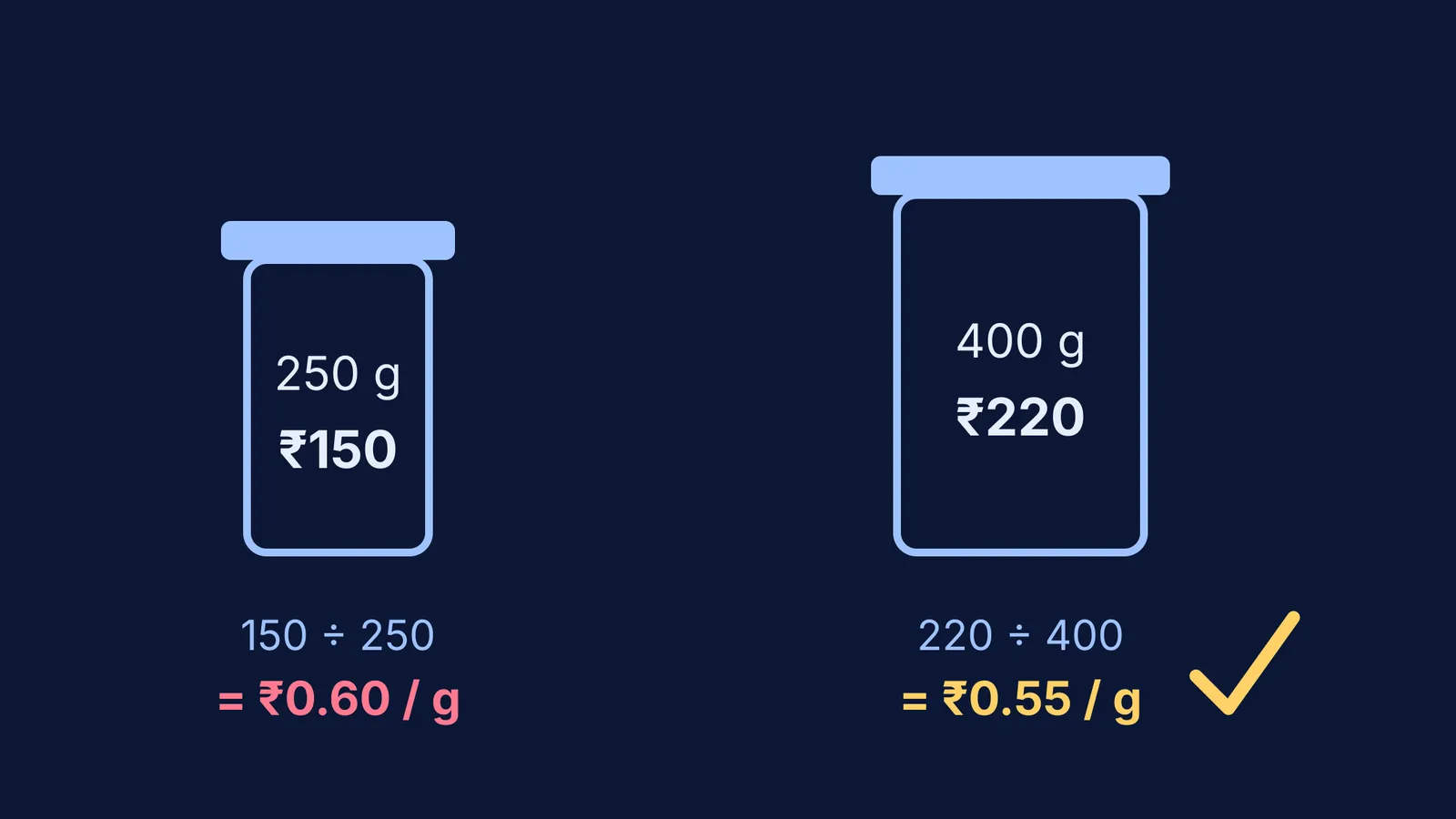
Have you ever stood in a supermarket aisle, holding a 250-gram jar of coffee in one hand and a 400-gram jar in the other, wondering which one is actually cheaper? Supermarkets are filled with different pack sizes and promotions that make it difficult to compare items at a glance. To cut through the confusion, you need to rely on the unit price.
What is the unit price?
The unit price is the cost of a product for a standard unit of measurement, such as one gram, one kilogram, one litre, or one individual item. Instead of comparing the total cost of two different-sized boxes, you compare how much you are paying for every gram of the product inside them. This approach allows you to evaluate the true cost of an item regardless of how the manufacturer has packaged it.
The US National Institute of Standards and Technology (NIST SP 1181) outlines unit pricing as a best practice, noting that it provides consumers with the exact information needed to make accurate value comparisons. When you know the unit price, the size of the packaging no longer matters.
Which pack is better value?
To find the unit price, use the unitary method. The formula is straightforward and easy to use on a phone calculator:
Unit Price = Total Price ÷ Total Quantity
Let us look at a worked example. Imagine you want to buy breakfast cereal, and you have two choices:
A standard 300-gram box for ₹120.
A "family size" 500-gram box for ₹190.
For the standard box: Unit Price = 120 ÷ 300 = ₹0.40 per gram.
For the family size box: Unit Price = 190 ÷ 500 = ₹0.38 per gram.
In this case, the family size box offers a lower unit price and is the better value. This is a practical application of the maths you might see in quadratic word problems or when dealing with unit conversion.
Sometimes, packages are sold in different units, such as grams and kilograms. To compare them, you first need to convert both quantities to the same unit. For instance, if you are comparing a 500-gram packet and a 1.2-kilogram packet, remember that 1 kilogram equals 1000 grams. You would convert the 1.2-kilogram packet to 1200 grams before dividing the price by the total quantity. Keeping your working clear and writing down the units helps avoid mistakes, much like the habits that lead to neat working in physics exams.
Are "Buy 2 Get 1 Free" offers worth it?
Special offers can complicate the maths. A common supermarket promotion is "Buy 2 Get 1 Free". To find the true value of this deal, you need to calculate the unit price based on the *total quantity you receive* and the *total amount you actually pay*.
Suppose a 200-gram packet of biscuits costs ₹50. If you use the "Buy 2 Get 1 Free" offer, you pay for two packets (₹100) but receive three packets (600 grams total).
New Unit Price = ₹100 ÷ 600 grams = ₹0.166 per gram.
If a larger 500-gram pack of the same biscuits is priced at ₹90, its unit price is: Unit Price = 90 ÷ 500 = ₹0.18 per gram.
Even though the 500-gram pack seems like a bulk buy, the "Buy 2 Get 1 Free" offer on the smaller packets gives you a lower unit price. If you want to see how this works in harder examples, the Fermi Problem Library has worked problems with a step-by-step solver that explains the reasoning rather than just printing an answer.
Are larger packs always cheaper per gram?
It is a common assumption that buying in bulk always saves money. However, retailers sometimes price larger containers higher per gram than smaller ones. This can happen due to packaging costs, supply issues, or simply because retailers know that shoppers assume the bulk option is cheaper.
Always calculate the unit price before putting the item in your trolley. A few seconds of mental maths—or a quick check on a calculator—is all it takes to find out which pack is genuinely the better value.


