

On this page
Parents often wonder if drilling multiplication tables beyond 10 or 12 will give their child a distinct advantage, especially as they approach middle school and competitive exams. While instant recall of the foundational 1 to 10 tables is a non-negotiable step in mathematics, extending rote memorisation all the way up to 20 is generally inefficient.
Rather than relying on flashcards and repetitive drills for higher numbers, teaching children how to manipulate numbers builds deeper mathematical fluency. When students understand how numbers interact, they develop a toolkit that applies to algebra, calculus, and beyond.
Should a child learn tables up to 20?
The short answer is no, not through traditional rote memorisation. The primary goal of learning any times table is to achieve automaticity for single-digit numbers. When a student knows instantly that 7 × 8 = 56, they do not have to pause and count on their fingers during a complex algebraic equation or while simplifying fractions.
For two-digit numbers from 11 to 20, learning calculation strategies is far more effective than memorising isolated facts. For example, knowing how to confidently break down 14 × 6 into (10 × 6) + (4 × 6) is a foundational skill that scales to numbers of any size. Memorising the specific answer of 84, on the other hand, only helps with one single calculation. If you are looking to build a strong mathematical foundation early on, you can introduce these concepts gently through everyday, practical activities like maths while cooking.
How does working memory limit learning?
The science of learning helps explain why memorising large tables can become such an uphill battle for many students. According to cognitive load theory, human working memory is highly constrained and can only hold about 4 chunks of new information at a time (Structural Learning).
When a child has to stop and manually count up to find 6 × 7, that minor calculation completely consumes their limited working memory slots. As a result, they might forget the original parameters of a word problem by the time they find the basic product. Automating the 1 to 10 tables clears this cognitive bottleneck.
However, attempting to force a child to memorise the 13 to 20 tables often adds unnecessary extraneous cognitive load. Instead of freeing up memory, the sheer volume of numbers and the stress of memorisation eat into the child's processing capacity.
Why does rote memorisation backfire?
Focusing heavily on drilling and speed can actively harm a child's mathematical development and long-term confidence. A landmark study of 13 million 15-year-olds by the Programme for International Student Assessment (PISA) found that the lowest-achieving students globally are those who believe maths is primarily about rote memorisation (YouCubed at Stanford University). By contrast, the highest achievers in the study approached mathematics differently, focusing heavily on the underlying connections between mathematical ideas.
Furthermore, the pressure to memorise and recite tables quickly is often counterproductive. Research highlights that about one-third of students experience the onset of maths anxiety specifically due to timed testing of math facts (YouCubed at Stanford University). High stress levels physically block the working memory, meaning children literally cannot access the multiplication facts they have already learned. If you want to assess your child's progress without inducing this kind of anxiety, consider running low-stress practice tests at home that focus purely on accuracy and method over speed.
If your child gets stuck on breaking down these calculations and resorts to guessing, the Fermi Problem Library has worked problems with a step-by-step solver that explains the reasoning rather than printing an answer. This ensures they learn the strategic method rather than just skipping to the final number.
What patterns make tables 11 to 20 easier?
Instead of printing a massive wall chart of tables up to 20, teach your child mental maths patterns. These logical tricks are closely related to the techniques taught in abacus and Vedic maths, and they rely heavily on the distributive property—the ability to break numbers apart and multiply the pieces.
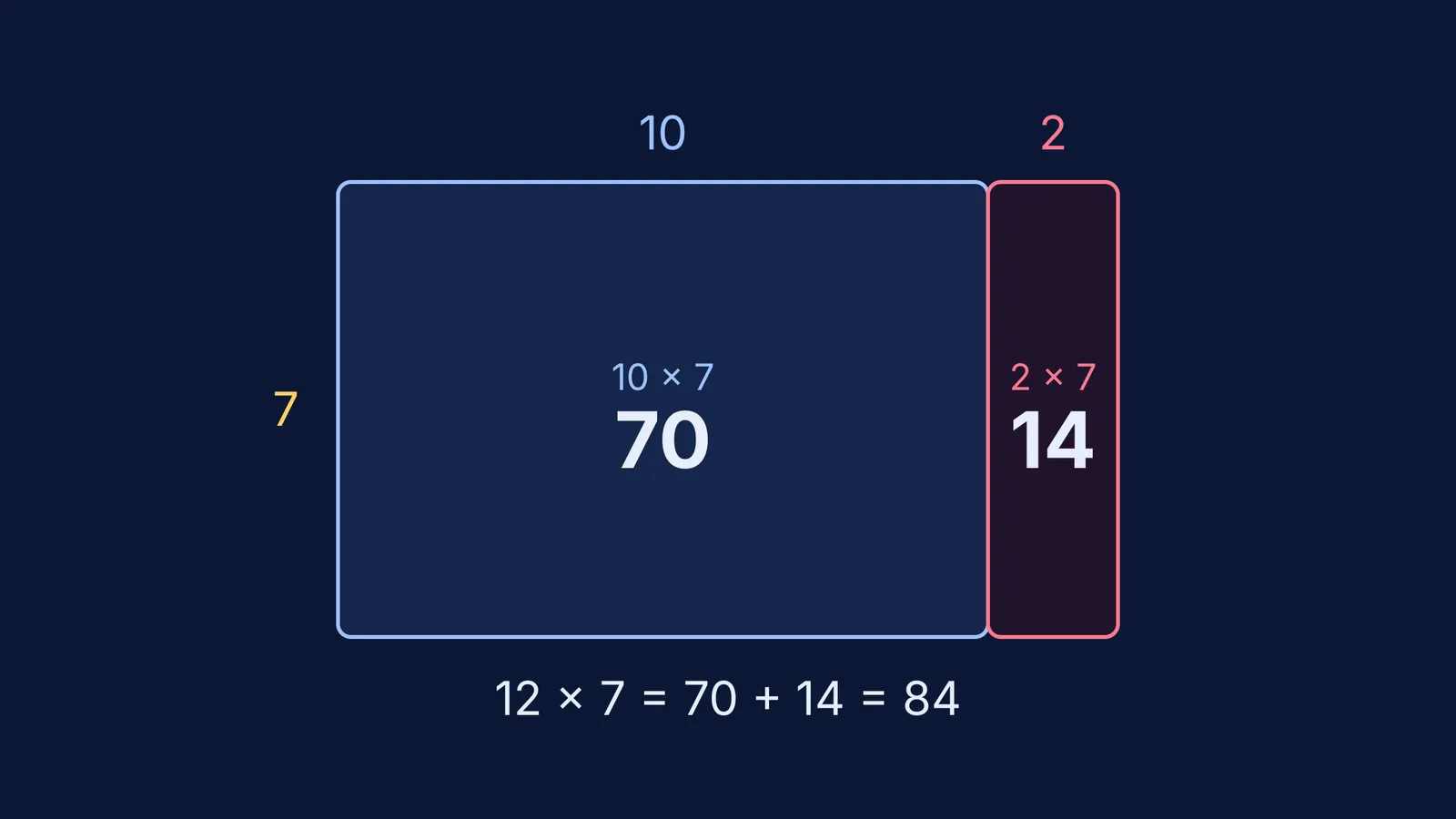
The "10 + 2" rule for the 12 table: To multiply any number by 12, simply multiply it by 10, then multiply it by 2, and add the two results together. For example, for 12 × 6, calculate (10 × 6) + (2 × 6) = 60 + 12 = 72.
The "Double Digit" rule for the 11 table: For single digits, simply repeat the number (for example, 11 × 4 = 44). For two-digit numbers, such as 11 × 15, separate the 1 and the 5, add them together (1 + 5 = 6), and place that 6 in the middle to instantly get 165.
The "Half of 10" rule for the 15 table: To multiply any number by 15, first multiply the number by 10, then add exactly half of that result. For 15 × 8, first find 10 × 8 = 80. Half of 80 is 40. Add them together: 80 + 40 = 120.
The "Double and Zero" rule for the 20 table: Double the number you are multiplying, then simply add a zero to the end. For 20 × 7, double the 7 to get 14, then add a zero to make 140.
By focusing on these patterns and the underlying logic, you equip your child with a flexible, robust number sense that will serve them far better in higher-level maths than a memorised list ever could.


