

On this page
Abacus and Vedic maths classes promise children faster mental arithmetic. Some of that holds up in research, but speed is not the same as understanding maths. Here is the evidence, a worked example to try at home, and what to ask before you pay a fee.
What do abacus and Vedic maths classes actually teach?
Mental abacus is a technique for fast, accurate arithmetic using a mental image of an abacus, as defined in a 2016 trial published in Child Development. Children usually learn on a physical abacus first, often a Japanese soroban, and then learn to move imagined beads in their heads.
Vedic maths comes from a book by Bharati Krishna Tirtha, published in 1965, that offers 16 short sutras for quick mental calculation (The Federal). Despite the name, the sutras are not found in the Vedas: even Tirtha's disciple Manjula Trivedi wrote in her foreword that they are not in the present versions of the Atharvaveda, according to the same article.
The book's own editor said the claim of Vedic origin was unsupported, and the mathematician S. G. Dani described it as a compendium of tricks for faster results in school arithmetic and algebra, presenting maths as methods without conceptual rigour (summary of the scholarship).
Are abacus classes useful for children?
For arithmetic, the best evidence says yes, with limits.
In the Child Development trial, 204 children aged 5 to 7 took part over three years. Children taught mental abacus outperformed a comparison group on arithmetic tests. The training did not strengthen underlying abilities such as working memory. Instead, a child's spatial working memory at the start helped explain how well they learned the abacus.
A British Psychological Society summary of the same trial says it ran at a charitable school in Vadodara, where the abacus group had three hours of extra lessons a week. They gained in place value as well as calculation, but their maths anxiety and attitudes towards maths did not change.
A shorter trial is more cautious. In a one-year classroom-randomised trial in a US school, first graders struggled to master the abacus, while second graders did better. Neither age group showed a significant advantage in calculation or cognitive abilities, though older children showed some hints of an advantage in place value. The authors advised caution about using mental abacus as a short-term intervention.
For Vedic maths, we did not find a comparable randomised trial.
What do speed classes not teach?
Knowing how to do a calculation and understanding why it works are different kinds of knowledge. A review in Educational Psychology Review found that the two support each other in both directions. So practising fast methods can help understanding, and it helps most when someone connects the steps to the ideas.
Try this worked example. A Vedic shortcut for 98 x 97: each number is 2 and 3 short of 100. Subtract across (98 - 3 = 95), multiply the shortfalls (2 x 3 = 06) and write 9506. Now ask why it works. The answer is algebra: (100 - 2)(100 - 3) = 10,000 - 500 + 6 = 9,506. A class that teaches only the first half has taught a trick. A class that teaches both has taught maths.
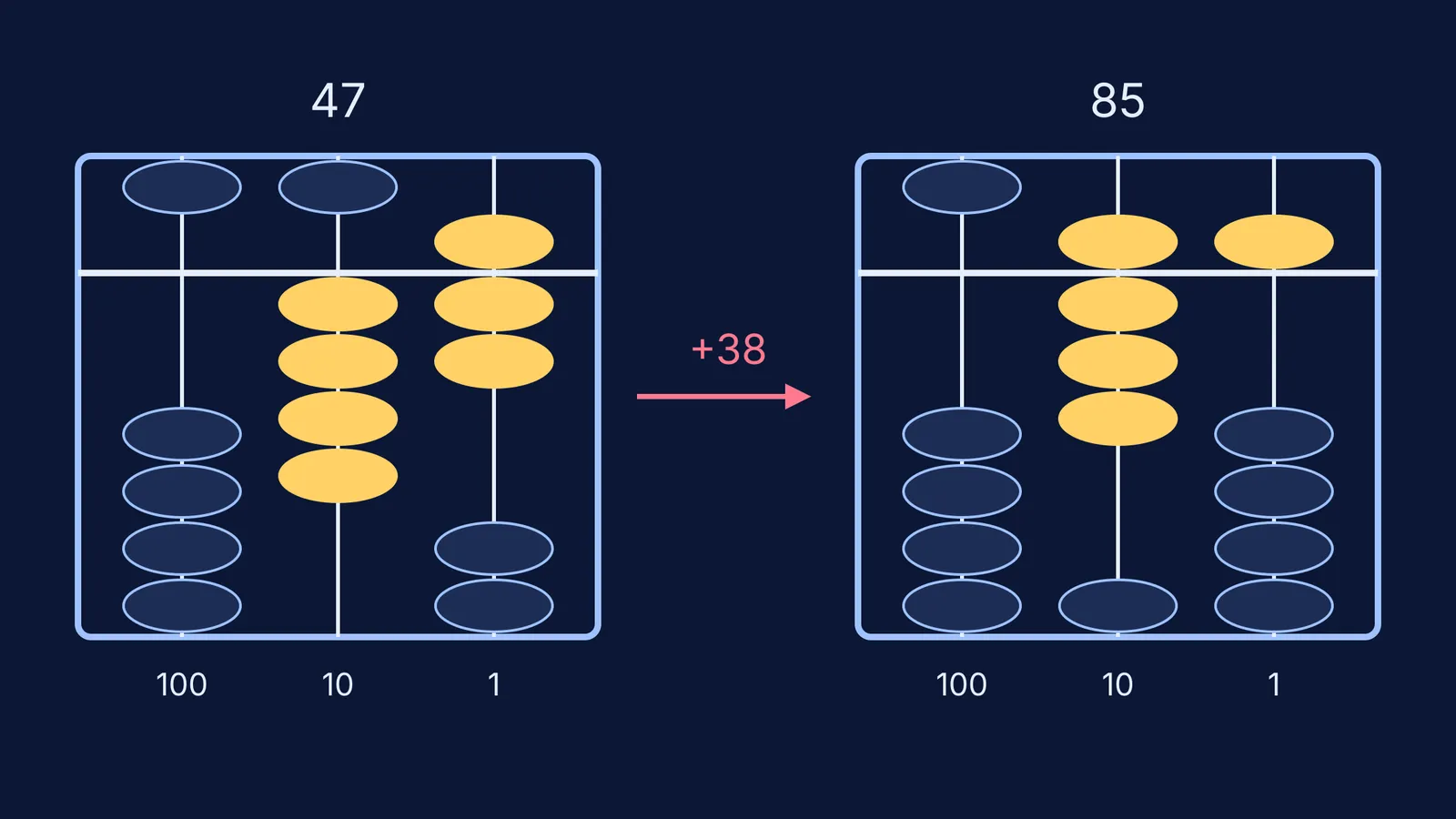
The same goes for the abacus. A child who moves beads to add 47 and 38 should also be able to tell you that 7 and 8 make 15, which is one ten and five ones. That place-value idea is what the bead moves stand for.
For whether mental speed still matters, see our piece on how calculators affect maths learning.
What should you ask before enrolling?
Take these questions to the demo class:
What will my child be able to do by the end of the first term, and how will you show me?
Do you explain why each method works, or only the steps?
How do you connect the methods to the school syllabus, such as place value, fractions and algebra?
What happens if my child finds it hard? In the Vadodara trial, children's spatial working memory helped explain how well they learned the abacus.
Can we stop after one term without losing fees?
Do you claim effects on IQ, memory or exam ranks? If so, ask to see the study.
A short script: "Before we sign up, could you show us how you explain why a method works? Could our child try one problem and explain it back to you?"
If maths starts to feel like a race your child is losing, our guide on what to do when your child says they are bad at maths can help. For younger children, everyday maths talk at home builds number sense without a fee.
If your child can do a shortcut but cannot say why it works, the Fermi Concept Library has its own lesson for every concept in mathematics, so the trick has an idea to attach to.
An abacus or Vedic maths class can be a good hobby that builds speed and confidence with numbers. Just make sure someone is also asking your child: why?


