

On this page
Your three-year-old can point to the circle on a flashcard and still insist that a tall, thin triangle is not a triangle. That is normal. Flashcards and picture books usually show a neat triangle sitting on its base, so children learn the picture, not the rule.
What does research say is the best way to teach shapes?
In a 2013 study in Child Development, Kelly Fisher, Kathy Hirsh-Pasek, Nora Newcombe and Roberta Golinkoff taught 70 children aged 4 to 5 about triangles, rectangles, pentagons and hexagons in one of three ways: guided play, free play with the same materials, or didactic instruction, where an adult explained while the child watched. In the guided play group, adult and child put on detective hats to discover each shape's "secret". The child touched and traced the shapes, then built new ones from sticks.
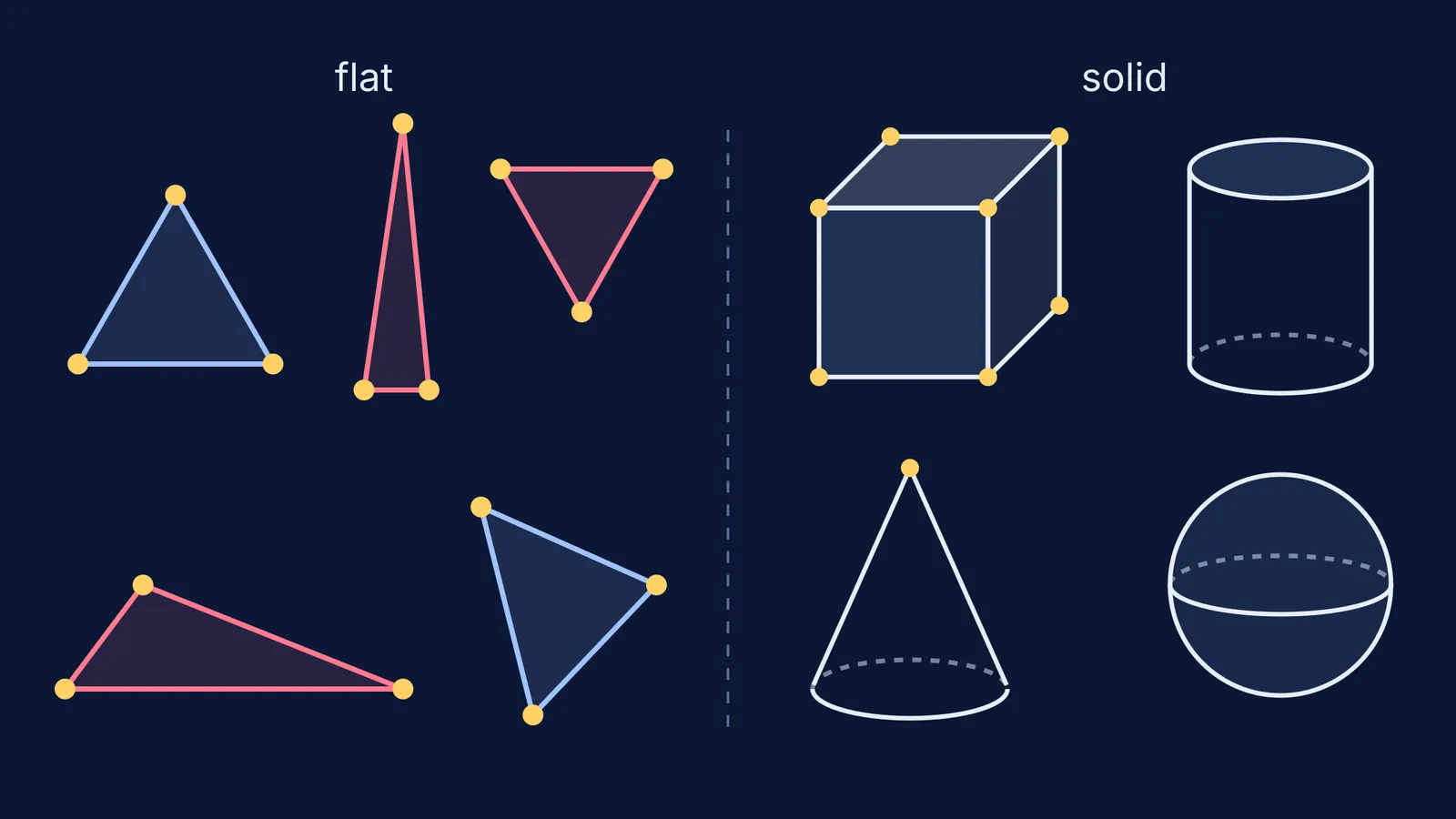
The test was a sorting game: put real shapes in a box and fake ones in a bin. Children taught through guided play accepted about 70% of the odd-looking real shapes, such as long, skinny triangles, while children who had free play accepted only about 15%, according to the paper. The gap was still there a week later. Several children taught by explanation counted sides at random: they learnt that counting mattered, but not why.
Guided play means your child leads the activity while you set it up and ask questions that point at the rule. For a three-year-old, use shorter sessions, fewer shapes and more touching.
How do I teach shapes to my 3 year old at home?
Use three routines of about ten minutes each. If your child wanders off, stop.
The shape hunt. Pick one shape a day and hunt for it around the house. Circles: a roti, a bangle, a steel plate, a coin. Rectangles: the door, a book, the TV. Squares: floor tiles, a carrom board. Triangles: a sandwich cut corner to corner, a slice of watermelon, a coat hanger.
What to say:
"Let's be shape detectives. Today we are hunting triangles."
When they find one: "How do you know it's a triangle?" Run their finger along each side: "One, two, three straight sides. One, two, three corners."
Turn a paper triangle upside down, or stretch it tall: "Is it still a triangle? Let's count."
When they point at something round: "Does it have corners? Let's feel."
The feely bag. Put a ball, a wooden block, a dice, a steel tumbler and a funnel in a cloth bag. Your child reaches in without looking, so they have to feel for edges and corners.
Start easy: "Find the ball."
Then by feature: "Find something with corners." "Find something that rolls."
Then the tricky ones: "Find something with a flat side and a round side." That is the tumbler, a cylinder.
How do building blocks teach solid shapes?
In a 2014 Child Development study, Brian Verdine and colleagues asked 102 three-year-olds to copy small block models. How well children built was linked to their early maths skills, even after other factors were taken into account. The same study found that parents from lower socioeconomic status families reported using fewer spatial words with their children.
Words matter on their own too. A study of 52 parent-child pairs by Shannon Pruden, Susan Levine and Janellen Huttenlocher recorded everyday talk at home from 14 to 46 months. Children who heard more spatial words, such as big, tall, circle, curvy and edge, used more of them, and children who used more did better on spatial puzzles at 54 months. Both studies show links, not proof of cause, but blocks and talk cost little.
Three block games:
Copy my tower. Build three blocks in a pattern and ask your child to make the same one.
Stack or roll? Sort blocks into those that stack and those that roll, then ask why.
Stamp the faces. Press each solid into atta dough. A cube leaves a square, a cylinder leaves a circle. Your child sees that flat shapes are the faces of solid ones.
What does a two-week shape plan look like?
Days 1 to 4: one hunt a day for circle, square, triangle and rectangle, plus feely bag level 1.
Days 5 to 7: odd examples. Cut paper shapes that are skinny, huge, tiny or upside down, and play "real or fake", with a fake that has a gap in one side.
Days 8 to 11: solids. Ball, cube, cylinder, cone. Feely bag levels 2 and 3, and dough stamping.
Days 12 to 14: block copying, and a hunt where your child picks the shape.
You will know it is working when your child gives a reason: "It has three corners, so it's a triangle." For more play like this, try these sorting games for young children and these colour-mixing experiments. For what school expects next, read what to expect from nursery to LKG.
Years later, those same shapes return as area, volume and nets. When that happens, the Fermi Concept Library gives every concept in mathematics its own lesson.


