

On this page
Colour mixing is one of the easiest science activities to run at home, and a three-year-old and a ten-year-old can do it side by side. Any child who has played Holi already knows that colours mix. The trick is to turn "let's make purple" into a small experiment: say what you think will happen, try it, then look closely at what really happened.
What do you need for colour mixing at home?
Six clear glasses or clear plastic cups, so you can see the colour
Liquid food colour in red, yellow and blue, the kind sold for cakes and sweets
A cheap watercolour set, a thick brush and paper
Two torches (or two phone torches), red and green cellophane from a stationery or gift-wrap shop, and rubber bands
A white wall or white chart paper, and a room you can darken
An old towel, because food colour stains clothes and floors
Activity 1: food colour in glasses
Fill three glasses two-thirds with water. Add two drops of red to the first, yellow to the second and blue to the third. Set out three empty glasses, one for each pair of colours.
Before you pour, ask: "What colour will red and yellow make?" Let your child point to a crayon and leave it by the glass as a record of the guess. Then pour some of each into an empty glass and look.
Do all three pairs. Then try one variation that changes only one thing: two drops of blue and one drop of yellow instead of equal amounts. Does the green get darker or bluer? Changing one thing at a time is the heart of a fair test. In a study in the journal Cognition, preschoolers with a mean age of 54 months rarely tried to isolate possible causes when the evidence was clear, but chose and designed informative tests when it was ambiguous (Cook, Goodman and Schulz, 2011). A puzzling glass is the moment to ask, "What could we change to find out?"
Activity 2: watercolours on paper
Paint a yellow stripe, let it dry, and paint a blue stripe across it. Next to it, mix wet yellow and blue on the paper. Ask your child to compare the two greens: which is darker, and where are the edges sharp?
Then set a challenge: make the brightest purple you can from red and blue. If it comes out dull or brownish, treat that as a real observation to talk about, not a mistake.
Why does torchlight mix differently from paint?
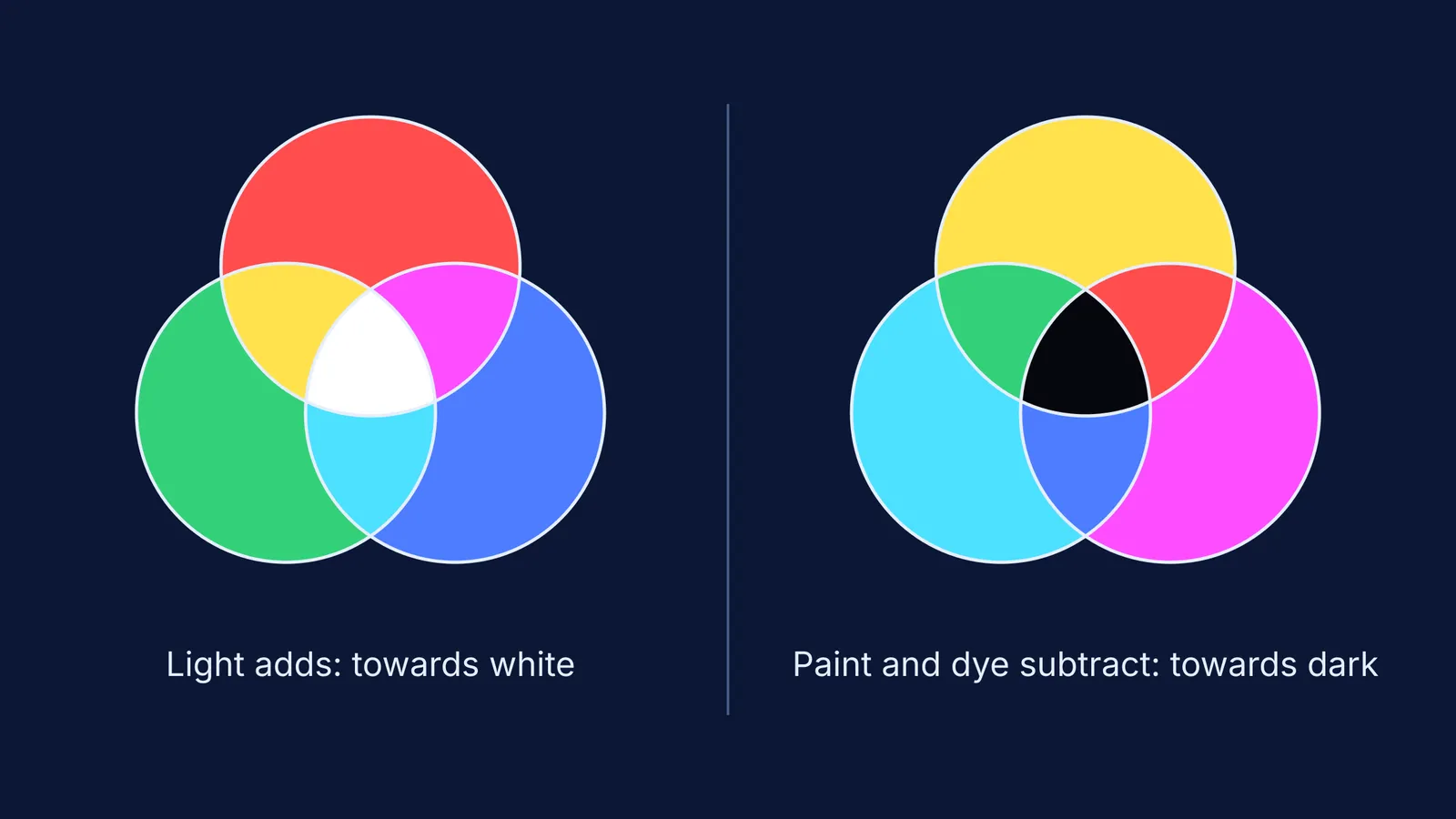
This one surprises adults too. Paints, dyes and coloured filters mix by subtraction: each one absorbs some colours of light and lets the rest through. The University of Wisconsin–Madison's physics museum explains that cyan absorbs red, magenta absorbs green and yellow absorbs blue, and that overlapping filters follow these subtractive rules (Ingersoll Physics Museum, subtractive mixing).
Light mixes by addition. Red, green and blue are the additive primary colours, red light plus green light looks yellow, and all three in equal amounts look white (Ingersoll Physics Museum, additive mixing). The same page notes that these rules do not apply to paints.
Try it. Fix red cellophane over one torch and green over the other. In a dark room, shine both at a white wall so the two circles overlap. First ask: "What will red light and green light make together?" Then switch on. Cellophane is an imperfect filter, so expect a pale or patchy yellow. Next, put both sheets over one torch. The spot goes very dim, because each sheet blocks most of what the other lets through: subtraction again.
How do you get a young child to predict and observe carefully?
Use the same three-step script for every activity:
Predict: "What do you think will happen? Why?" Record the guess with a crayon or a word.
Observe: "Look closely. What do you see first? Has anything changed after a minute?"
Compare: "Was it what you guessed? What surprised you?"
The prediction step is not just ceremony. In a 2021 review, psychologist Garvin Brod pointed to initial evidence that predicting before seeing an answer boosts surprise when the answer is unexpected, which draws attention to the correct answer and strengthens memory for it (Brod, Psychonomic Bulletin and Review). The review covers simple factual learning, so treat it as a reason to ask for guesses, not a promise.
Praise the looking, not the right guess. "You noticed the edge went darker" teaches more than "you're so clever", a difference explained in our guide to process praise versus praising ability. Keep a simple observation sheet with three columns: the guess, what happened, and a crayon swatch of the result.
For more of the same habit, try our five safe kitchen science experiments and the questions in encouraging curiosity at home.
If an older sibling enjoys this kind of seeing for yourself, the Fermi Simulation Lab has interactive simulations for ideas that are easier to see than to read.


