

On this page
Many children know they have a heart and bones long before they know how the parts work together. These three activities cost almost nothing and fit into a weekend.
What do children already know about the inside of their body?
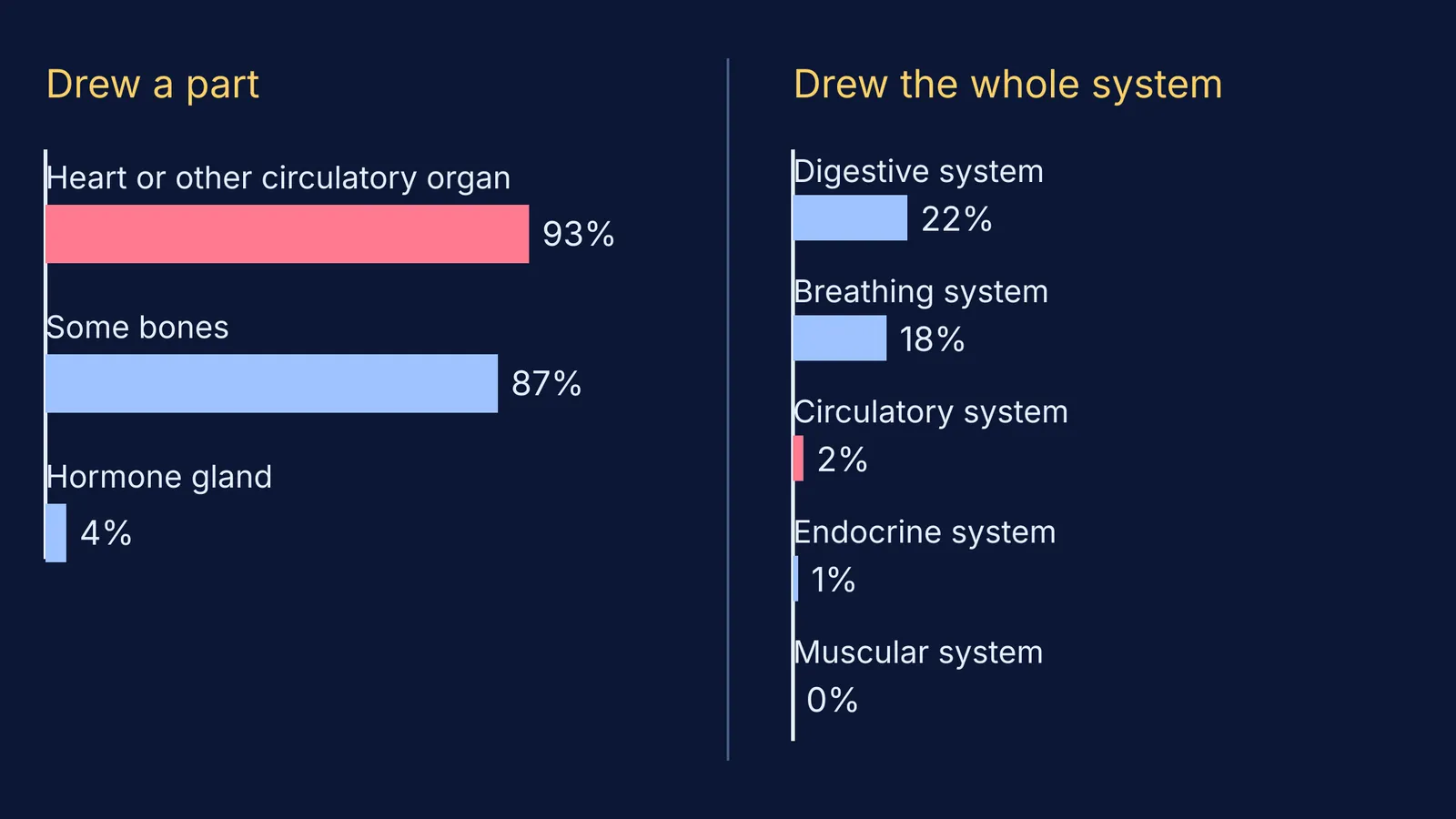
Michael Reiss and Sue Dale Tunnicliffe asked 158 students in England, from 4-year-olds to first-year undergraduates, to draw what they thought was inside themselves (Research in Science Education, 2001). In the full paper, 93% of drawings showed an organ from the circulatory system, nearly always the heart, and 87% showed some bones.
Whole systems were much rarer. Only 22% of drawings showed a complete digestive system, 18% a complete breathing system and 2% a complete circulatory system, and none showed the muscular system (Reiss and Tunnicliffe). Drawings improved little after age 7 or 8, except among biology specialists. The authors describe students' insides as a scattered set of isolated organs rather than a working whole. Your job at home is to connect the pieces.
How do you do the body outline activity?
Tape together old newspaper or chart paper longer than your child. Ask them to lie on it and trace around them with a crayon.
Before you show any book, ask: "Draw everything you think is inside you." Do not correct anything yet. Write the date on it.
Ask three questions: "Where does food go after you swallow?", "Where does the air go?" and "What makes your arm bend?"
Look up one system together in their school science book and add it in a second colour, joined from start to end: mouth to stomach to intestines, or nose to windpipe to lungs.
Keep the outline on a wall, add one system a week, and ask for a fresh drawing in a month to compare.
How do you measure pulse and breathing after jumping?
MedlinePlus explains how to take a pulse: press the index and middle fingers on the underside of the wrist, below the base of the thumb, count for 15 seconds and multiply by 4 (MedlinePlus). It gives a normal resting range of 75 to 115 beats per minute for children aged 5 to 6, 70 to 110 for ages 7 to 9, and 60 to 100 for ages 10 and above.
Sit quietly for two minutes. Count pulse for 15 seconds and write it down.
Count breaths for 30 seconds while your child sits still (one breath in and out counts as one). Multiply by 2.
Jump on the spot for one minute.
Count both again straight away, then every minute until the numbers come back to the start.
A worked example: 22 beats in 15 seconds is 22 × 4 = 88 beats per minute. Ask your child to predict the after number first, then plot the counts against time. End with: "Why did your heart and your lungs speed up together?" That is the link between systems the drawing study found missing.
The US CDC recommends that children and teens aged 6 to 17 get 60 minutes or more of moderate-to-vigorous physical activity each day (CDC), so a few rounds of jumping count towards that. For a home-made way to hear the heartbeat, try our guide to making a paper-cone stethoscope.
How do you make simple models of lungs and bones?
For the lungs, cut the bottom off a small plastic bottle. Push a balloon into the neck and stretch its open end over the mouth. Tie a knot in a second balloon, cut off its wide end and stretch it across the open bottom. Pull the knot down and the inside balloon inflates: the bottom sheet is the diaphragm. Older children can read where the bell jar breathing model goes wrong.
For bones, the adult skeleton usually has 206 named bones, 80 along the body's central axis (skull, spine and rib cage) and 126 in the limbs and their girdles (US National Cancer Institute SEER training). Build an arm from two cardboard strips joined at the elbow with a split pin. Tape a rubber band from upper arm to forearm as the biceps and let your child pull it to bend the elbow. Bones need muscles to move, and no drawing in the Reiss and Tunnicliffe study showed the muscular system.
What should you say when your child asks a hard question?
"Good question. What do you think?" Let them guess first.
"Let's check in a book together."
"I don't know. How could we find out?"
For "Where does the blood go?", our explainer on how blood circulates in the human body gives you the simple version. For older siblings, the Fermi Simulation Lab has interactive simulations for ideas that are easier to see than to read.
This weekend, start with the outline and a crayon. The jumping and the models can follow.


