

On this page
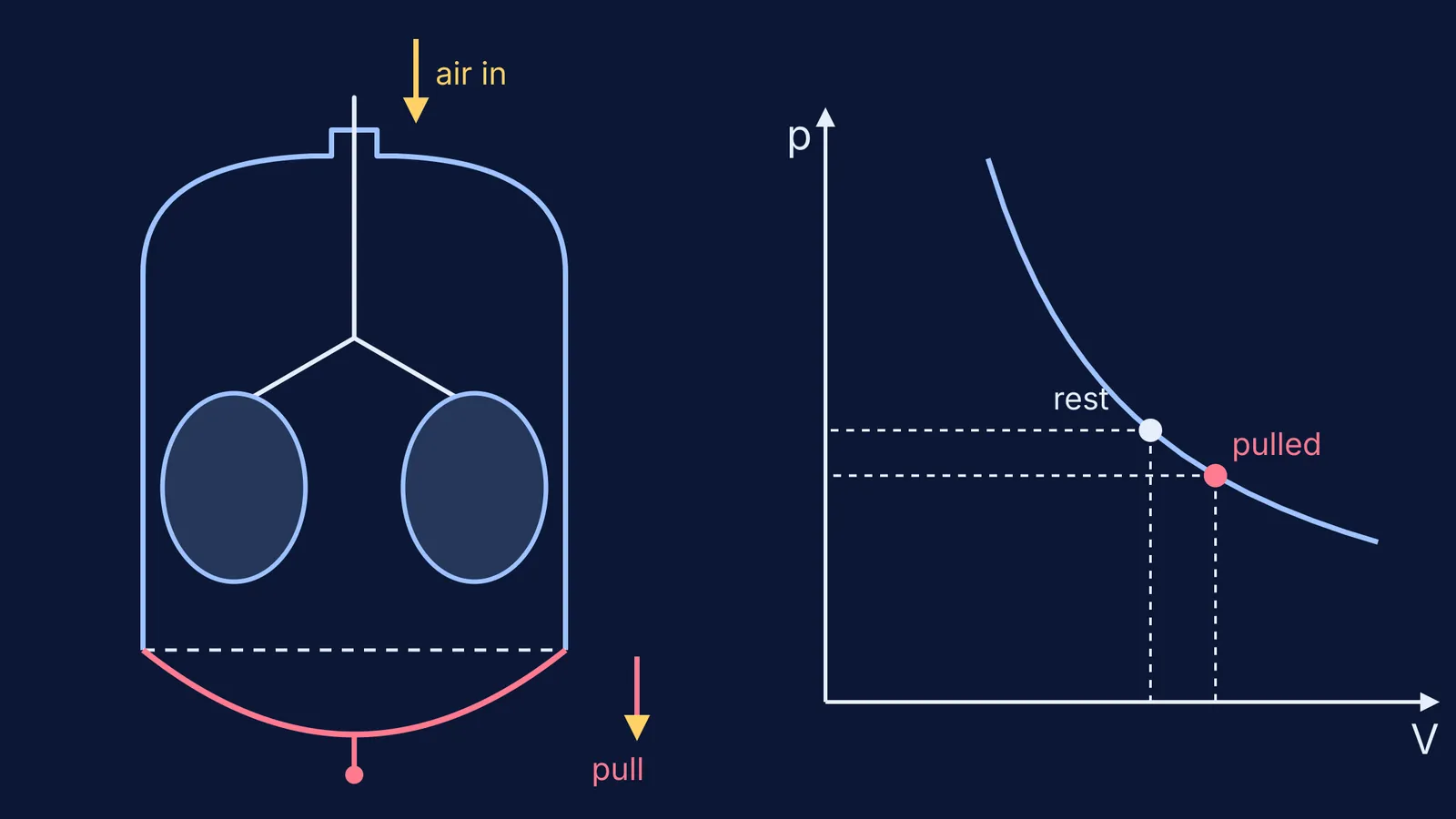
The bell jar model is a sealed glass jar with two balloons on a Y-shaped tube inside and a rubber sheet stretched across the open bottom. In this model the balloons represent the lungs, the jar the rib cage, the tube the trachea and bronchi, and the rubber sheet the diaphragm (EdPlace). It makes one hidden idea visible: air is not sucked into your lungs. The atmosphere pushes it in when the space around the lungs gets bigger.
A good way to learn the model is to predict before you pull. Below you'll find five moves to try, a worked calculation, and what the model leaves out.
How does the bell jar model show breathing?
Pull the rubber sheet down and the jar's volume goes up, so the pressure inside falls and air rushes into the balloons (Study Rocket). Push the sheet up and the opposite happens: the volume shrinks, the pressure rises and air leaves the balloons.
The physics is Boyle's law. For a fixed amount of gas at constant temperature, pressure × volume stays constant (NASA Glenn Research Center). In the body, contracting the diaphragm moves it down towards the abdomen and makes the chest cavity bigger (OpenStax Anatomy and Physiology). That is the step the rubber sheet stands in for.
What should you predict before pulling the diaphragm?
Write down an answer to each move first, then try it. If a prediction turns out wrong, work out which step you missed.
Pull the sheet down slowly. Prediction: both balloons inflate, because the jar's pressure drops below the air pressure outside.
Push the sheet up past its resting position. Prediction: the balloons shrink further and air leaves through the tube.
Block the top of the tube, then pull. Prediction: the balloons barely grow and the sheet feels stiff, because no outside air can get in to balance the pressure.
Make a small leak in the jar wall, then pull. Prediction: air comes in through the leak and the balloons stay limp. The pressure drop only works if the space around the balloons is sealed. In the body, sticky pleural fluid lets the chest wall pull the lungs outward (OpenStax).
Pull the sheet halfway and hold it. Prediction: the balloons stay part-filled. Air flows only while there is a pressure difference.
A worked example with numbers
Say the air around the balloons fills 2.0 L at 760 mm Hg. That is sea-level atmospheric pressure, as given in OpenStax. Pulling the sheet adds 0.4 L of space.
If the tube were blocked and the balloons could not change size, Boyle's law gives p₂ = 760 × 2.0 ÷ 2.4 ≈ 633 mm Hg. That is a large drop, which is why the sheet feels stiff in move 3.
With the tube open, the balloons fill and take up almost all of that new 0.4 L. The jar's pressure ends up only slightly below atmospheric, just enough to keep the balloon rubber stretched. That small difference is the whole point: breathing needs only a slight pressure gap.
For scale, one quiet breath moves about 500 mL of air (OpenStax). For a teenager breathing about 15 times a minute, inside the 12 to 18 range OpenStax gives for adolescents, that is roughly 7.5 L of air every minute.
What does the bell jar model get wrong about real lungs?
Exam questions often ask for this, so give specifics, not "it is too simple".
The ribs do not move. The jar is rigid. In real breathing, the external intercostal muscles move the ribs up and out (OpenStax).
The diaphragm works the wrong way. A real diaphragm flattens when its own muscle contracts. In the model, someone pulls the sheet from below (EdPlace).
The lungs are never slack. At rest the balloons hang loose. In the body, the pressure in the space around the lungs stays about 4 mm Hg below atmospheric pressure through the whole breath, always lower than the pressure inside the lungs, so the lungs stay slightly stretched (OpenStax).
Breathing out is passive. You have to push the sheet back up. In the body, normal breathing out needs no muscle effort: the stretchy lung tissue simply recoils (OpenStax).
Nothing is exchanged. The model has no bronchioles, no alveoli and no blood vessels, so it cannot show gas exchange (Study Rocket).
Where to go next
Once the pressure idea makes sense, try the lung volume sums in our guide to breathing and gas exchange. To find out when a moving model helps more than a textbook figure, read what studies found about simulations versus static diagrams.
If the link between pressure and volume still feels abstract, the Fermi Simulation Lab has interactive simulations for ideas that are easier to see than to read. Make your five predictions first, then check them.


