

On this page
Listening to a heartbeat does not require complex medical equipment. The very first stethoscope was made from a simple piece of rolled paper. By making your own paper cone or using a funnel and a tube, you can hear the mechanical action of the heart and measure your own resting heart rate.
How do you make a simple stethoscope?
In 1816, the French physician René Laennec invented the stethoscope by rolling a piece of paper into a tight cylinder to listen to a patient's chest (Laennec and the Invention of the Stethoscope, 1993). Before this, doctors simply pressed their ear directly against the chest. You can easily replicate his discovery at home using everyday items.
Here is a simple plan for making and using a paper cone stethoscope:
Take a large piece of stiff paper or thin cardboard.
Roll it into a cone shape, leaving a wide opening (about 10 centimetres across) at one end and a small opening (about 2 centimetres across) at the other.
Tape the cone securely so it holds its shape.
Place the wide end flat against a person's bare chest, slightly to the left of the centre, over the heart.
Put your ear close to the narrow end and listen for the classic "lub-dub" sound.
If you want a more flexible version, you can insert the narrow end of a plastic kitchen funnel into a length of flexible plastic tubing. This allows you to listen to your own heart more comfortably, as the tube bends to reach your ear.
How do you measure your resting heart rate?
Once you can hear the heartbeat clearly through your stethoscope, you can calculate the resting heart rate. The normal resting heart rate for adults is between 60 and 100 beats per minute (StatPearls: Sinus Tachycardia, 2023). For children, the rate is often higher, starting between 100 and 150 beats per minute in infancy and gradually reducing over the next six years.
To find your beats per minute (bpm), follow these steps:
Sit quietly for a few minutes so your heart rate returns to its resting baseline.
Using a stopwatch or a clock with a second hand, count the number of "lub-dub" cycles (each full cycle counts as one beat) for 30 seconds.
Multiply that number by two to get your heart rate in beats per minute.
You can verify this measurement by finding your pulse. Place two fingers (not your thumb) on the inside of your wrist, just below the base of your thumb. The pulse you feel is the pressure wave generated by the heart pushing blood through your arteries. Because the electrical signals from the atrioventricular node trigger the mechanical contraction that creates this wave, your wrist pulse should perfectly match the rhythm you hear in your chest.
Why does a paper cone work as a stethoscope?
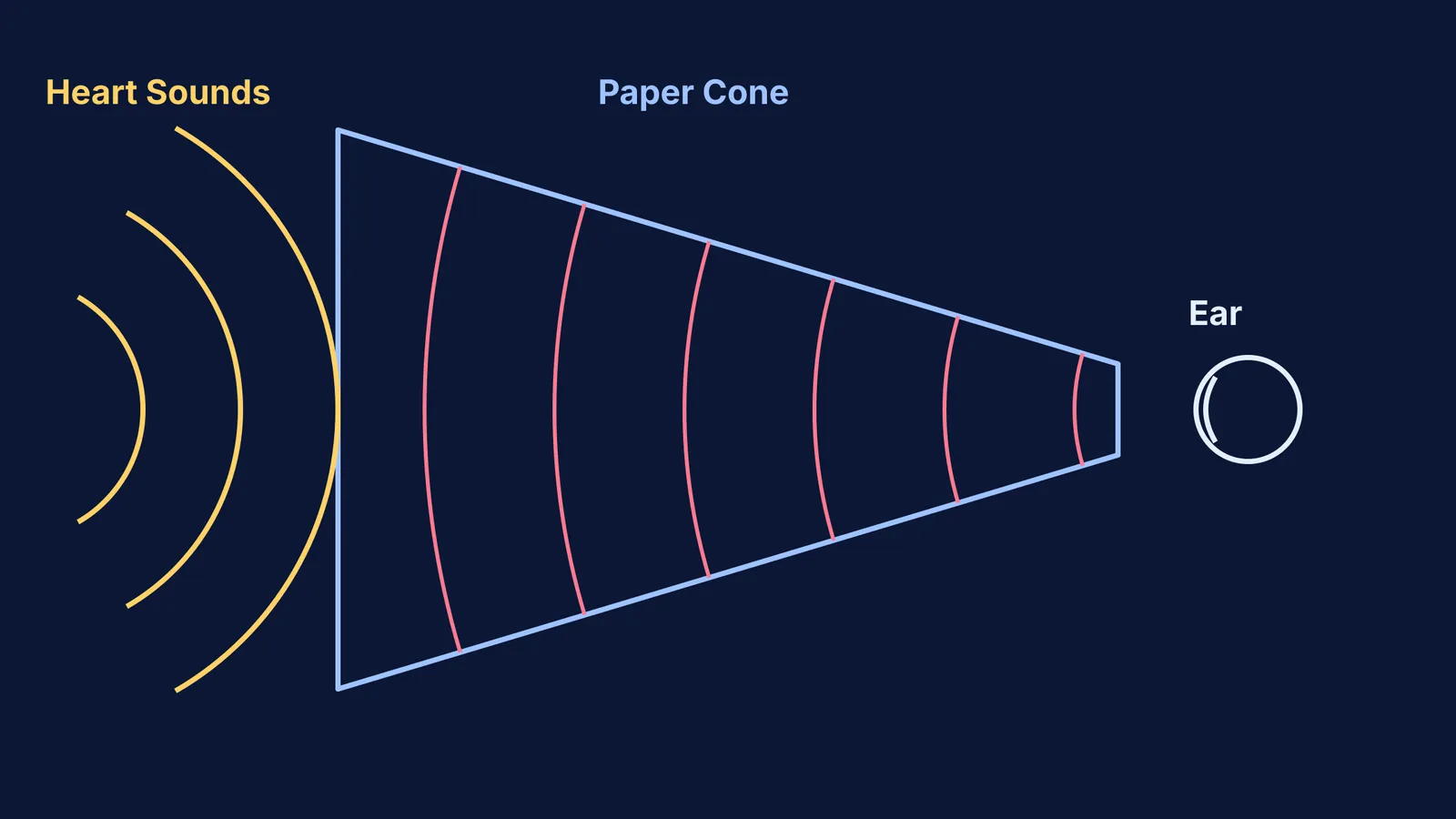
A rolled paper cone or a plastic funnel acts as an acoustic horn. When sound waves leave the chest, they spread out in all directions. The wide end of the cone captures a larger area of these displacement and pressure waves in sound.
As the sound waves travel down the narrowing cone, the acoustic energy is concentrated into a smaller area, amplifying the pressure variations by the time they reach your ear. This simple physical principle is the foundation for all acoustic stethoscopes, though modern versions add a diaphragm to better capture high-frequency sounds, much like the methods pioneered by Nikolai Korotkov to hear the sounds of blood pressure.
Connecting these biological actions with the physics of sound can be complex. In the Fermi Concept Library, you can trace the path of mechanical waves or the electrical conduction of the heart, with every concept having its own lesson and its place in the map. If you get stuck on a calculation, the Fermi Problem Library has worked problems with a step-by-step solver that explains the reasoning rather than printing an answer.


