

On this page
Your child can probably recite "1 kilogram is 1000 grams". The trouble starts when a question gives 750 g of sugar and 1.2 kg of flour and asks for the total. Writing 751.2 usually means the units never felt real. The fix: a measuring jug, a kitchen scale and a tape measure.
Why do children mix up grams and kilograms?
A unit is not a label you stick on after the maths. It tells you what "one" counts as. The kilogram is the SI base unit of mass, one of seven base units listed by the International Bureau of Weights and Measures (BIPM).
The prefix kilo means 10³ (1000), centi means 10⁻² and milli means 10⁻³, according to the BIPM table of SI prefixes. Once a child sees that "kilo" means "a thousand of", kilometres and kilograms become one rule, not two facts.
The kind of hands-on practice matters. In a 2024 study, Kwon, Congdon, Ping and Levine tested 120 second graders on reading a ruler when the object did not start at zero; the 88 who scored no better than chance went on to training. They improved significantly only when the training gave them disconfirming evidence: they said how long a shifted object was, then counted the unit spaces under it to check. In an exploratory analysis, the gains came faster and lasted better when this was combined with laying plastic unit chips over the ruler's units. The lesson for home: let your child guess first, then measure and check.
Adults get units wrong too. NASA lost the Mars Climate Orbiter in 1999. Arthur Stephenson, chair of the investigation board, said the root cause was "the failed translation of English units into metric units in a segment of ground-based, navigation-related mission software" (NASA release, 10 November 1999).
How do I teach my child units and conversions at home?
Each activity below uses the same prefix rule from the BIPM prefix table: milli means one thousandth. Give each quantity its own tool, and follow the same four steps every time: guess, measure, write the number with its unit, then convert.
The jug (volume). Ask how many 250 ml cups will fill a 1 litre jug. Let your child guess, then pour. Four cups, so 1 L = 1000 ml.
The scale (mass). Put a 1 kg packet of atta on the scale, then weigh out 100 g of dal. Ask, "How many of these heaps would balance the packet?"
The tape (length). Measure a door in centimetres, then say the same length in metres. If it reads 203 cm, write 2.03 m next to it.
For more, try these estimation games where children guess first and then measure and these kitchen maths activities for ages 5 to 11.
What should a units ladder on the fridge look like?
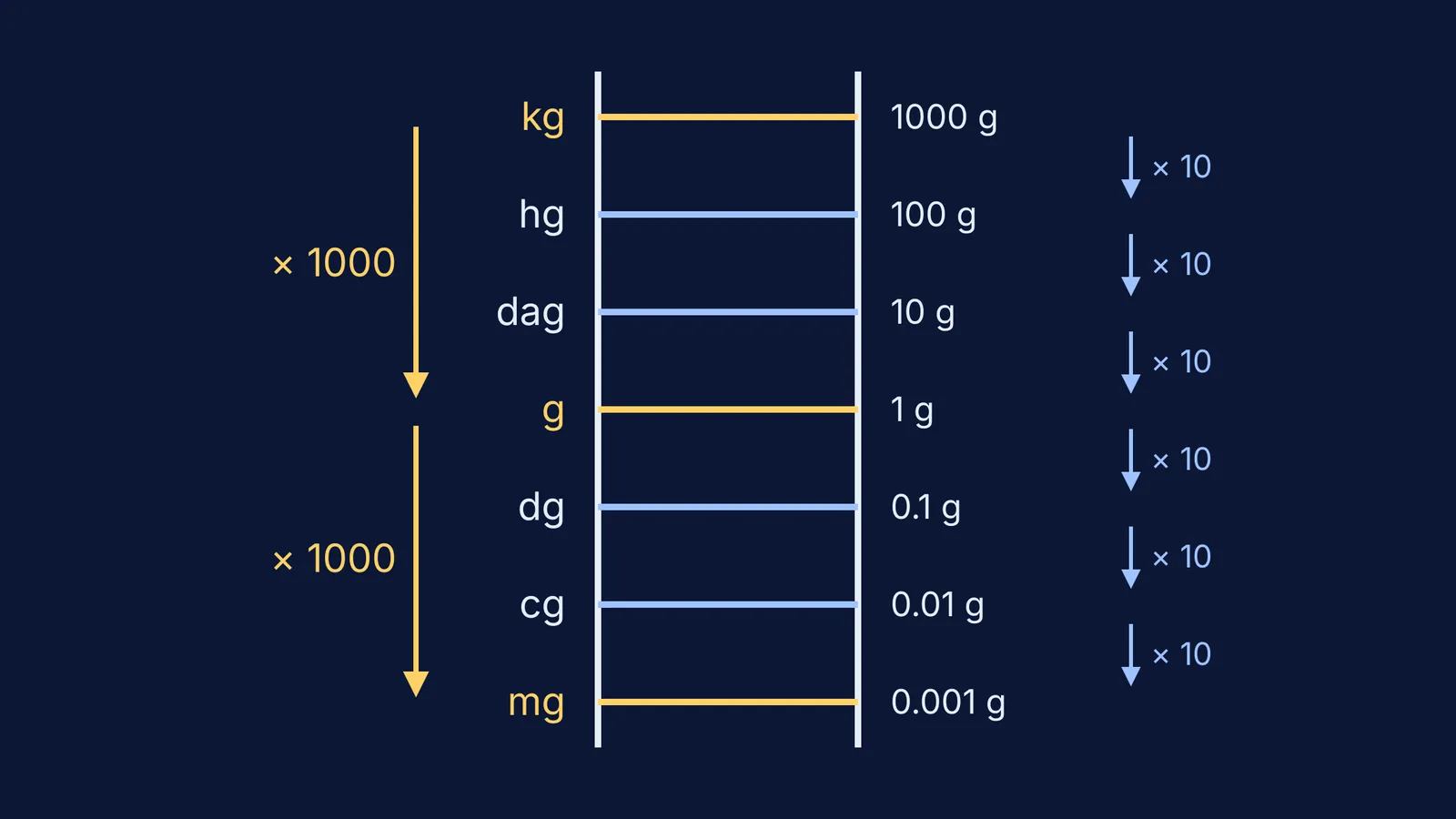
Draw a ladder with seven rungs. From top to bottom: kilo, hecto, deca, the plain unit (gram, metre or litre), deci, centi, milli. Each step down multiplies by 10 and each step up divides by 10, because BIPM defines hecto as 10², deca as 10¹ and deci as 10⁻¹. Colour the kilo, plain-unit and milli rungs, since those are the ones your child will meet most. Kilo is three rungs above the plain unit, which is why the jump is 1000.
Worked example: 750 g of sugar plus 1.2 kg of flour
Choose one unit for the answer. Grams avoid decimals here.
Convert 1.2 kg to grams. Kilo to gram is three rungs down, so multiply by 10 × 10 × 10 = 1000. That gives 1.2 × 1000 = 1200 g.
Add: 750 g + 1200 g = 1950 g.
Check on the way back up: 1950 ÷ 1000 = 1.95 kg. Between 1 kg and 2 kg, as the packets feel.
The wrong answer fails this check at once: flour and sugar cannot weigh 751.2 kg.
Can a missing unit really cost marks?
Yes. In board exams, a correct number can still lose marks if the unit is wrong or missing. The general instructions in CBSE's 2013 Class 12 physics marking scheme told examiners to "Deduct ½ mark for writing wrong units, missing units, in the final answer to numerical problems" (CBSE marking scheme, 2013). Rules can change, so check the current scheme on the CBSE website.
Use this short check when your child shows you a numerical answer:
"What unit is the question in? What unit is your answer in?"
"Did you convert before you added or multiplied?"
"Is the size sensible? Could a school bag weigh 4000 kg?"
"Is the unit written next to the final answer?"
In Classes 11 and 12, the same idea grows into dimensional analysis. This guide to using dimensions to check physics answers is a good next step. If your child converts correctly but still sets problems up the wrong way, the Fermi Problem Library has worked problems with a step-by-step solver that explains the reasoning rather than printing an answer.
Start this weekend: one jug, one scale, one tape and a ladder on the fridge.


