

On this page
Children learn the clock and calendar in a fairly predictable order. Teach in that order, tie each step to family routines, and a few minutes a day is usually enough.
In what order do children learn clocks and calendars?
NCERT's primary mathematics syllabus builds time knowledge class by class: earlier and later in Class I; days of the week and months in Class II; calendar dates and the time to the hour in Class III; the nearest minute, a.m. and p.m., durations and days between two dates in Class IV; and time intervals by addition and subtraction in Class V. England's national curriculum uses a similar ladder: hour and half past, then five minutes, then the nearest minute.
Research points the same way. A 2019 paper by Brace and colleagues at City, University of London cites a review of North American studies from the 1970s and 1980s: many children tell whole-hour times by age 6, five-minute times by 7 or 8, and one-minute times between 8 and 10. In one study it describes, Friedman and Laycock (1989) tested 32 children in each of five age groups; on an analogue clock, a time such as 2:43 was still hard for some children in the oldest group, with a mean age of ten and a half.
The same paper reports Friedman's proposal that children first learn the days and months as an ordered list, and by about age 10 have a sense of the year as a cycle.
How do I teach my child to read an analogue clock?
Hang one real clock with numbers where your child eats or does homework. Each step pairs an everyday activity with a sign they are ready to move on.
Before and after. Narrate the day: "First bath, then breakfast, then school." Ready when they can order four events of their day.
Days and months. Cross off each day on a wall calendar at bedtime. Ask, "What comes after Friday?" Ready when they can say the days forward from any day.
O'clock, short hand only. Point at the hour hand: "It's just past 7, so we leave soon." Ready when they say "a bit after 4" for a hand between 4 and 5.
Half past and quarter past. Cut a roti or paper circle into halves and quarters and hold it over the clock face. Ready when they can show half past 6 on a toy clock.
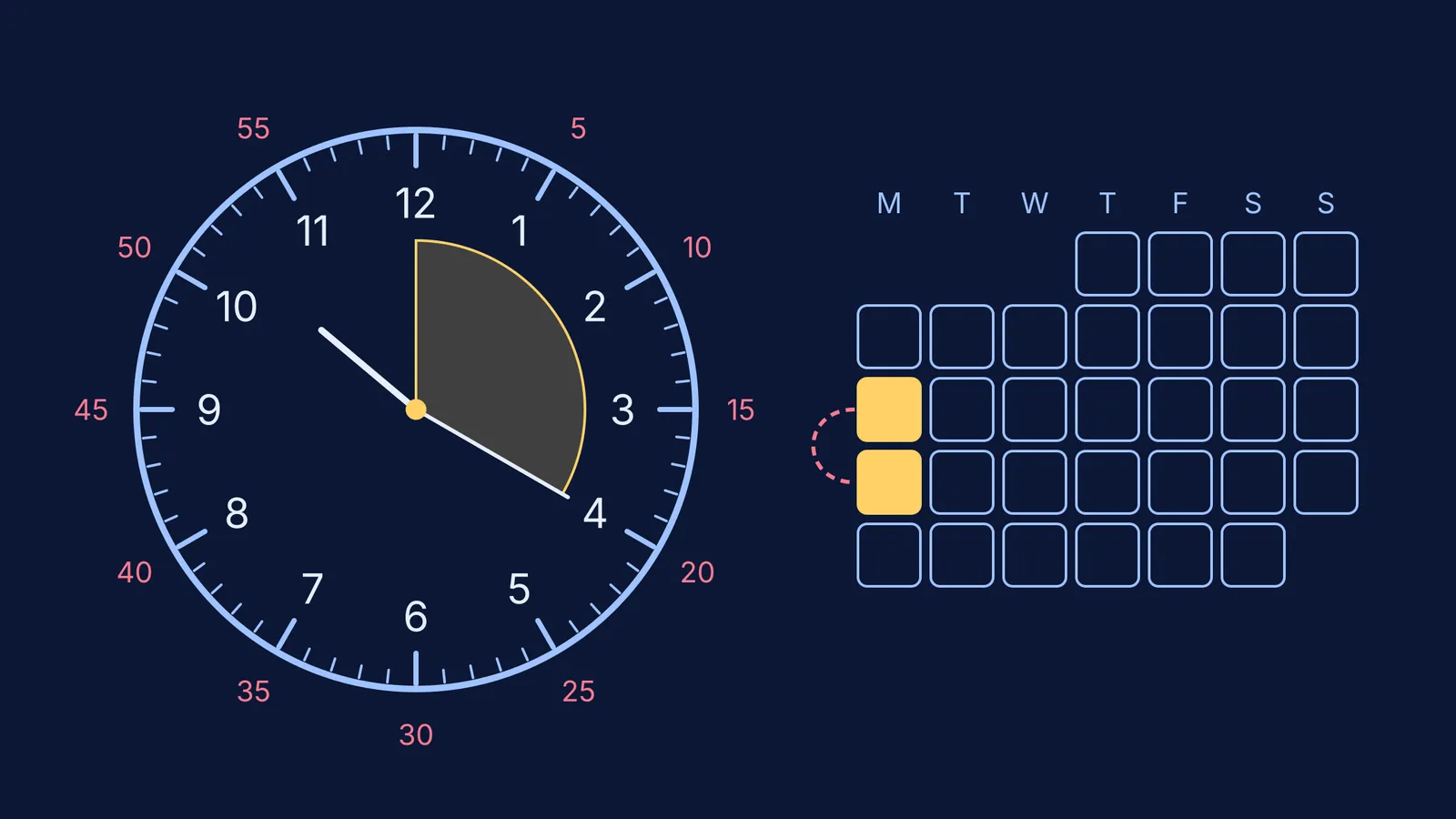
Counting in fives. Stick paper labels reading 5, 10, 15 and so on around the rim. Read the long hand by counting in fives, then remove one label each week.
To the minute. Count in fives, then ones: "40, 45, 46, 47." Use school and alarm times to practise a.m. and p.m.
How do I teach elapsed time?
Elapsed time is how long something lasts: the gap between a start time and an end time. NCERT's syllabus has Class IV children find approximate elapsed time by counting forward, so teach jumps, not subtraction.
Worked example: tuition runs from 4:40 to 5:25.
Jump to the next o'clock: 4:40 to 5:00 is 20 minutes.
Jump on: 5:00 to 5:25 is 25 minutes.
Add the jumps: 20 + 25 = 45 minutes.
Subtracting 440 from 525 gives 85, which is wrong because an hour has 60 minutes, not 100. Showing that mistake once can help the jumps make sense.
Time real things: the walk to school or how long dal takes in the pressure cooker. Ask for a guess first, as in these estimation games for kids, and borrow recipe timings from maths while cooking with kids.
How do I teach my child to count days on a calendar?
Use the same jumps. Worked example: today is 27 October and a cousin's birthday is on 9 November.
Days left in October: 28, 29, 30 and 31, so 4 days.
Days into November: 9 days.
Total: 4 + 9 = 13 days to go.
Before a festival, make a paper chain and tear off one link each morning.
What if my child still finds the clock hard?
It can trace back to counting. Burny, Valcke and Desoete compared 154 Belgian children with mathematics difficulties with 571 average-achieving children and found the first group worse at clock reading, with errors reflecting immature counting strategies and weaker memory retrieval. The City, University of London paper gives an example: reading 10:20 as 10:04, a sign the child is not counting in fives.
Keep sessions short and calm. If clock trouble comes with wider difficulty in maths, talk to the class teacher, who sees your child's work every day.
Later, the clock returns in middle-school maths as the angle between the hands. The Fermi Concept Library has a lesson for every concept in mathematics, for an older child curious where clock puzzles lead. For the next step, try teaching time zones with a globe.
Start tonight: point at the short hand before dinner and ask what hour it is.


