

On this page
Time zones can feel like magic to a young child. Why is it dinner time in India when a cousin in Canada is just waking up? Explaining that the Earth is a spinning ball is one thing; helping a child visualise it is another.
Spatial reasoning—the ability to picture how objects look from different angles—is a crucial skill for science and mathematics. But teaching it with a flat map often fails. Flat maps inevitably distort the size and shape of landmasses, making it harder for children to build a correct mental map of the world. A 2026 study published in Edunesia found that elementary students taught geographic concepts using physical globes achieved a normalised gain score of 0.734, compared to just 0.337 for students who learned through conventional methods. The physical model more than doubled the effectiveness of the lesson.
Research in embodied cognition also supports this approach. Physically interacting with a 3D object helps the brain bridge the gap between motor action and mental imagery. Here is a step-by-step active learning method to teach your child about time zones using tools you likely have at home.
How do you explain day and night with a globe and flashlight?
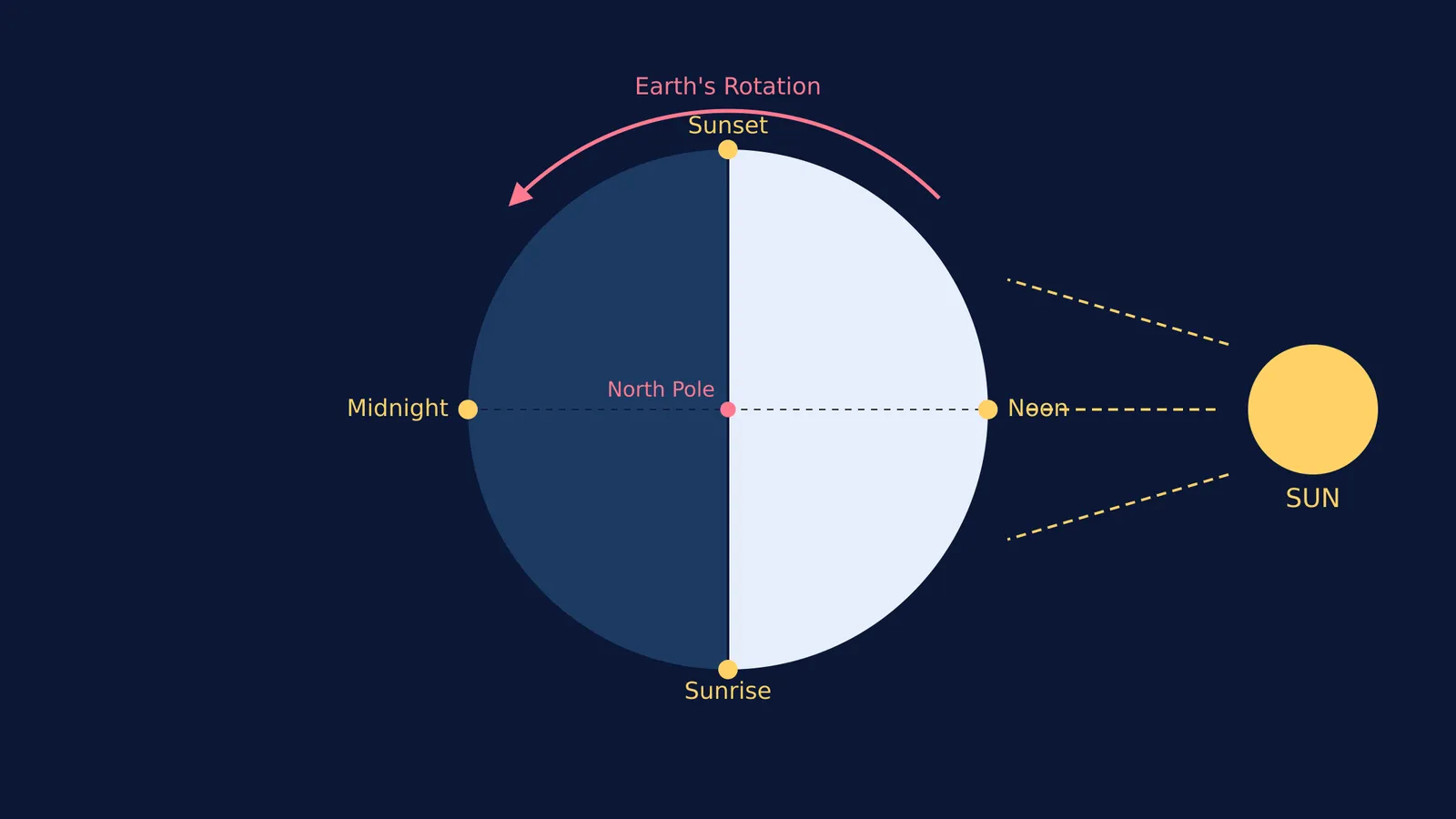
Before children can understand time zones, they need to understand rotation. Because a globe requires physical manipulation, it serves as a concrete learning medium that bridges the gap between the physical world and abstract concepts like latitude and longitude.
Set the scene: Take a physical globe and a small sticker. Let your child place the sticker roughly where you live.
Be the Sun: In a darkened room, hold a flashlight (the Sun) steady. Ask your child to hold the globe.
Spin the Earth: Have your child slowly turn the globe counter-clockwise (from West to East). Ask them to watch the sticker move from darkness (night) into the edge of the light (sunrise), to directly under the beam (noon), and back into the shadow (sunset).
How do you teach the concept of time zones?
Once the child understands that only half the Earth is lit at any time, introduce the idea of dividing the planet into slices.
Ask your child how many hours there are in a day. When they say 24, explain that we divide the Earth into 24 imaginary slices, like an orange. Each slice represents one hour of rotation.
A great way to reinforce this is with human movement. Place a lamp in the centre of the room to be the Sun. Have your child stand facing the lamp—this is 'noon'. Ask them to spin slowly in place. When their right shoulder faces the lamp, it is morning; when their left shoulder faces it, it is evening; when their back is turned, it is midnight. This physical experience cements the sequence of time, turning an abstract idea into a memory they can feel.
If your child has questions about the Earth's rotation or other planetary movements that are hard to picture, Fermi's AI tutor can draw the figure or guide them through the geometry of orbits step by step.
How do family calls help practise spatial reasoning?
The best way to test learning is to connect it to a real social need. Calling family or friends who live far away turns time zones into a practical maths problem and helps children practise allocentric reasoning—understanding spatial relationships from another person's viewpoint.
Before picking up the phone, look at the globe together. Find your home and find the relative's city. Remind them of the simple rule: if you move East (to the right), time moves forward. If you move West (to the left), time moves backward.
Here is a short script to guide the conversation:
Parent: "We are going to call Uncle today. Where does he live on the globe?"
Child: *(points to the city)*
Parent: "Right! Now, is his city to the East or West of ours?"
Child: "It is to the West."
Parent: "Since it is West, do we add hours or subtract them?"
Child: "Subtract."
Parent: "If it is 4:00 PM here, and he is five slices to the West, what time is it there? Is he likely to be awake?"
This simple routine links geography, addition, subtraction, and empathy. The physical act of counting slices across the curved surface makes the abstract concept stick.
If you are looking for more ways to make learning concrete, you can try Kitchen science: five safe experiments at home, or read about Teaching your child to plan their time. The history behind standard time is also fascinating; you can explore the story of Sandford Fleming and the idea of standard time zones with your older children.


