

On this page
A tangram is one square cut into seven pieces, and every piece is an exact fraction of that square. One sheet of paper becomes a fractions kit your child can hold. Below are the fractions, how to cut a set at home, and puzzles for ages 8 to 12, with answers.
What fraction of the square is each tangram piece?
The tangram is a puzzle of seven flat pieces, reputed to have been invented in China around the late 18th century; the oldest surviving set was given to the Philadelphia shipping magnate Francis Waln in 1802, according to the Wikipedia entry on tangrams.
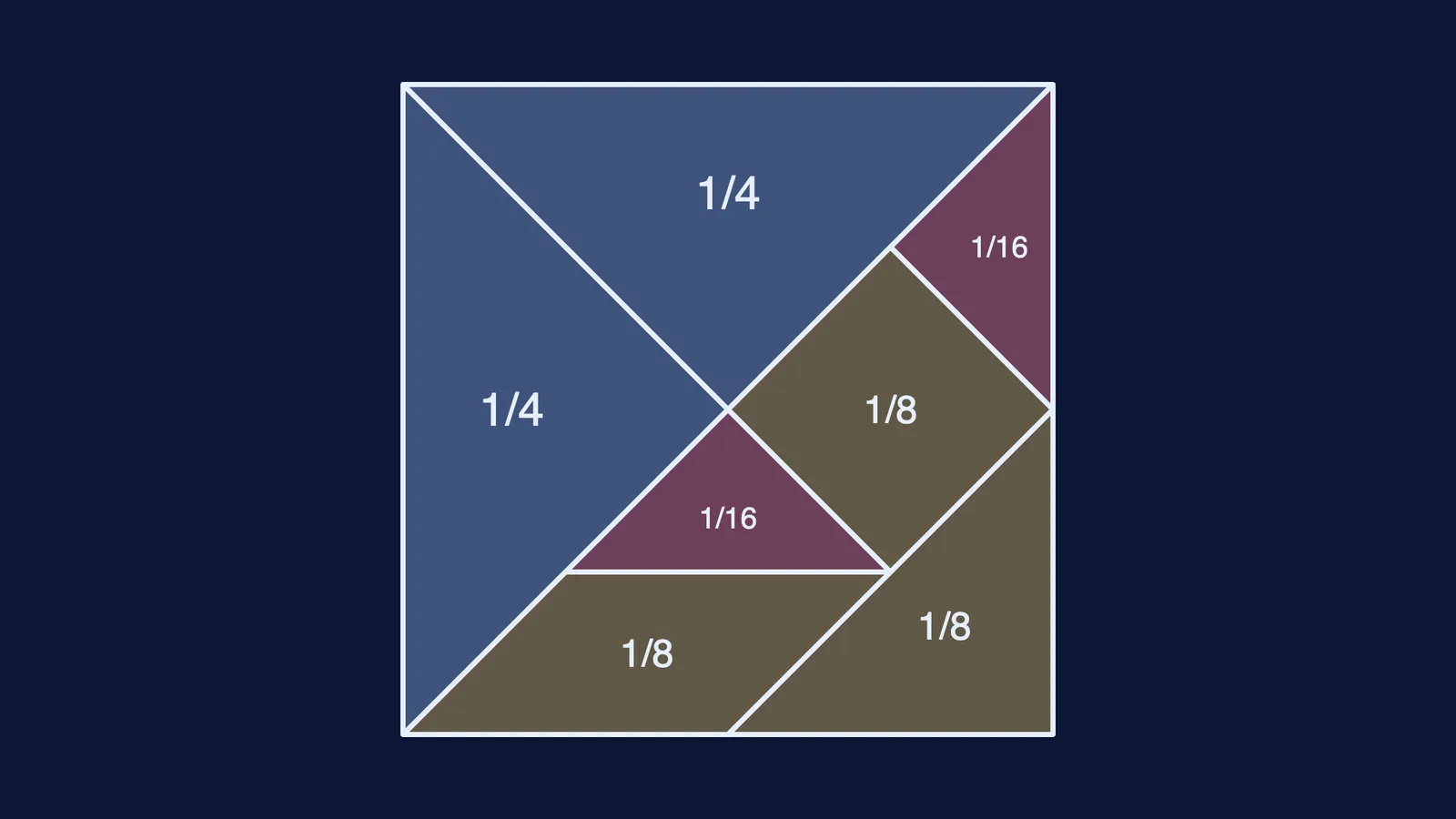
If the whole square has an area of 1, the pieces are worth these fractions, as listed in the tangram piece measurements:
Each of the two large triangles is 1/4 of the square.
The medium triangle, the square and the parallelogram are 1/8 each.
Each of the two small triangles is 1/16 of the square.
Your child can check this without a formula. Treat the small triangle as the unit. The square, the parallelogram and the medium triangle can each be covered by exactly two small triangles. A large triangle takes four. Two large triangles make 8 units, three middle pieces make 6, and the two small triangles make 2, so the square is 16 small triangles and each one is 1/16.
How do you make a tangram from one square of paper?
Use a square of stiff paper or an old greeting card.
Fold the square along one diagonal and cut. You now have two halves.
Fold one half in two and cut along the fold. These are the two large triangles.
Take the other half. Fold its right-angle corner down to touch the middle of the long side, and cut along the crease. The small triangle you cut off is the medium triangle.
Fold the strip that is left in half and cut, giving two equal pieces.
From one piece, cut a small triangle and the square. From the other, cut a small triangle and the parallelogram.
Write each fraction on the back once your child has proved it.
Which tangram puzzles teach fractions and area?
Ages 8 to 9: cover and compare
Lay the two small triangles on the square, then on the parallelogram, then on the medium triangle. Ask: which pieces are the same size, even though they look different? Answer: all three, because each is two small triangles.
Build a shape exactly like a large triangle out of smaller pieces. Answers: the medium triangle and two small triangles; the square and two small triangles; or the parallelogram and two small triangles.
Ages 10 to 11: fraction sums
Find pieces that cover exactly half the square. Answers include both large triangles (1/4 + 1/4); one large triangle, the square and the parallelogram (1/4 + 1/8 + 1/8); or one large triangle, the medium triangle and both small ones.
What fraction is the medium triangle plus one small triangle? Write 1/8 + 1/16 = 2/16 + 1/16 = 3/16. If changing 1/8 into 2/16 is the sticking point, our guide to reducing fractions to simplest form with HCF works the same idea backwards.
Pick pieces worth 5/8. One answer: both large triangles and the square.
Ages 11 to 12: area without a formula
If the whole square is worth 16 points, what is each piece worth? Then build a shape worth exactly 7 points (a large triangle, a middle piece and a small triangle).
Make one big triangle from all seven pieces. Did the area change? Did the perimeter? Measure both shapes with a piece of string.
What to say while they work: ask "How do you know?" instead of saying "Correct". If they are stuck, offer one piece, not the answer.
Do hands-on pieces help children learn maths?
A meta-analysis by Carbonneau, Marley and Selig in the Journal of Educational Psychology pooled 55 studies covering 7,237 students from kindergarten to college. It found small to moderate effects in favour of teaching with concrete objects over abstract symbols alone, with moderate to large effects on remembering what was learnt and small effects on problem solving and transfer. How much the objects helped depended on how they were used in teaching.
The practical lesson is to link the pieces to the written maths every time: after each puzzle, your child writes the fraction sentence. For more play that builds the same habits, see our list of board games for maths skills at each age, and for older children, the maths of origami folds.
When your child moves from pieces to symbols and wants a fuller explanation of fractions, the Fermi Concept Library has a lesson for every concept in mathematics, each with its place in the map.
Start tonight with one square of paper and the first puzzle.


