

On this page
Most families who pay for tuition or entrance coaching wonder at some point whether their child should know the fee. Say nothing and your teenager guesses, often wrongly. Say it badly and a number becomes a weight they carry into every mock test.
Should I tell my child how much coaching costs?
For a teenager, usually yes. Coaching is a common family expense in India. In the Comprehensive Modular Survey: Education 2025, run by the National Statistics Office, 37.0% of higher-secondary students were taking or had taken private coaching during the academic year (MoSPI release via PIB, 26 August 2025).
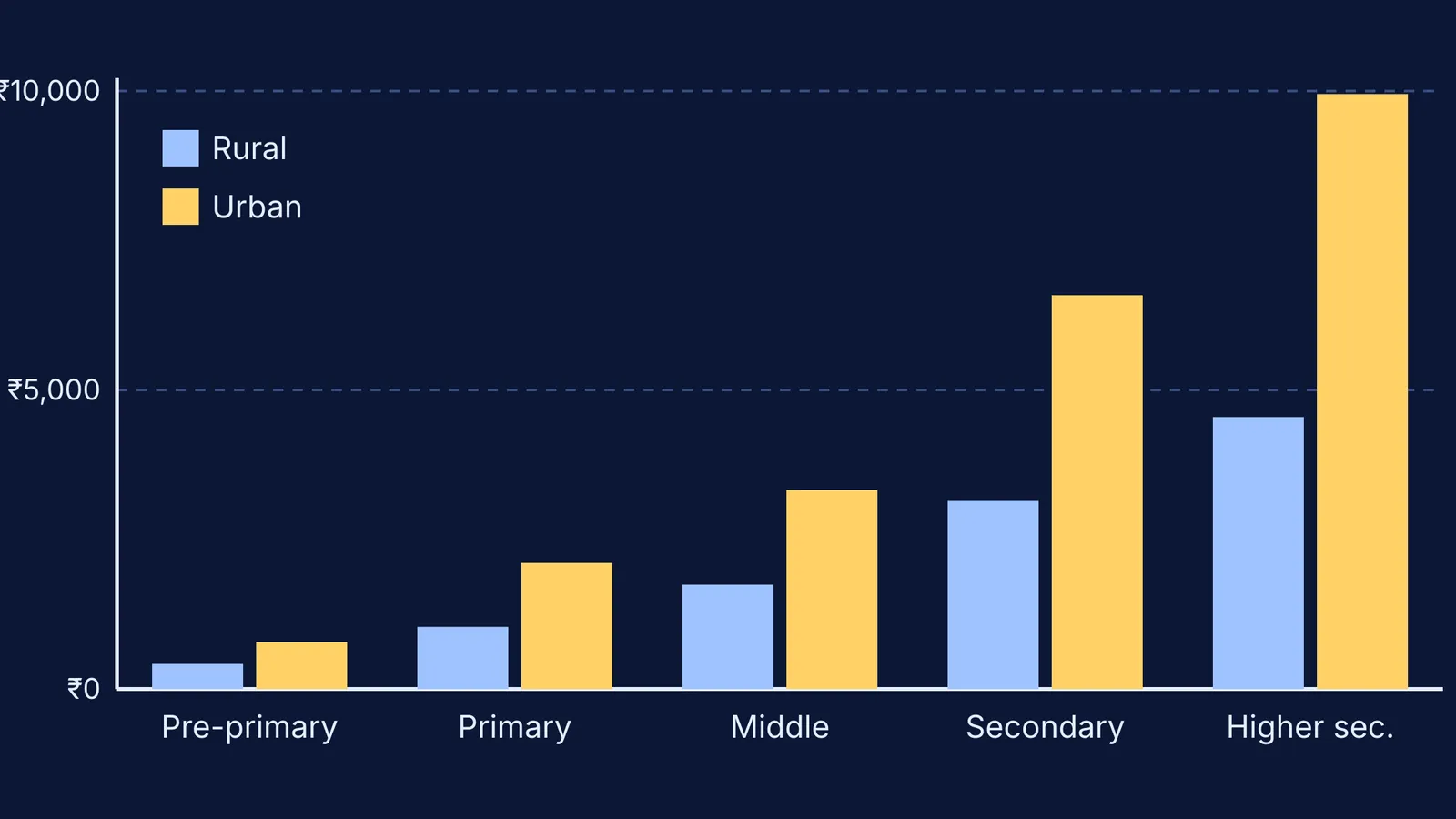
The same survey put average household spending on private coaching per urban higher-secondary student at ₹9,950 a year, against ₹4,548 in rural areas (PIB). These averages include students who took no coaching at all, so families who do pay often spend far more.
Families carry this cost almost alone: 95% of students who spent money on school education said their main source of funding was other members of their household (PIB). Being open turns a vague sense of "this costs a lot" into a fact they can understand.
Why can talking about fees make a child feel guilty?
The number is rarely the problem. The message attached to it is. Family researcher Brian Barber described parental psychological control as control that "constrains, invalidates, and manipulates children's psychological and emotional experience and expression". Across three studies, it consistently predicted depression in children, particularly as preadolescents and adolescents perceived it (Barber, Child Development, 1996).
Guilt induction ("after everything we have done for you") is one form of psychological control. In a randomised trial with families where a parent had a history of depression, parents in a family-based group programme cut back on guilt induction, and those reductions were linked with fewer anxiety and depression symptoms in their children a year after the programme ended (McKee and colleagues, Development and Psychopathology, 2014).
Knowing that parents sacrifice is not harmful in itself. In a study that surveyed 1,569 Chinese adolescents three times, a year apart, mothers' sacrifice was linked with a stronger sense of filial duty, which in turn was linked with less hopelessness (Leung, Journal of Adolescence, 2020). Children can value what you give without being made to feel they owe you for it.
What should I say when I tell my child the fee?
Pick a calm evening, not results day, and use your own words.
Give the number and what it covers. "Your coaching costs us about this much a year, including the test series."
Make it concrete. If the fee is ₹1,20,000 a year, that is ₹10,000 a month.
Say whose decision it was. "We chose this because we thought it would help. It was our decision, and it fits our budget."
Say what it does not mean. "This is not a loan. Your marks are not a repayment."
Ask for their view. "Is it actually helping? What is working and what is not?"
Agree a review date, such as after the next set of mock tests, so changing course is normal rather than a failure.
Our guide to teaching children the value of money at each age covers the groundwork.
Which phrases should I avoid?
"Do you know how much we are spending on you?" Try: "We have budgeted for this because we think it is worth it."
"All that money will be wasted if you do not clear it." Try: "Whatever happens, you will have learned a lot of physics and maths."
"Your cousin's parents could never afford this." Comparisons add shame and no information.
Bringing up the fee after a bad result. Keep money talks and marks talks on separate days.
The same principle applies in our post on saying no to an expensive school trip: give the reason, not a lecture.
What if my child already feels guilty or wants to quit?
Some teenagers hear "this is a lot of money" no matter how gently you say it. Watch for signs such as refusing to rest, hiding test scores, or saying they are "wasting" your money. Repeat the core message: the decision was yours, and their worth is not a return on the fee.
If they want to stop, treat it as information about what is working. Our post on what to do when your teen wants to quit JEE coaching walks through that conversation. If guilt has turned into not knowing where they are stuck, Fermi's AI tutor can work out what they already know and build a plan for the session, so study time has a clear next step.
If your child seems low for weeks, talks about hopelessness, or stops eating or sleeping well, speak to a school counsellor or doctor. Tele MANAS, the government's free 24x7 mental health helpline, is on 14416 or 1-800-891-4416 (Tele MANAS).
Start with one honest sentence about the fee and one about what it does not mean. Then let your child talk.


