

On this page
A bicycle already does half of a speed lesson: its wheel measures distance. Add a phone stopwatch and a quiet lane, and your child can collect their own numbers, calculate a speed and prove the answer right.
What should a child know before you start?
The rule is the one in NCERT's Class 7 science textbook. Chapter 8 of Curiosity, Measurement of Time and Motion, defines speed as the total distance covered divided by the total time taken. The SI unit of speed is the metre per second (m/s); with kilometres and hours it becomes km/h.
The chapter also rearranges the rule into distance = speed × time and time = distance ÷ speed. It notes that a speed found this way is an average speed, because an object may not move at the same speed the whole time.
How do you measure distance with a bicycle wheel?
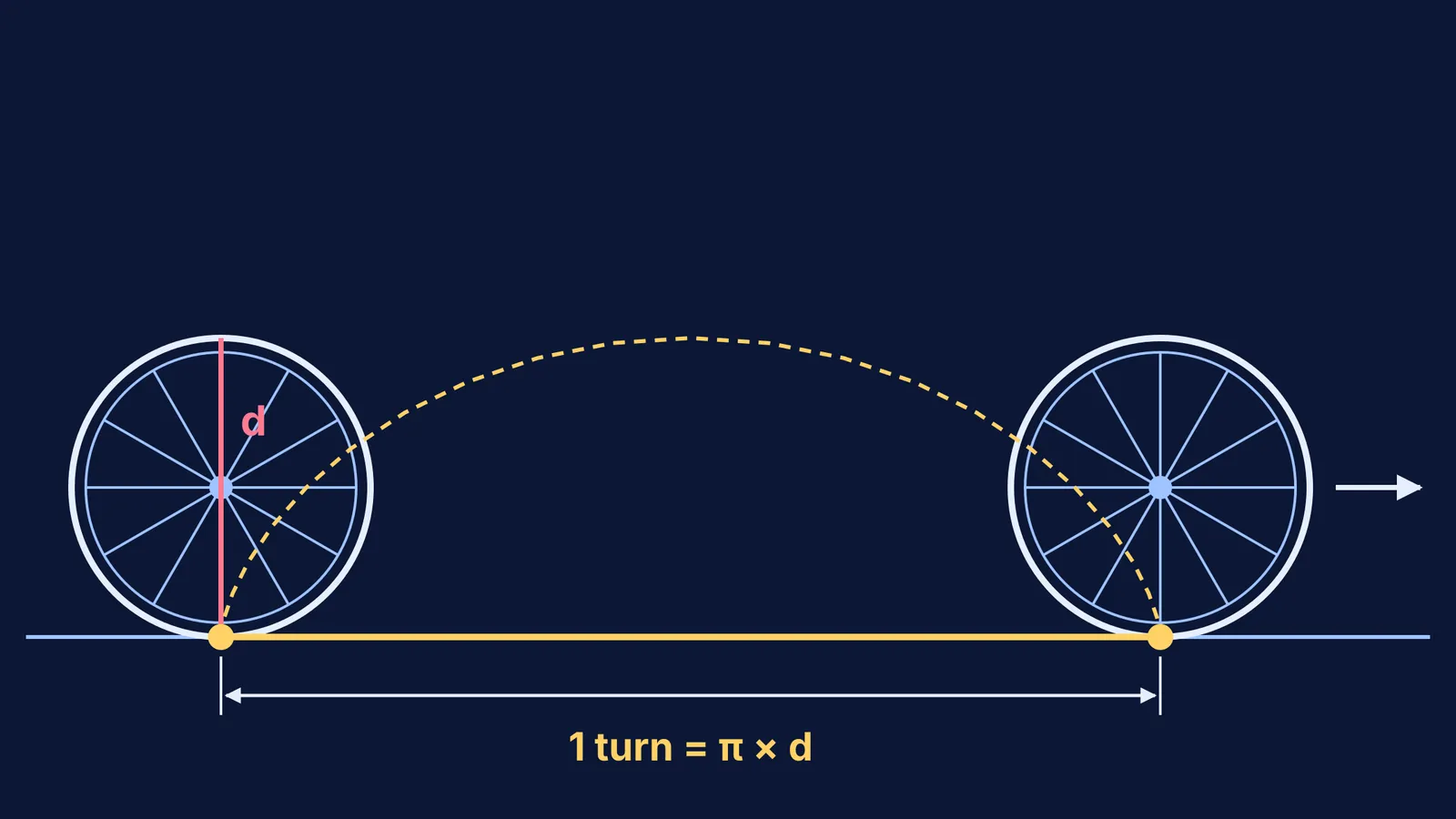
Each turn of a wheel lays its circumference along the ground, so one turn moves the bicycle forward by π × diameter. Your child can test this rather than trust it.
Put a chalk mark on the front tyre where it touches the ground, and a matching mark on the ground.
Walk the bicycle forward in a straight line until the tyre mark comes back to the bottom. Mark the ground again.
Measure the gap between the two ground marks with a tape. That is one turn.
Check it: diameter × 3.14 should come out close. If not, measure again.
Walk the lane, counting turns from start to finish. Lane length = turns × one turn.
For a warm-up, try our measurement and estimation games for children.
How do you time laps safely?
Pick a flat, traffic-free lane, such as a housing society compound or an empty school ground. One child rides, one times, and an adult watches the whole lane.
Helmets are part of the kit. A Cochrane systematic review by Thompson, Rivara and Thompson, drawing on five case-control studies, found that helmets were linked to a 63% to 88% lower risk of head, brain and severe brain injury for cyclists of all ages.
Let the rider start rolling a few metres before the start line, so the stopwatch measures riding, not setting off. Start and stop the watch as the front wheel crosses each line. Do three runs at the same pace and write every time down.
Worked example: from lap times to speed
Sample numbers, worked in full:
One turn of the wheel, measured on the ground: 1.57 m (the diameter was 50 cm, and 3.14 × 0.50 = 1.57 m)
Turns along the lane: 32, so the lane is 32 × 1.57 = 50.2 m
Three lap times: 14.2 s, 13.8 s and 14.6 s, so the average lap is 42.6 ÷ 3 = 14.2 s
Speed = 50.2 m ÷ 14.2 s = 3.54 m/s
To turn m/s into km/h, multiply by 3.6: one metre every second is 3,600 metres in an hour, which is 3.6 km. So 3.54 m/s is about 12.7 km/h. Our explainer on converting km/h to m/s works through both directions.
How can children check their own answers?
Before anyone says correct, your child runs four checks.
Reverse the sum. Speed × time should give the distance back: 3.54 × 14.2 = 50.3 m, close to the 50.2 m lane; the gap is rounding.
Check the units. Metres divided by seconds must give m/s.
Ask if it is sensible. NCERT's own example has a child cycling 3.6 km to school in 15 minutes, which works out to 4 m/s. An easy lap near 3.5 m/s fits; 35 m/s means a slipped decimal point.
Compare the runs. If one time is far from the others, redo that run rather than averaging it in.
One trap is worth setting on purpose. Time a ride out (14.0 s) and a slower ride back (20.0 s). The speeds are 3.59 m/s and 2.51 m/s, and the tempting answer is their average, 3.05 m/s. The real average speed is total distance over total time: 100.4 m ÷ 34.0 s = 2.95 m/s. Our post on why average speed is not the average of the speeds explains the difference.
What should you say when the numbers come out wrong?
The aim is for your child to find the mistake, not you. Try these lines:
Don't rub it out yet. Which check failed first?
If you rode twice as long at the same speed, what should happen to the distance?
Do you trust your timing or your measuring more? How could we test that?
When the same slips turn up in textbook problems, the Fermi Problem Library has worked problems with a step-by-step solver that explains the reasoning rather than printing an answer. If a wheel laying its circumference along the ground is hard to picture, the Fermi Simulation Lab has interactive simulations for ideas that are easier to see than to read.
Next weekend, change one thing, such as a different bicycle, a gentle slope or a slower pace, and ask your child to predict the new speed before you time it.


