On this page
You took a seat to be safe, and now a better offer has come, or the course is not what you expected. The question at home is simple: how much of the fee comes back, and by when must you act? For universities and their affiliated colleges in India, the University Grants Commission (UGC) sets the answer, not the prospectus.
What are the UGC fee refund rules for cancelling a college seat?
The UGC's Fee Refund Policy 2024-25 (letter of 12 June 2024) says colleges must give a full refund for all cancellations of admission or migration up to 30 September, and may deduct a processing fee of not more than ₹1,000 up to 31 October. It applies "notwithstanding anything contained in any guidelines/ prospectus", so a stricter college rule does not override it.
The policy covers universities under Central or State Acts, deemed universities and affiliated colleges, and counselling bodies that collect fees for colleges. In a letter dated 27 October 2025, the UGC said it stays in force until a new policy is issued. The University of Calicut's order of 14 July 2026, for example, sets the 2026-27 dates as 30 September 2026 and 31 October 2026.
What happens if you withdraw after 31 October?
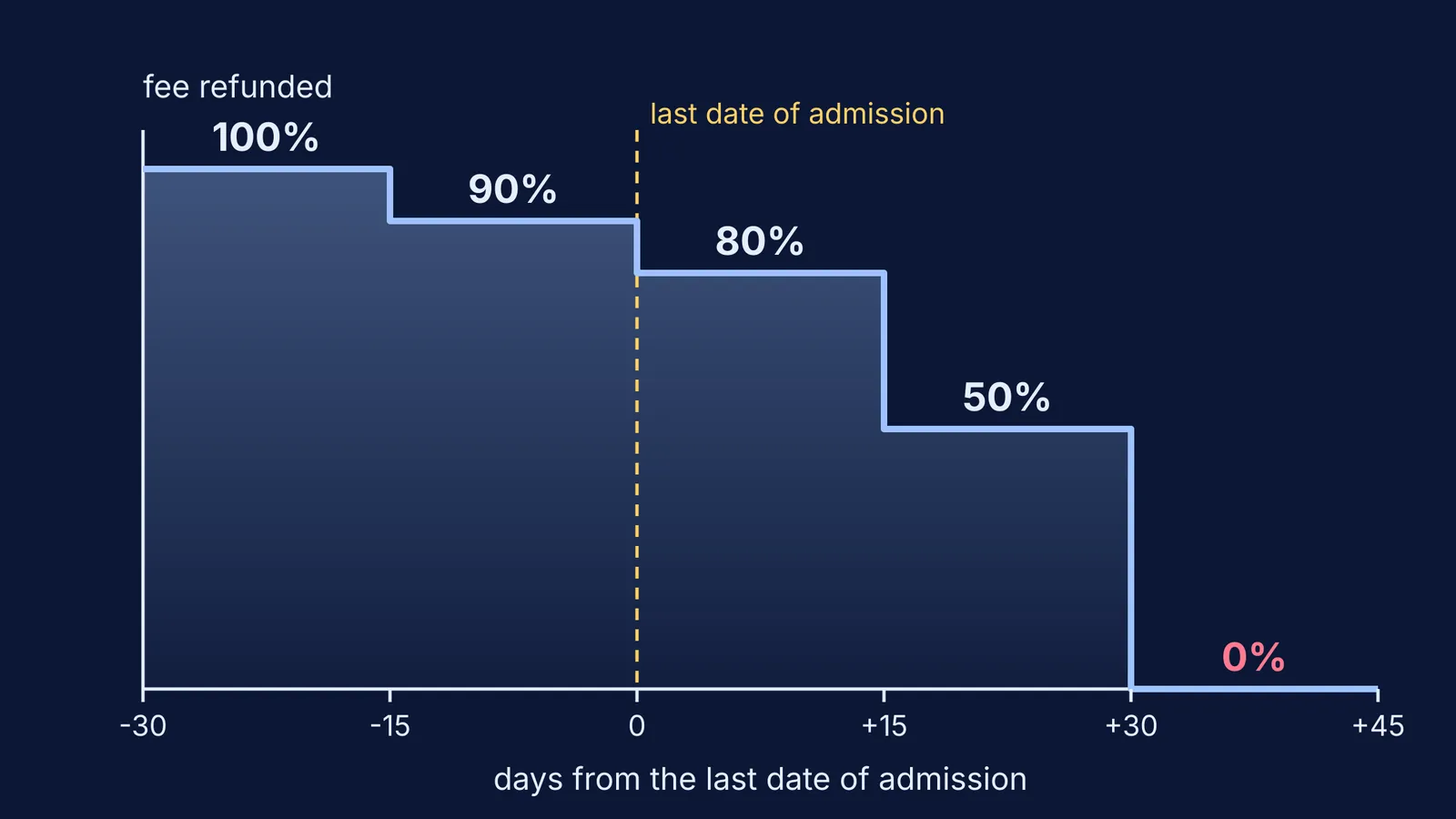
For admission schedules that run past 31 October, the UGC's October 2018 notification on refund of fees applies. It counts from the formally notified last date of admission, using the date your notice reaches the college:
15 days or more before the last date: 100%, minus processing charges of up to 5% of fees, capped at ₹5,000
Less than 15 days before: 90%
Up to 15 days after: 80%
16 to 30 days after: 50%
More than 30 days after: nothing
The same notification says caution money and security deposits are not fees and must be refunded in full. Colleges must pay within 15 days of receiving a written application, and may not keep your original certificates.
How much would you get back in practice?
Say a programme's last date of admission is 30 November, and you paid ₹80,000 in fees plus a ₹10,000 caution deposit (a made-up case). Applying the 2018 UGC scale:
Notice received 10 November (20 days before): at least ₹76,000, since processing is capped at 5%.
Received 20 November (10 days before): 90%, ₹72,000.
Received 10 December (10 days after): 80%, ₹64,000.
Received 25 December (25 days after): 50%, ₹40,000.
Received 5 January (36 days after): ₹0.
In every case the ₹10,000 caution deposit comes back in full.
How does a JoSAA seat withdrawal refund work?
IIT, NIT and other JoSAA seats follow JoSAA's business rules, which are reissued each year. In the JoSAA 2025 FAQ, the seat acceptance fee was ₹30,000, or ₹15,000 for SC, ST and PwD candidates. A valid withdrawal got it back minus ₹7,000; a seat cancelled for failing eligibility or document checks lost ₹5,000. For NIT+ institutes, the partial admission fee paid at the end of round 6 was not refundable but was adjusted against the institute's fee.
The same FAQ says that to stay eligible for JEE Advanced the next year, you had to withdraw a confirmed IIT seat before the last round. State and medical counselling bodies set their own rules, so read the current information bulletin before you pay.
How do you request a fee refund from a college?
Use the college's withdrawal form, or write a letter if there isn't one.
Submit it by email and in person, and ask for a dated acknowledgement.
Attach the fee receipt, your admission number and bank details.
Note the date 15 days after they received it, the payment deadline in the UGC's 2018 notification.
You can adapt this script:
"I, [name], admission number [number], withdraw my admission to [programme] with effect from [date]. Under the UGC Fee Refund Policy, I request a refund of fees of ₹[amount] and my caution deposit of ₹[amount] within 15 days, as set out in the UGC notification of October 2018. Bank details are attached. Please acknowledge receipt."
If no refund arrives, go first to the college's grievance redressal mechanism, which the 2018 notification says must be available on its website and must address grievances within 30 days. The UGC's 2023 grievance regulations list delay or denial of a refund to a student who withdraws as a student grievance. Next, complain on the UGC e-Samadhaan portal, helpline 1800-111-656.
If you are giving up a seat to prepare again for JEE Main or JEE Advanced, Fermi's AI tutor can work out what you already know and build a plan for the session, so the first week back starts with a clear next step.