

On this page
A science birthday party works when every child has something to do with their hands every few minutes, and an adult stays close to the two risky items: balloons and slime. Here is a plan for six to ten year olds.
What science activities work for a birthday party?
Choose activities that show a result in under a minute, can be repeated, and need no heat or flame. These four pass that test:
Balloon rockets: a balloon taped to a straw zips along a string. NASA's Jet Propulsion Laboratory runs this as a classroom lesson on Newton's third law, where the balloon travels in the opposite direction to the escaping air, the same way a rocket does.
Oobleck or slime: stretchy and squishy, and usually the station children remember most.
Colour mixing: cups of red, yellow and blue water, droppers and a white tray.
Fizz: baking soda and vinegar in a bottle with a balloon stretched over the neck.
Is slime safe for a kids' party?
It can be, if you control what goes into it. Many classic slime recipes use a borax or boric-acid activator, and the concern is boron. When the UK consumer group Which? tested 13 toy slimes and putties in December 2018, more than 40% failed the EU toy safety standard (EN 71-3), which requires boron in toy slime to stay below 300 mg/kg. Which? notes that excessive boron could cause irritation, diarrhoea and vomiting in the short term.
Three ways to keep this station safe:
Skip borax and make oobleck instead: cornflour stirred into water until it is thick, plus one drop of food colour. It flows when tilted and goes firm when poked hard.
If you do use a borax recipe, an adult mixes the activator out of the children's reach and only hands out the finished slime.
Everyone washes their hands at the end, slime stays away from mouths, and any child with a cut or sore skin on their hands plays with oobleck.
Are balloon rockets safe for six to ten year olds?
The risk is uninflated and burst balloons, not fully inflated ones. The US Consumer Product Safety Commission's balloon safety alert says that, of all children's products, balloons are the leading cause of suffocation death, according to its injury data. It recommends that children under eight do not play with uninflated balloons without supervision, and that if a balloon breaks you collect the pieces straight away and dispose of them out of reach of young children.
At the rocket station, that means:
An adult or a hand pump inflates every balloon. Children never blow them up.
Burst pieces go into a tin with a lid, which you empty into the outdoor bin.
Uninflated balloons stay in an adult's pocket, not on the table.
Our explainer on how a balloon rocket moves gives the reason in two sentences.
How do you run science stations without a huge mess?
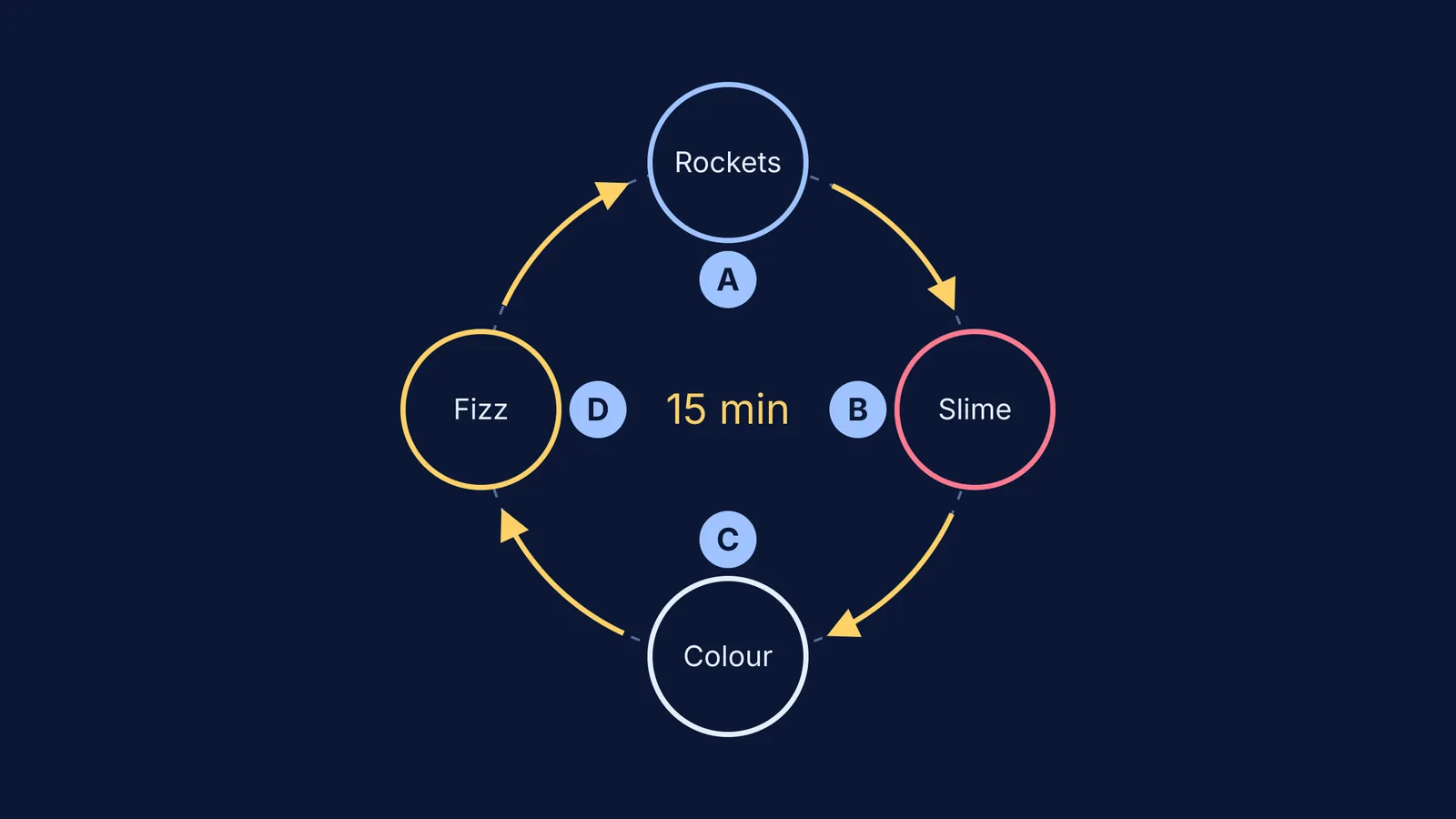
Split the guests into four groups, A to D, of two or three children each. Each group spends fifteen minutes at a station and moves clockwise when you ring a bell. Four rounds take about an hour, which is about right before cake.
Set up the mess kit before anyone arrives:
An old bedsheet or newspaper under every table, with the slime and fizz stations on a balcony or near a sink.
One tray per child, so spills stay inside the tray.
Old T-shirts as aprons. Mention in the invitation that food colour can stain hands and clothes for a day.
A wet cloth, a bucket and a bin bag taped to the edge of each table.
Food colour only from a dropper an adult controls, one drop at a time.
What happens at each station:
Rockets: two strings across the room, so two children can race. Ask what happens with less air.
Oobleck or slime: each child gets a zip bag to take theirs home.
Colour mixing: children predict the new colour before every drop. Our guide to colour mixing experiments for young children has more rounds for the youngest guests.
Fizz: children spoon baking soda into the balloon through a funnel, and an adult stretches it over a bottle of vinegar. Everyone at this table wears goggles or sunglasses.
Ask other parents or an older cousin to stay, so each station has one adult.
What do you say to keep children curious?
Use the same three questions at every station:
Before: “Guess what will happen. Thumbs up if it goes far, thumbs down if it flops.”
During: “What did you change? What happened?”
After: “Why do you think it did that?” Accept any answer. Guessing is the point.
If your child is still asking why a week later, the Fermi Simulation Lab has interactive simulations for ideas that are easier to see than to read, and you can explore them together.
If your child wants a bigger, more expensive party, our post on what to do when a child wants an expensive birthday party suggests how to talk it through.


