

On this page
The Class 10 trip circular has come home, and the dinner-table question is whether the boards can spare three days. Here is how to weigh it, and a plan that protects the syllabus.
What does a child gain from a school trip?
The best evidence comes from residential and outdoor programmes, close cousins of the school trip. A 1997 meta-analysis in the Review of Educational Research pooled 96 studies of adventure programmes and found an average effect size of 0.34 at the end of the programmes, on outcomes such as self-concept, locus of control and leadership (Hattie, Marsh, Neill and Richards, 1997). In contrast to most education research, the gains grew further after the programmes ended, by an extra effect size of 0.17 at follow-up. Effects varied by programme and were larger for longer programmes and older participants. These were adventure programmes such as Outward Bound, not school trips.
A UK evaluation of school residential trips, called Learning Away, surveyed students after their trips and again later (Learning Away evaluation by York Consulting, 2015). In that evaluation, 87% of secondary students said they had felt more confident to try new things. 84% said they got on better with the other pupils in their class, and 79% said the trip made them realise that what they learn at school is important to them. These are students' own reports, not marks, so treat them as a signal.
In a board year, friendships, confidence and a reason to care about school are not soft extras.
Will missing study time hurt board exam marks?
Work out what the trip actually costs before deciding. A Friday-to-Sunday trip usually takes two or three evenings of self-study out of a year with hundreds of them. If the whole section goes, ask the class teacher whether any new teaching falls on those days, and whether your child will miss coaching or tuition.
The bigger risk is the tired week after. Teenagers aged 13 to 18 should sleep 8 to 10 hours per 24 hours on a regular basis, according to the American Academy of Sleep Medicine (Paruthi et al., 2016). Trips rarely allow that, so plan a recovery evening rather than a cram night.
There are good reasons to say no or not yet:
The trip falls just before pre-boards, practicals or a project deadline. Mark it on a board exam year calendar for parents first.
Your child is already far behind and the gap is making them anxious.
The cost strains the family budget. Here is how to say no to an expensive school trip without guilt.
How do you plan study before and after the trip?
A 2013 review of ten study techniques rated practice testing and distributed practice (spreading study over time) as high utility, and rereading and highlighting as low utility (Dunlosky et al., 2013). Students who tested themselves on prose passages remembered more after two days and after one week than students who restudied, even though restudying made them feel more confident (Roediger and Karpicke, 2006).
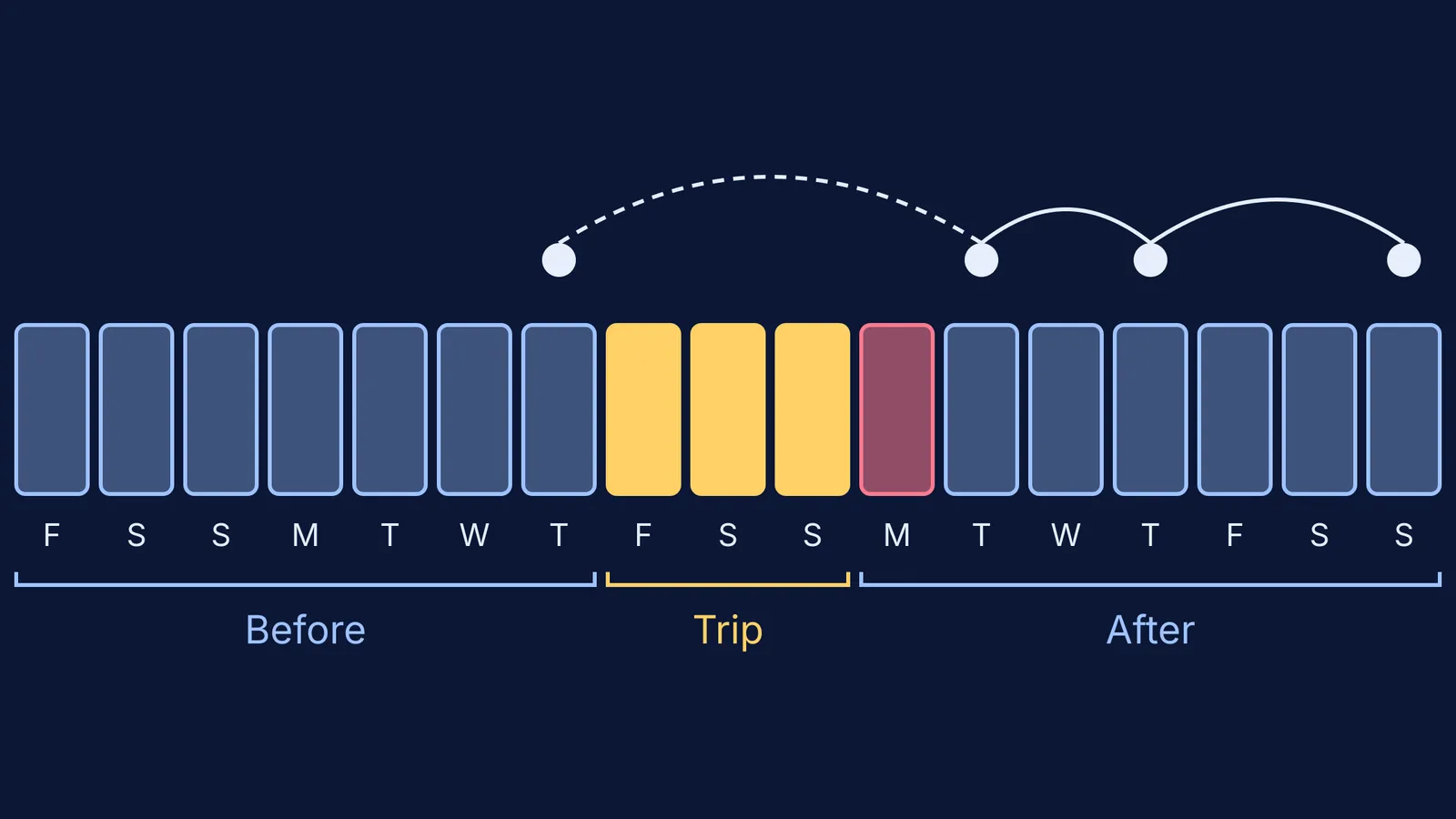
Here is a worked plan for a trip from Friday to Sunday.
The week before
Add 30 minutes on four evenings to cover the work the trip evenings would have held.
Ask the teacher or a friend which topics come next and skim their first pages.
On Thursday, do a 20-minute closed-book self-test on the week's chapters and write every question you missed on one sheet.
Pack no books.
During the trip
No studying. Sleep when the lights go out.
On the way home, note three things you saw that link to the syllabus, such as a river's meanders or how a monument's arches carry weight.
The week after
Monday: early night, and only 30 minutes of answering the missed-questions sheet from memory.
Tuesday: closed-book recall of the pre-trip chapters; copy notes for any missed periods.
Thursday: a second self-test with mixed questions from those chapters.
Sunday: one timed section of a sample paper.
If a coaching week was missed too, follow these steps to help your child recover after missing a week of coaching. If the backlog feels shapeless, Fermi's AI tutor can work out what you already know and build a plan for the session, so the first evening back starts with a clear next step.
What should parents say about the trip?
Decide together and early, with a script like this:
"I want you to go. Before we pay, let's write down how you'll keep up the week before and the week after."
"If you'd rather stay back, that's fine too. Tell me why, and we'll plan something you'll enjoy after the boards."
"If we say no this time, it's because of the dates or the money, not because we don't trust you."
If the trip question comes with tears, sleeplessness or a lot of worry about exams, talk to the school counsellor. Tele MANAS, the Government of India's free, 24x7 mental health helpline, is on 14416 (Tele MANAS helpline details).
Sign the form, pin the plan to the fridge, and let them go.


