On this page
Two months of late nights do not undo themselves on the first day of school. A simple fix is a seven-day plan that moves three things together: sleep, a little revision, and the practical kit.
How early should you start shifting your child's sleep?
Start at least a week before school reopens. The Children's Health Sleep Center in Dallas advises making bedtime 15 minutes earlier every night, and wake time 15 minutes earlier every morning too, starting at least a week or two before the first day. National Jewish Health recommends the same 15-minute step, begun a few weeks before school.
Small steps help because a sudden two-hour jump can mean lying awake at the new bedtime and dragging through the first mornings.
The American Academy of Sleep Medicine recommends 9 to 12 hours of sleep for children aged 6 to 12 and 8 to 10 hours for teenagers aged 13 to 18 (Paruthi et al., Journal of Clinical Sleep Medicine, 2016).
What does a one-week sleep shift look like for a 14-year-old?
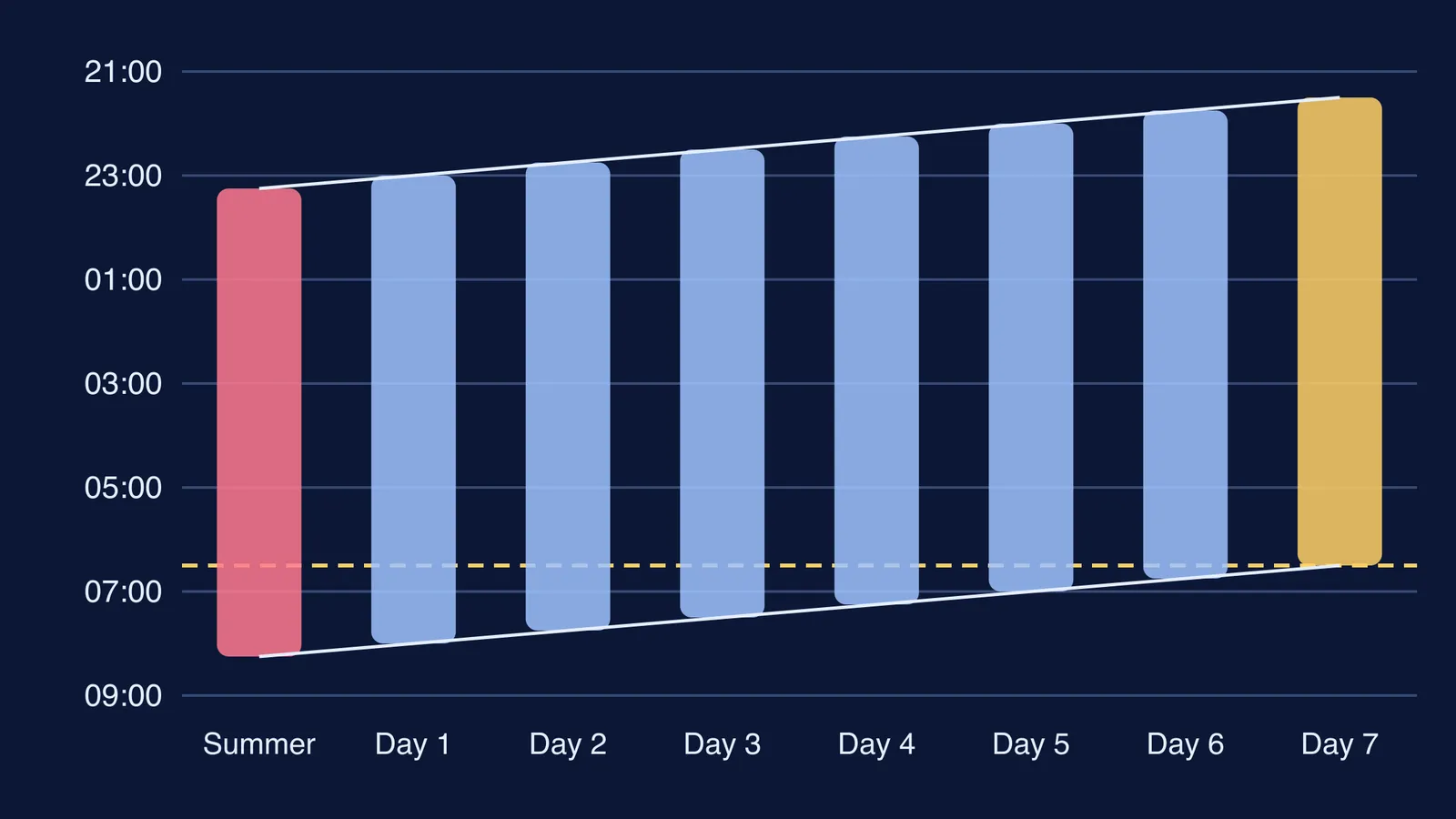
Say your child has been sleeping from 11:15 pm to 8:15 am, and school needs them up at 6:30 am. Nine hours sits inside the 8-to-10-hour range, so the target is 9:30 pm to 6:30 am. That is 1 hour 45 minutes, or seven 15-minute steps.
Day 1: bed 11:00 pm, up 8:00 am
Day 2: bed 10:45 pm, up 7:45 am
Day 3: bed 10:30 pm, up 7:30 am
Day 4: bed 10:15 pm, up 7:15 am
Day 5: bed 10:00 pm, up 7:00 am
Day 6: bed 9:45 pm, up 6:45 am
Day 7, the night before school: bed 9:30 pm, up 6:30 am
Treat the wake time as the anchor and keep to it even after a restless night. The Children's Health guidance also suggests turning off electronics and dimming lights at least two hours before bed. It says children should not have caffeine at all, and teenagers who do should have none after noon, including tea, coffee and soda.
What should my child revise before school reopens?
Not the new syllabus. Go back over last year's basics that this year builds on: tables and fractions for younger children, algebra and the core science chapters for Class 9 and above.
A review of 39 studies found that test scores drop over the summer break, and a meta-analysis of 13 recent ones put the loss at about one month on a grade-level scale, with maths hit harder than reading (Cooper et al., Review of Educational Research, 1996). That research is from US schools; our post on what the research says about summer learning loss goes into it further.
Self-testing beats rereading. In a 2006 study, students who took recall tests on prose passages remembered substantially more on delayed tests than students who simply restudied them, even though the restudiers felt more confident (Roediger and Karpicke, Psychological Science).
A 20-minute daily routine:
Pick one chapter from last year.
Close the book and write down everything your child remembers for five minutes.
Open the book, mark what was missing, and do three or four questions on just that part.
Start the next day by recalling yesterday's gaps before moving on.
If a gap turns out to be a whole idea rather than a forgotten formula, the Fermi Concept Library has a lesson for every concept in physics, chemistry, biology and mathematics, so your child can rebuild it first.
How do you get books, bag and uniform ready without a last-night rush?
Spread the jobs across the same week so Day 7 is quiet:
Day 2: try on uniform and shoes; note what no longer fits.
Day 3: check the school's book list; order missing books and notebooks.
Day 4: buy or repair what is needed; cover and label books.
Day 5: pack the bag for the first day's timetable; check ID card, diary and water bottle.
Day 6: a trial morning at the new wake time, in uniform.
Day 7: lay out the uniform and keep the bag by the door.
Let your child do the packing; our night-before bag routine keeps that habit going all term.
What can you say if your child resists the plan?
Offer choices inside the plan, not a vote on it. You could try:
"We're moving bedtime a little earlier each day so the first morning doesn't feel awful. You pick which chapter we revise first."
If late nights creep back once term starts, use our one-week plan for a child who naps after school and studies late.
If worry about going back looks bigger than first-day nerves, such as many nights of poor sleep, stomach aches every morning or refusing to go, talk to your child's doctor or school counsellor. Tele MANAS, the Ministry of Health and Family Welfare's free 24x7 mental-health helpline, is on 14416 or 1800-891-4416 (details via IIT Kanpur's counselling service).
Start with tonight's bedtime: one small step earlier is enough to begin today.