On this page
Most problems at school are fixed fastest by the person closest to them. The class or subject teacher sees your child every day, knows the context, and can often sort out a marking error, a seating clash or a homework mix-up in one conversation. Going over their head first usually slows things down. Some problems should not wait, though, and knowing which is which is most of the skill.
When should you complain to the school principal?
Straight away, if your child's safety or dignity is at stake. That covers physical punishment, humiliation by staff, bullying that keeps happening, an injury nobody told you about, or any hint of abuse. Section 17 of the Right of Children to Free and Compulsory Education Act, 2009 states: "No child shall be subjected to physical punishment or mental harassment." If something may be a crime, contact the police as well; the school is not the only place you can go.
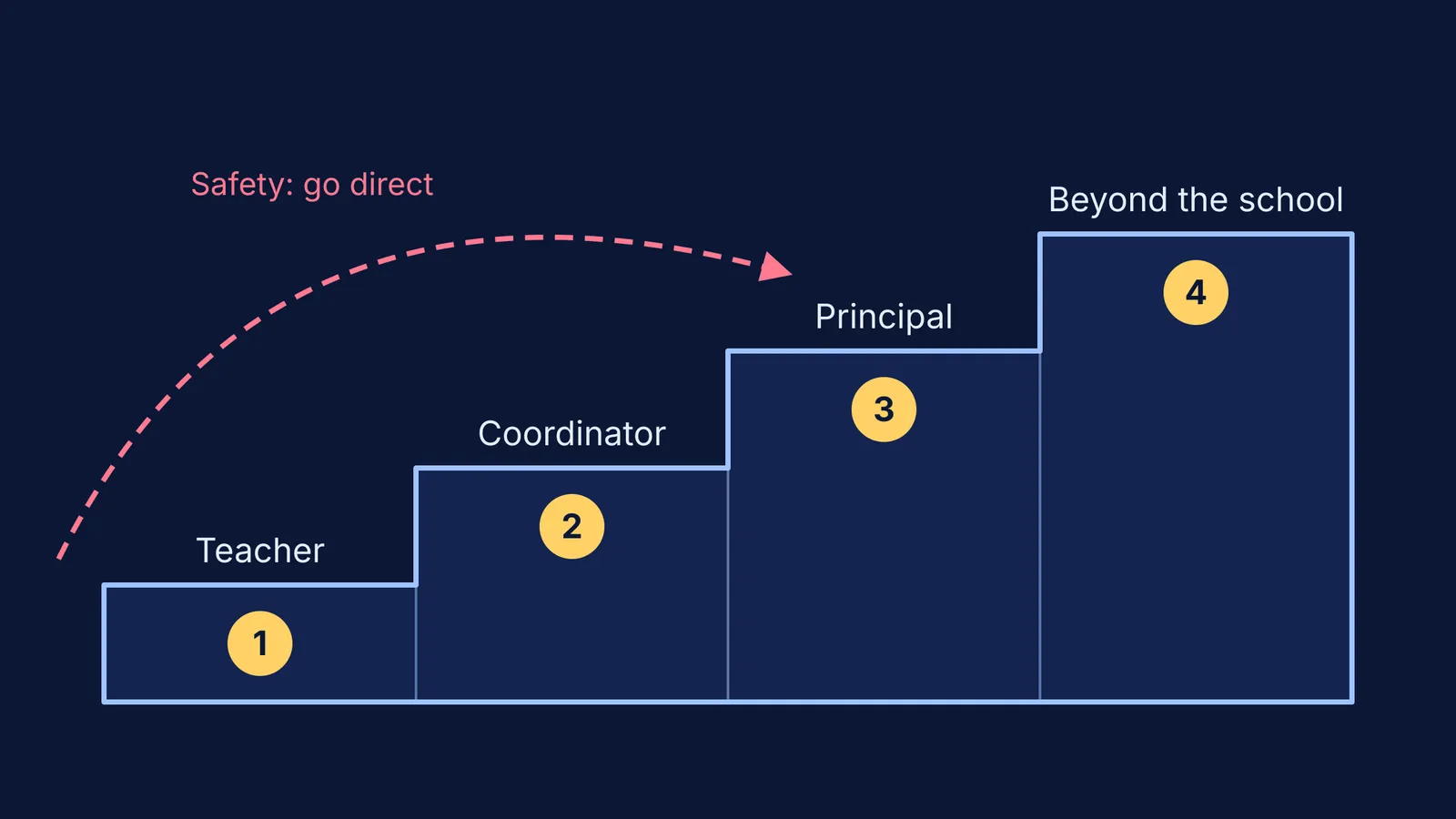
After the ladder, for everything else. Marks, homework load or a clash with a teacher's style go to the teacher, then the coordinator, and reach the principal only if neither has fixed it.
What is the right order to escalate a school concern?
Class or subject teacher. Ask for a short meeting or send a brief note. If you are unsure how to word it, our template for emailing the class teacher keeps it short and polite.
Coordinator or section head. Go here if the teacher does not reply or nothing changes. For worries about mood or friendships, the school counsellor may be the better second step.
Principal. Write, do not just turn up. Attach or summarise what you already raised and with whom.
Beyond the school. Private schools usually have a management or trust above the principal. Government and aided schools must have a School Management Committee in which "at least three-fourth of members" are parents or guardians, under Section 21 of the RTE Act. For a grievance about a child's rights under that Act, Section 32 lets anyone with a grievance complain in writing to the local authority, which must decide within three months; an appeal then lies with the State Commission for Protection of Child Rights or another prescribed authority.
Bullying has its own route. A CBSE circular from March 2015 suggests schools set up an Anti-Bullying Committee and display its members' names and contact numbers in the school, and says parents should be encouraged to report bullying in confidence. See also what to do when a child is afraid to tell the teacher about bullying first.
How do you keep a complaint factual?
A principal has to be fair to the teacher too, so dates and documents move faster than adjectives. Before you write, put these on one page:
What happened, with dates.
Who was involved, by role.
What your child told you, written as "my child said", not as settled fact.
Evidence you have: the answer sheet, the diary note, the message.
Whom you already asked, when, and what they said.
The one thing you want to happen next.
Here is the same concern written two ways.
Feelings first: "The maths teacher is always unfair to my son and nobody in this school cares."
Facts first: "On 3 and 10 October, Aarav lost marks on two maths tests for working that matches the answer key. I wrote to the class teacher on 11 October and have not had a reply. Could the coordinator look at both papers with us this week?"
The second gives the school something to check. For marking disputes, see our guide on what to do when a teacher makes a mistake in correction.
What should you say to the principal?
Keep it to five or six sentences. A script you can adapt:
"Dear Principal, I am writing about [child's name], Class [X], Section [Y]. On [date] [what happened]. I raised this with [teacher] on [date] and with [coordinator] on [date], and [what they said, or that there was no reply]. I have attached [evidence]. I would like [one specific outcome]. Could we meet, or could you let me know the next step by [a reasonable date]?"
In the meeting, hear the school's account before you respond, take notes, and end with: "Who will do what, and when will we hear back?" Students can send the same note themselves.
If the root problem is a subject your child has fallen behind in, you can help without waiting for the school. Fermi's AI tutor works out what your child already knows and builds a plan for the session, so the catching up starts while the conversation with the school carries on.
If the situation has left your child anxious, low or unwilling to go to school, talk to the school counsellor or a doctor. You can also call Tele MANAS on 14416, the government's toll-free mental health helpline.
Start at the lowest step that can fix the problem, write down what happens, and move up only when you have to.