

On this page
Your child studies hard, understands the concept, but brings home a test paper with a lower score than expected. Upon closer look, you spot an obvious mistake: a totaling error, or a correct step that was marked wrong.
Grading mistakes happen, but addressing them can feel tricky. You want the correct grade for your child, but you also want to maintain a good relationship with the teacher.
Are grading mistakes common?
Yes. Teachers mark hundreds of assignments under tight deadlines, and errors are a normal part of the process.
A 2024 report by the Equitable Grading Project, which analysed over 33,000 middle and high school course grades, found that nearly 60% of grades were inaccurate when compared to the student's mastery on standardized tests (Crescendo Education Group, 2024). While this includes structural issues like grade inflation, it highlights that grades are not always a perfect reflection of knowledge.
Simple calculation and checking errors are also frequent. In India, formal correction processes are heavily used because these mistakes happen so often. During the 2024 CBSE Class 12 board exams, approximately 1.68 lakh students applied for verification and re-evaluation of their marks (Hindustan Times, 2024). Many of these students saw their marks increase simply because an answer was overlooked or incorrectly totalled.
When should you let your child ask first?
If your child is in primary or middle school, you will likely need to send an email to the teacher. However, if your child is in Class 9 or above, this is an excellent opportunity to let them take the lead.
Advocating for themselves teaches teenagers how to resolve conflicts professionally. You can help them prepare what to say, but letting them approach the teacher builds independence. A teacher is also much more likely to be receptive to a student who takes ownership of their learning.
How should you prepare the evidence before speaking?
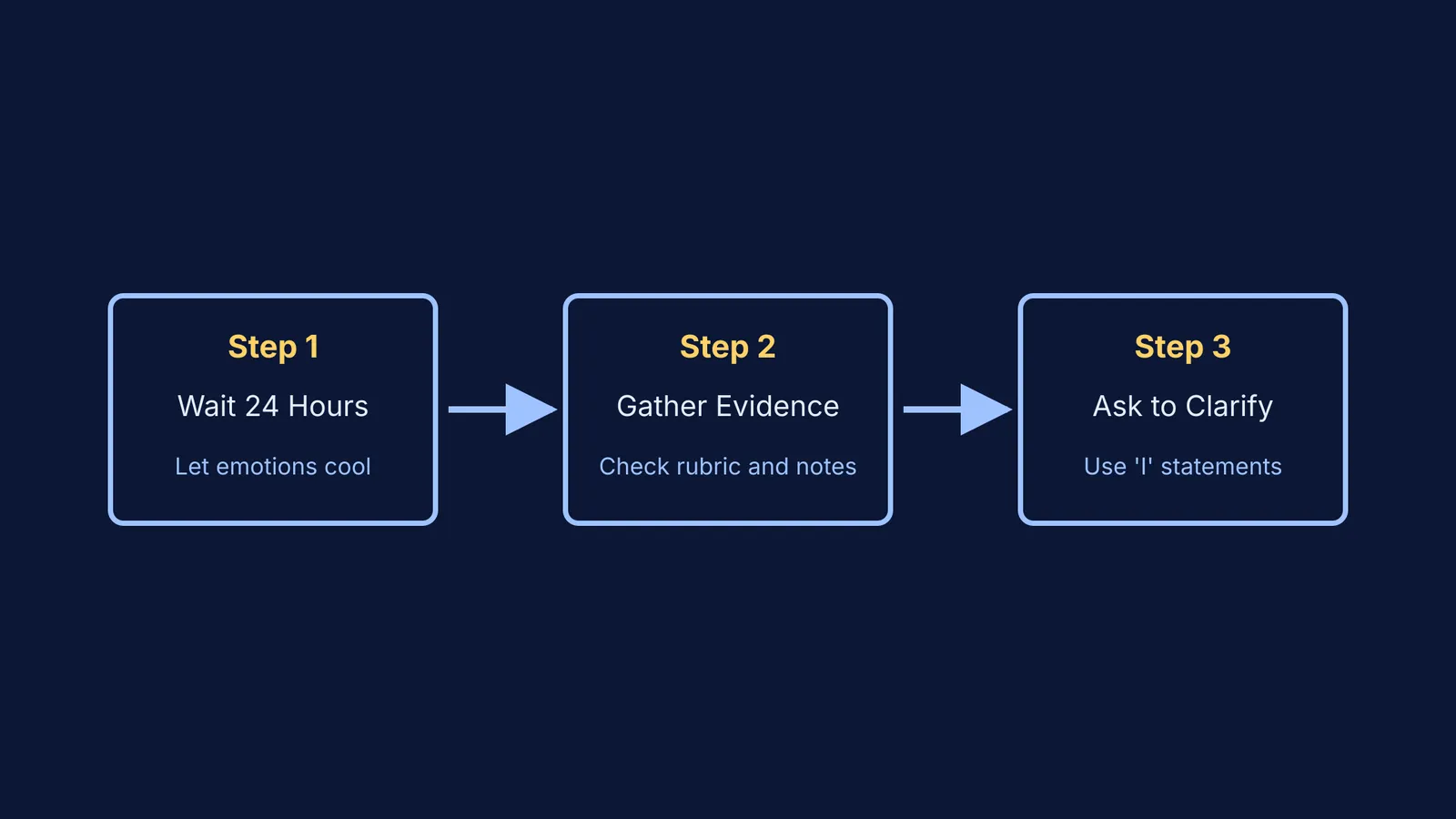
Before sending an email or speaking to the teacher, follow these three steps to ensure you have a strong, objective case.
Wait 24 hours: If the grade feels unfair, emotions might run high. Waiting a day ensures the conversation remains calm and objective.
Review the rubric: Sometimes, a mathematically correct final answer loses marks because a specific method was required by the syllabus. Check the assignment instructions to be certain an error occurred.
Pinpoint the exact mistake: Be ready to show exactly where the discrepancy is, whether it is an addition error or a correct formula that was marked wrong.
If you are unsure whether your child's method was actually correct, try entering the question into the Fermi Problem Library. It has worked problems with a step-by-step solver that explains the reasoning rather than printing an answer, allowing you to verify the logic before speaking to the teacher.
What to say to a teacher about a grading mistake?
The most effective way to address a grading mistake is to frame it as a request for clarification rather than an accusation. Teachers are much more receptive when they do not feel attacked.
Instead of saying, "You marked this wrong," use "I" statements. Ask the teacher to help you understand the feedback.
A script for parents
If you are emailing on behalf of a younger child, keep it brief and supportive:
*Dear [Teacher's Name],* *We were reviewing [Child's Name]’s recent maths test last night and noticed a possible discrepancy in the totaling on page two. It appears the points add up to 45 rather than 35. Could you please take a look when you have a moment to see if this was a simple oversight? We appreciate your help and all your dedication to the class.*
A script for students
If your teenager is approaching the teacher, they should focus on learning:
*Dear [Teacher's Name],* *I was looking over my physics test to see where I went wrong. On Question 4, I used the method we discussed in class, but I lost marks. I want to make sure I understand this before the final exam. Could you help me understand where my mistake was?*
This approach gives the teacher space to either explain a nuance the student missed, or gracefully correct the error.
For more advice on guiding your child through academic challenges, read about What To Do When Your Child's School Physics Teacher Is Weak or learn how to Use AI to Understand Mistakes, Not Get Answers.


