On this page
The call usually comes in Class 9 or Class 11. A teacher suggests your child would cope better with open schooling and hands you a form. Sometimes that is honest advice; sometimes it is about the school's board result. Either way, you can ask questions before you sign anything.
Why do some schools push low scorers out before boards?
Every student a school sends for the board exam counts towards its result, and a student it expects to fail lowers that figure. Shifting the student to an open school before the school sends CBSE its list of exam candidates takes them out of the count.
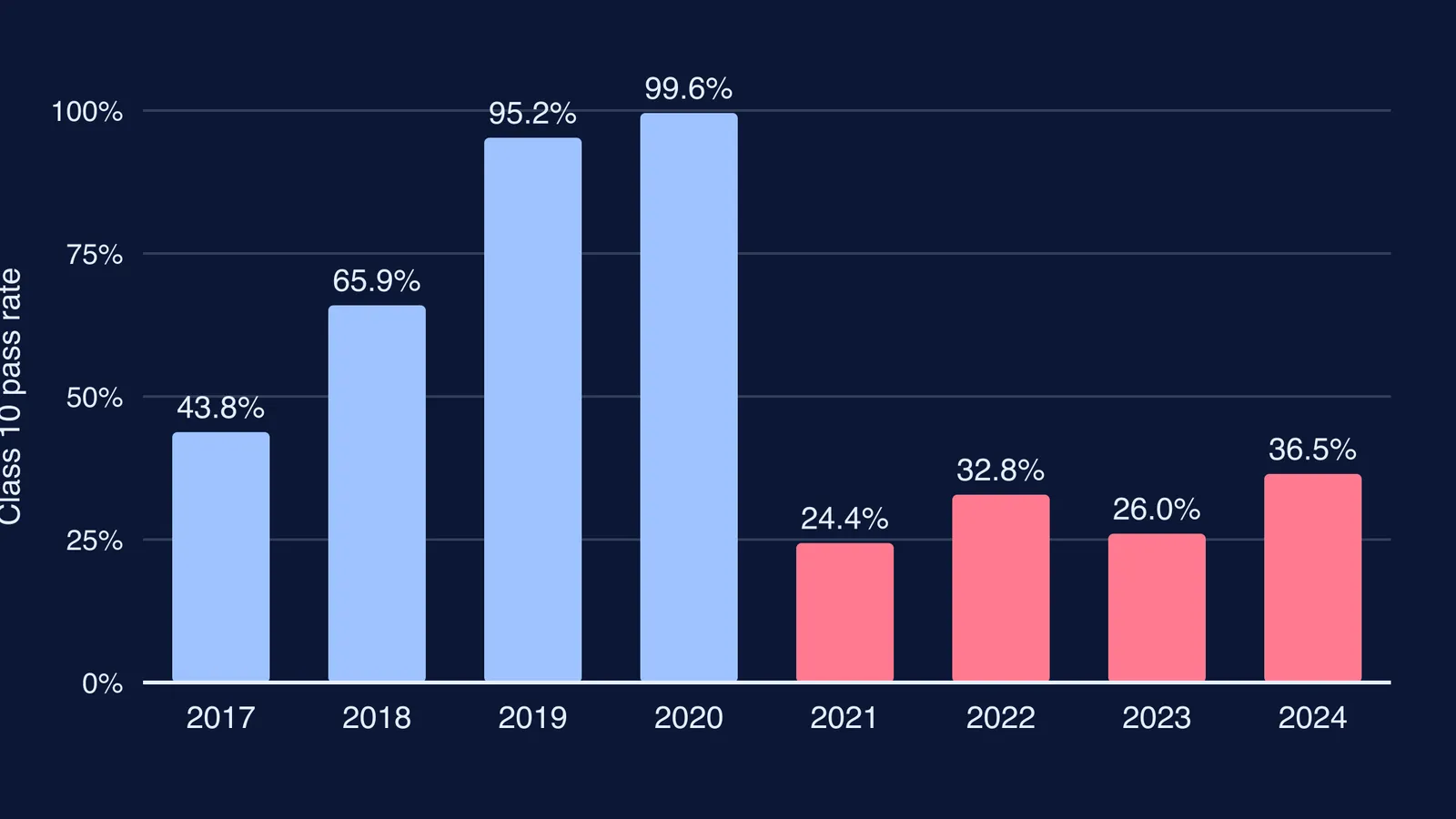
Under the Delhi government's NIOS Project, students who fail Classes 9 and 10 and academically weaker students are registered with the National Institute of Open Schooling, according to RTI data obtained by PTI and reported by Careers360. In 2023, 7,658 of the 29,436 students registered passed Class 10. Over the last four years, an average of 70% of those who took the Class 10 exam failed. An unnamed government school teacher quoted in the report said principals enrol weak students in NIOS to improve their school's Class 10 results, and that teachers do not hold classes for academically weaker students.
In June 2026, Delhi's Directorate of Education told school heads to list students who had failed Class 9 two or three times and to invite them and their parents in for counselling. The directive says schools should encourage these students to continue in regular school, and guide them towards NIOS only if families decline.
What do CBSE registration rules protect?
Before Classes 10 and 12, each school sends CBSE a List of Candidates (LOC): the students it will send for the board exam.
CBSE's LOC circular for the 2027 exams, dated 17 September 2026, says only students whose names are submitted in the LOC may sit the Class 10 and 12 board exams in 2026-27. It tells principals to make sure that "no bonafide student's name is left unsponsored."
The same circular quotes para 14.2.5 of CBSE's Affiliation Bye-laws 2018: every affiliated school must regularly sponsor its bona fide, eligible students, or inform CBSE in writing, with reasons, if it does not.
The limit is eligibility: sponsored students must attend regularly, meet CBSE's minimum attendance norms and be eligible under its Examination Bye-laws.
When does NIOS really fit?
According to the NIOS evaluation rules, public exams are held twice a year, in April-May and October-November. A learner gets nine chances to sit them over five years. Passed subjects are saved until the learner completes the certificate, and credit for two subjects passed with certain other boards can be transferred.
That flexibility can suit a self-driven student who is training for a sport, recovering from a long illness or needs their own pace. A student who needs a teacher every day should ask who will provide that teaching: the Delhi results show how badly open schooling can go when that support is missing. Our guide to NIOS for Class 12 JEE or NEET aspirants covers the higher-stakes case.
What should you ask before you agree to anything?
Take these to the meeting, and do not sign a withdrawal or transfer form on the spot.
Is my child eligible for the board exam under CBSE rules? If not, which rule applies? Please put it in writing.
Which marks and attendance records is this based on? May I have copies?
What extra help will the school give before the LOC is filed: remedial classes, a re-test, a subject teacher's plan?
If we choose NIOS, who will teach my child, where, and how many hours a week?
Can my child return to this school for Class 11 after passing Class 10 with NIOS?
A script you can use: "We will consider every option. Please share the reason and the school's support plan in writing, and we will reply within a week."
If you get no written answer, read our guide on when to complain to the principal and how to escalate. If your child sits the exam and does not pass, there is still a route as a CBSE private candidate.
What if the marks really are the problem?
Check whether the marks come from a few weak chapters. A four-week plan:
Week 1: list the three chapters that cost the most marks in the last two tests.
Week 2: rebuild the basic concepts of the first chapter before doing more practice questions.
Week 3: do the same for the second and third chapters, and try past-paper questions.
Week 4: sit one timed paper at home and compare it with the school test.
If the gaps are in maths or science, the Fermi Concept Library gives every concept in physics, chemistry, biology and mathematics its own lesson, so your child can rebuild one chapter at a time.
Being told to leave can hurt. If your child seems low for weeks, talk to a counsellor or call Tele MANAS, the toll-free government helpline, on 14416 or 1800-89-14416.
Ask for the reason in writing first. Then decide.