On this page
If your child takes a bus for 60 to 90 minutes each way, that travel time eats directly into their rest. In city traffic, where a 2017 circular from the Central Board of Secondary Education (CBSE) mandates that school buses cannot exceed 40 km/h, even moderate distances take a long time to cross (Source). The frequent stops required to pick up other children only extend the journey further.
The connection between travel and tiredness is direct. A 2019 study published in the *Journal of Planning Education and Research* found that for every additional minute a student spends commuting, they lose an average of 1.3 minutes of sleep (DOI: 10.1177/0739456X17725148). This means a child with a 60-minute one-way commute could be losing over an hour of sleep a night compared to a child who lives next to the school.
The loss of sleep is not just about feeling drowsy; it affects learning directly. When a child sleeps, their brain consolidates the facts they learned during the day. If they are losing an hour of sleep every night because of a commute, their memory and attention span suffer. The commute also forces an early wake-up time, throwing the child's body clock out of sync and creating what researchers call "social jet lag." Furthermore, long passive commutes mean less physical activity; the same 2019 study noted that students with commutes longer than 30 minutes spent 1 hour and 15 minutes less per day exercising.
How should we adjust homework and sleep for a long commute?
When time is squeezed, the goal is to protect sleep and limit frustration. You cannot create more hours in the evening, so the remaining time has to be used deliberately.
Shift dinner earlier: Do not wait until 8:30 PM to eat. A heavy, late meal delays sleep and affects its quality. Serve a substantial snack or early dinner as soon as the child comes home, so they have energy to study and can go to bed earlier.
Move rote tasks to the morning: If the child is a morning person, move simple reading, vocabulary practice, or revision to the hour before the bus arrives. See our post on Morning or night study for how to work out their natural chronotype and use it to your advantage.
Do not let them get stuck on homework: A tired child can easily spend 45 minutes staring at a single maths problem, achieving nothing but frustration. If they are stuck for more than 10 minutes, they need a hint, not more staring. Fermi's AI tutor can work out what they already know and build a plan for the session, so they sit down to a clear next step instead of a blank page.
Use the weekend to catch up on concepts: Keep weekday homework strictly to the immediate school deadlines. Move deep learning, long-term revision, and building a study routine that lasts to Saturday and Sunday when they are well-rested.
What is a realistic evening schedule?
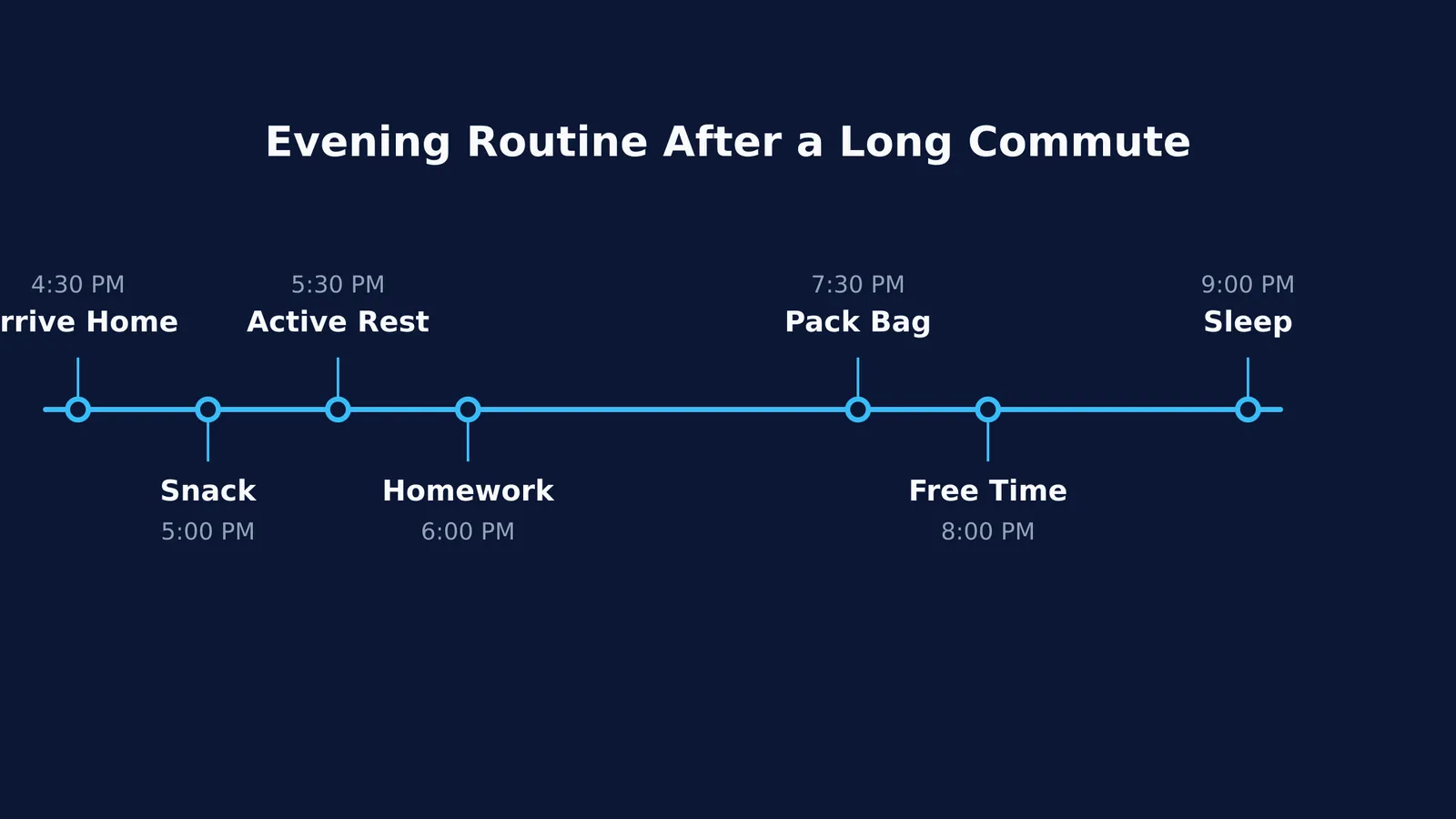
A framework helps keep the evening moving without arguments. Here is a baseline schedule for a child who gets home at 4:30 PM after a long ride:
4:30 PM: Arrive home. Take off the uniform, wash up, and step away from screens immediately.
5:00 PM: Early dinner or heavy snack (focus on protein and complex carbohydrates, avoiding sugary biscuits).
5:30 PM: Active rest or physical activity. Even 20 minutes of stretching or walking around the neighbourhood helps counteract the passive bus ride.
6:00 PM: Homework block. Tackle the most demanding and cognitively heavy tasks first while they still have some energy.
7:30 PM: Stop studying. Pack the school bag for the next day to avoid morning panic.
8:00 PM: Light reading, winding down, or family time.
9:00 PM: Sleep.
Can we change the commute itself?
Often, parents feel trapped by the bus route, but it is worth exploring alternatives. While you might not be able to change the physical distance to the school, you can sometimes shorten the time spent travelling.
Speak to the school's transport manager about the route structure. Sometimes a child is the first one picked up and the last one dropped off simply because of the direction the bus drives its loop. Requesting a route reversal every term can share the burden fairly among the students on that route.
If the bus ride is simply too long due to the number of stops, consider carpooling with nearby parents. A direct drive in a private car can often cut a 90-minute school bus ride down to a 40-minute direct trip, giving your child back nearly two hours of their day.
Adjusting to a long commute means accepting that your child has less free time than their peers. By protecting their sleep, restructuring their meals, and stepping in when homework stalls, you can stop the commute from entirely draining their energy.