

On this page
A marked test comes home. You can lecture about the total, or spend 20 minutes finding where the marks went. This routine suits Class 6 to 12. You need the paper and a blank sheet; your child holds the pencil.
What should you do before looking at the marks?
Spend the first three minutes away from the total. Ask which question felt hard and which one your child was pleased with, then have them read the teacher's comments aloud.
John Hattie and Helen Timperley's review The Power of Feedback concluded that feedback is among the major influences on learning, but that its impact can be either positive or negative, and that the type of feedback and the way it is given make a difference. A returned paper is already feedback; your job is to keep it the useful kind.
If papers are not reaching you at all, start with what to do when your child hides test marks.
How do you sort the lost marks on a test paper?
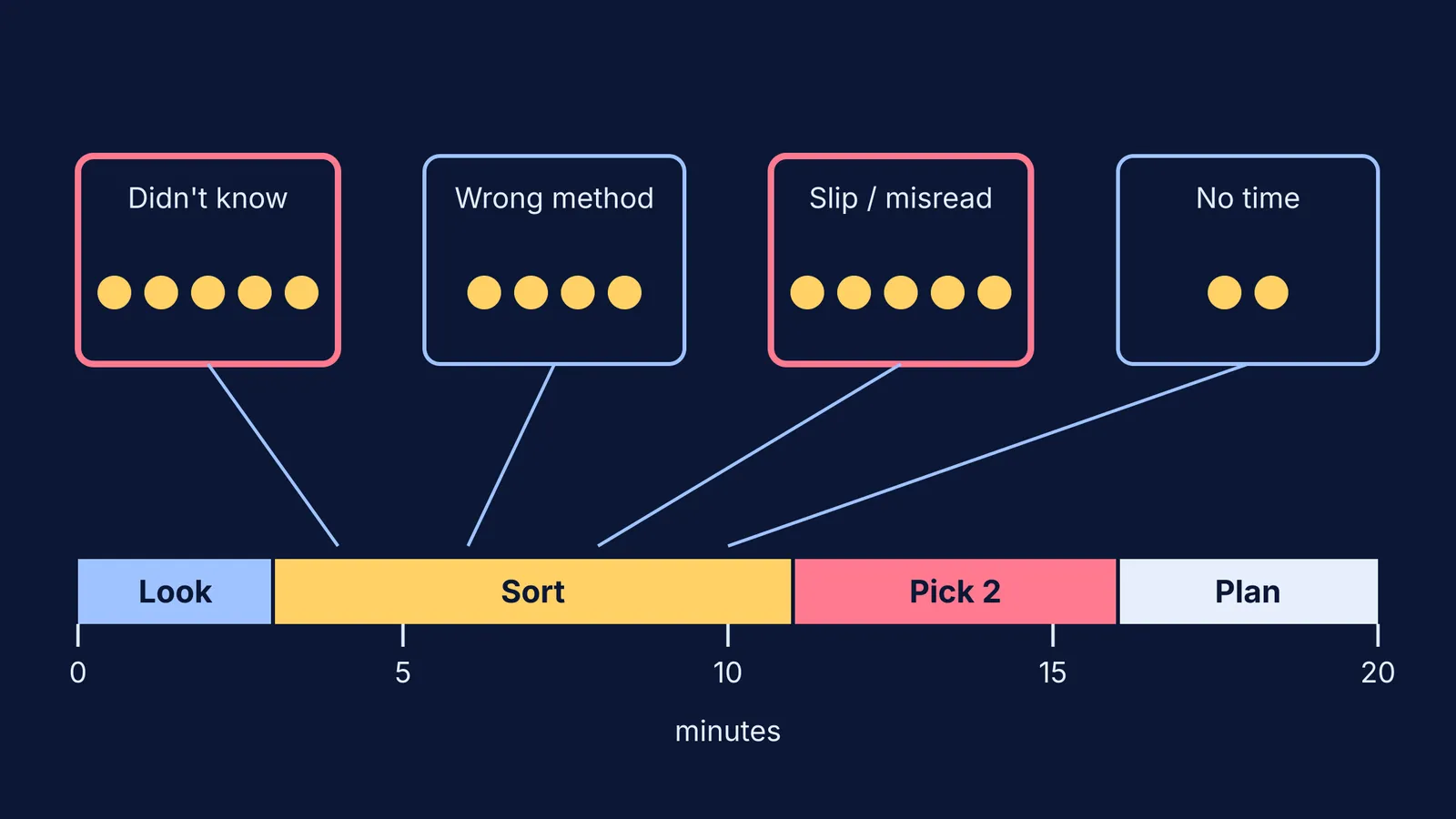
Minutes 3 to 11. Put every lost mark into a bin on the blank sheet:
Didn't know it. The idea or formula was not there.
Wrong method. Knew the topic but chose the wrong approach.
Slip or misread. Copied a number wrong, dropped a sign, or answered a different question.
Ran out of time. Left blank or rushed at the end.
Let your child choose the bin. One question settles most cases: "Could you do this one now, with no help?" If yes, it is a slip or a time problem; if no, it belongs in one of the first two bins.
Then ask which wrong answers they felt sure about. Janet Metcalfe's review Learning from Errors reports that errors made with high confidence are corrected more readily than low-confidence errors, and that corrective feedback, including analysis of the reasoning leading up to the mistake, is crucial. So for each sure-but-wrong answer, have your child point to the step where it went off.
For example, a Class 9 maths unit test scores 34 out of 50: 16 marks lost. After sorting:
Didn't know it: 5 marks, all on one probability question
Wrong method: 4 marks, a word problem set up the wrong way round
Slip or misread: 5 marks, two sign errors and one 27 copied as 72
Ran out of time: 2 marks, the last question left blank
The total says "34". The bins say 7 of the 16 lost marks came from things this child could already do.
Which two fixes should your child pick?
Minutes 11 to 16. Pick two fixes, no more: usually the biggest bin, plus one that is cheap to fix.
Didn't know it: reread that part of the chapter, then do a few similar questions this week.
Wrong method: redo it on blank paper, then compare each step with a correct solution.
Slip or misread: an exam habit, such as underlining what the question asks and checking signs and units on every last line.
Ran out of time: next test, note the time after each section and attempt questions in order of marks.
In the example, the two fixes are the slip habit (cheap, 5 marks) and basic probability (a gap that returns in later chapters).
For wrong-method marks, a step-by-step solver that explains the reasoning, such as the Fermi Problem Library, shows where your child's method parted from one that works; for didn't-know marks, the Fermi Concept Library has a lesson for each concept. Keep the marked paper, too: see how to revise with past class tests.
What should you not say when going through a test paper?
Minutes 16 to 20. Write the two fixes at the top of the paper and agree when each will happen.
In six studies, Claudia Mueller and Carol Dweck found that children praised for intelligence showed less persistence after failure, enjoyed the task less and performed worse than children praised for effort. So talk about the work, not how smart your child is. Swap these lines:
Instead of "How did you lose 16 marks?", try "Let's see where the 16 went."
Instead of "You're so clever, how could you get this wrong?", try "You can do this one now. What happened on the day?"
Instead of comparing with a classmate or cousin, compare with your child's own last test.
Instead of "You're just weak in maths", try "This bin is the biggest, so that's what we'll work on."
Then end with something that has nothing to do with marks.
When is it more than a test paper?
If your child cries, stops sleeping well, or talks about being worthless after results, the paper is not the main issue. Comfort first; the review can wait. See what to do when your child cries over low marks. If distress lasts, talk to the school counsellor or a doctor, or call Tele MANAS, the government's toll-free tele-mental health helpline, on 14416.
Next time a paper comes home, keep a pencil and a blank sheet ready, and start with the question your child liked.


