

On this page
Why do students repeat the same mistakes on future exams?
When a student brings home a graded unit test, the routine is familiar: they check the marks, compare scores with classmates, feel a momentary sting or relief, and shove the paper into their bag. Even when parents urge them to review mistakes, reading a teacher's red corrections produces what psychologists call a fluency illusion. Because the completed solution is visible, the child nods, assumes they understand it, and moves on.
In a comprehensive review in the Annual Review of Psychology, psychologist Janet Metcalfe showed that errors provide powerful learning opportunities only when followed by active corrective analysis. Merely looking over completed answers leaves students prone to repeating identical errors on upcoming exams. To break this cycle, families need to treat returned tests not as a final verdict, but as high-yield diagnostic material. As we explain in our guide on talking about failure at home, the way parents respond to red marks determines whether a teenager hides their test papers or uses them to build competence.
Why should children wait a week before redoing test questions?
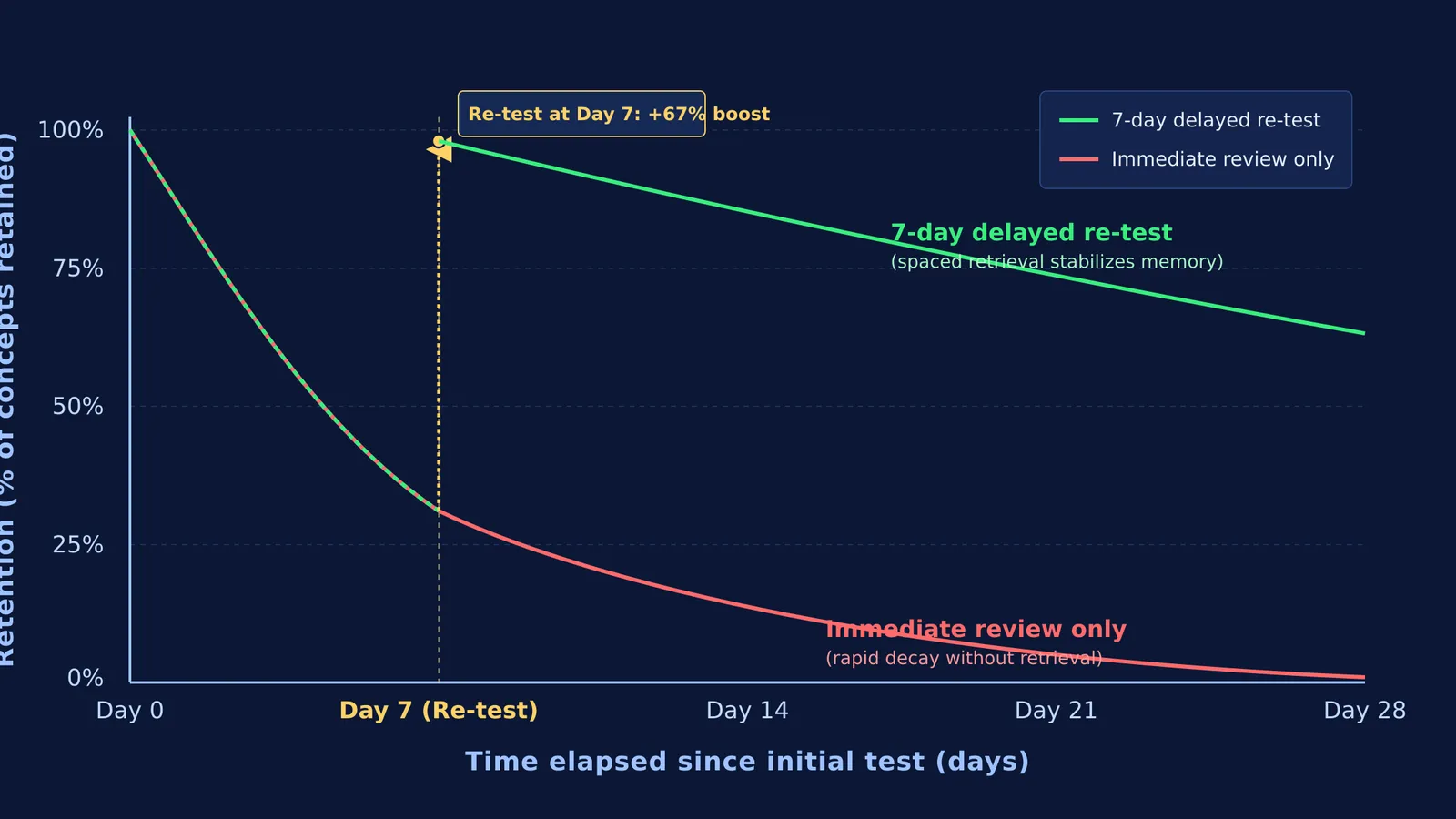
The natural instinct is to make a child rewrite incorrect answers the same evening a test comes home. However, cognitive science shows that immediate correction is surprisingly inefficient. When a student re-attempts a problem minutes after reading the model solution, they merely copy from short-term visual memory rather than retrieving knowledge from long-term memory.
In a study published in Memory & Cognition, cognitive psychologists Andrew C. Butler and Henry L. Roediger III demonstrated that introducing a delay in test feedback acts as a spaced learning event that substantially boosts long-term retention compared to immediate massed review. Spacing creates what cognitive scientists call a desirable difficulty: waiting seven days allows the superficial memory of the teacher's red ink to fade so solving the question requires genuine mental effort.
This spacing principle was tested across more than 1,350 individuals by Nicholas J. Cepeda, Harold Pashler, and colleagues in Psychological Science. They found that the optimal interstudy gap declined from about 20% to 40% of a 1-week retention interval down to 5% to 10% of a 1-year interval, averaging roughly 10% to 20% for typical school exam schedules. For an end-of-term exam scheduled weeks or months away, a seven-day gap between receiving a marked test and re-attempting its questions strikes the ideal balance: it allows working memory to clear while keeping foundational concepts accessible.
How do you turn returned school tests into a home revision bank?
You do not need complicated software or extra prep books to implement this technique. A single two-pocket folder and twenty minutes on a weekend are enough to create a reliable past-test revision routine.
Create a clean question bank. When a graded paper comes home, take a photocopy or write down only the question stems that lost marks onto blank index cards. The key rule: conceal the teacher's red corrections so your child faces an uncluttered question.
Run a three-minute error audit. Ask your child to classify each lost mark into one of three categories:
Concept gap: the child did not understand the underlying definition, theorem, or formula.
Process slip: the child understood the underlying concept, but made an arithmetic blunder or sign error along the way.
Misread stem: the child failed to notice a key instruction, such as missing the required units or overlooking negative phrasing.
Place questions in the seven-day holding pouch. File the clean cards in a folder labelled Next Saturday. Do not discuss the solutions again during the week, letting emotions cool and spaced retrieval do its work.
Run the Saturday re-attempt. On Saturday morning, give your child twenty minutes to solve the filed questions on blank paper, without notes or textbooks.
By praising the discipline of re-testing rather than raw scores, parents reinforce process praise. In our analysis of praising effort over innate ability, children who view effort as malleable tackle difficult questions with far higher persistence.
What should you do when your child gets stuck again?
Redoing marked questions a week later provides immediate clarity: questions your child solves effortlessly were simple slips, whereas questions where they stall expose genuine gaps in understanding.
In a landmark monograph in Psychological Science in the Public Interest, John Dunlosky and colleagues reviewed hundreds of studies and rated practice testing as having high educational utility. Furthermore, a 2018 meta-analysis on practice testing by Steven C. Pan and Timothy C. Rickard in *Psychological Bulletin* confirmed that retrieving knowledge on practice tests significantly improves transfer to novel problems, particularly when paired with explanatory feedback.
When a child is stuck on a persistent concept gap, the Fermi Concept Library covers every concept in physics, chemistry, biology, mathematics and computing with its own lesson and its place in the map, while the Fermi Problem Library offers worked problems with a step-by-step solver that explains the reasoning rather than printing an answer.
Once your child understands the concept and solves the problem correctly, move that card into a mastered pouch. What was once an overlooked stack of test papers becomes a personalized revision bank that prepares your child for major exams without eleventh-hour panic.


