On this page
Every results season brings the same hoardings: rows of smiling faces, “AIR 1” in bold, and a big number of selections. The students in the photos may well be real, and so may their ranks. The question that matters is: what did this institute actually teach them?
What did the regulator find when it checked a topper ad?
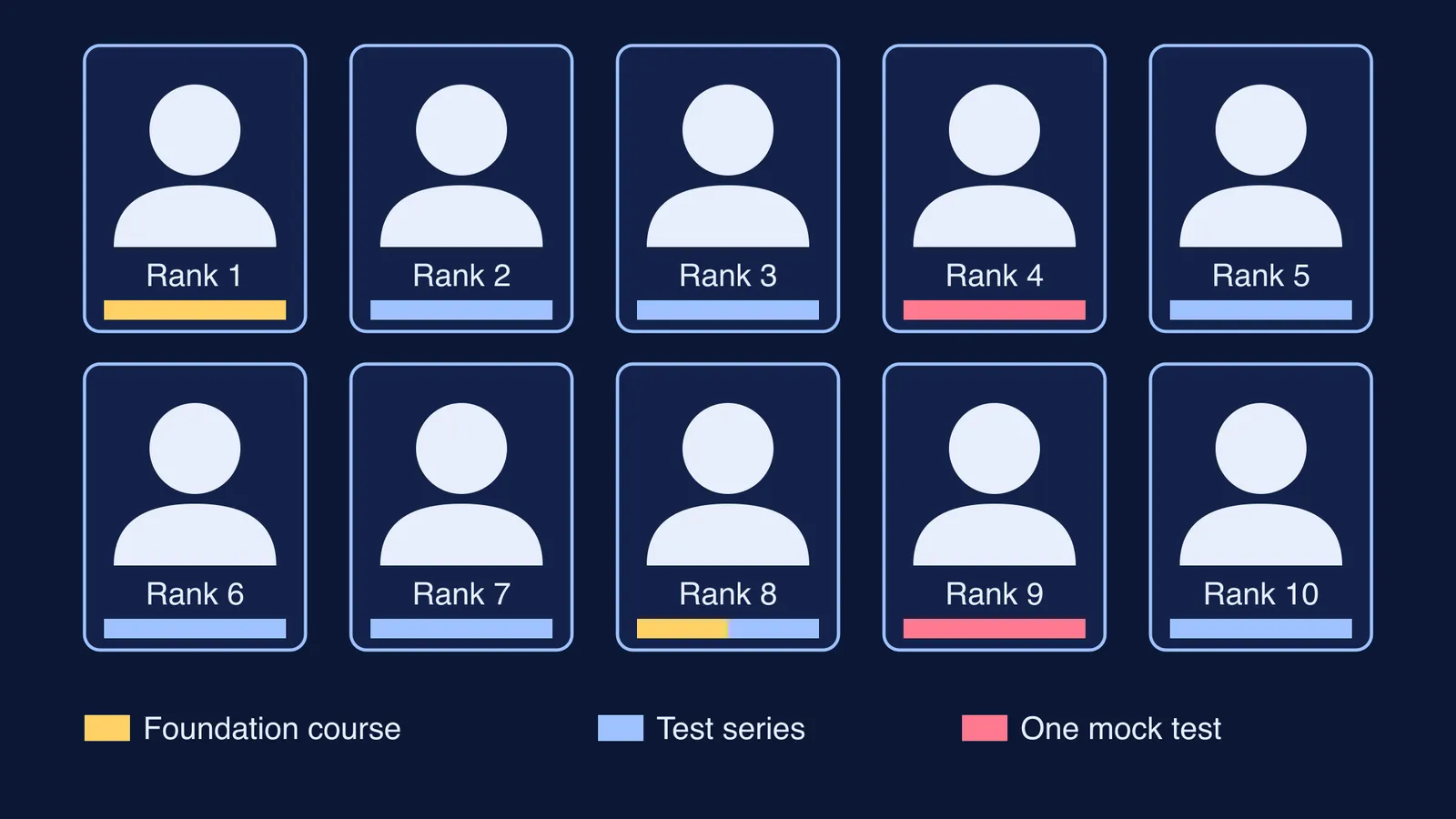
In January 2025, the Central Consumer Protection Authority (CCPA) announced a ₹3 lakh penalty on Vision IAS over an ad that claimed “10 in Top 10 selections in CSE 2020 from various programs of Vision IAS”. The ad named the course only for Rank 1, a classroom foundation student, and left out what the other nine had taken.
According to the CCPA, of those nine toppers, 1 took a foundation course, 6 took test series and 2 took Abhyaas, a prelims mock test. The CCPA noted that the foundation course cost ₹1,40,000, while the Abhyaas mock test cost ₹750. By hiding which course each topper took, the regulator said, the ad made every course look like it had the same success rate.
The CCPA also observed that several institutes use the same successful candidates' names and photographs to suggest they were regular classroom students. That case was about the UPSC civil services exam, but the 2024 guidelines below apply to coaching for any exam, including JEE and NEET.
What must a coaching ad disclose under the 2024 guidelines?
The Guidelines for Prevention of Misleading Advertisement in Coaching Sector, 2024 were issued by the CCPA on 13 November 2024. They cover coaching centres with more than fifty students, and also the public figures and other endorsers who promote them. According to the government's summary, they say:
No false claims about selection rates, success stories or exam rankings, and no promises of assured admission, high scores or guaranteed selection.
A topper's name, photo or testimonial may be used only with written consent, taken after the student's success, not signed at enrolment.
Next to a topper's photo, the ad must give the name, rank and course details, and say clearly whether the course was paid for.
Disclaimers must be in the same font size as the other important details, not hidden in fine print.
No false urgency, such as implying limited seats to rush your decision.
In April 2025, citing the recent IIT-JEE and NEET results, the CCPA issued notices to a few coaching centres over guaranteed selection and assurance of rank in JEE and NEET. It said it had by then issued 49 notices and imposed penalties of ₹77.60 lakh on 24 coaching centres.
Are coaching institute topper result claims true?
A claim can be true and still say nothing about the course you are buying. Five questions to ask:
Which course did this topper take, and for how long? A few weeks of test series is not two years of classroom teaching.
Was it paid or free? A free programme offered to already-strong students tells you little about the paid batch your child would join.
Out of how many? A selection count means little without the number of students enrolled in that programme that year.
Is the same face on another poster? Search the topper's name and rank. If three institutes claim them, ask each what they taught.
Will you put it in writing? Ask for the course-wise breakdown by email or WhatsApp.
What does a misleading topper poster look like?
Say a poster reads: “AIR 7, AIR 23, AIR 41. 312 selections! Limited seats, enrol by Sunday.” No course is listed under any face, so it is missing the details the coaching ad guidelines ask for. The 312 has no base: if it came from 30,000 students across every programme, that is about 1 in 100. And “enrol by Sunday” is the kind of urgency the rules warn against, unless the seats really are limited.
What to say at the counter: “Before we pay, could you tell us which programme each of these students took, for how long, whether it was paid, and how many students were in that programme the same year?”
Our guide to evaluating a coaching institute covers demo classes and faculty, and it is worth reading the fee refund policy before you sign. If topper walls are weighing on your child, see how to handle school ranks and topper pressure.
What can you do if a coaching ad seems misleading?
You can complain to the National Consumer Helpline on 1915 or 1800-11-4000, from 8 AM to 8 PM every day except national holidays, or on WhatsApp at 8800001915. Save a screenshot or photo of the ad and any receipts first.
When your child is stuck on a problem and wants to see the reasoning, the Fermi Problem Library has worked problems with a step-by-step solver that explains the reasoning rather than printing an answer.