

On this page
At Diwali, Pongal or on a slow Sunday, the rangoli on your floor is a ready-made maths lesson. With a dot grid and a few good questions, your child can find lines of symmetry, angles of rotation and repeating patterns in something they made.
What does a rangoli teach about symmetry?
The first page of the symmetry chapter in NCERT's Class 6 maths textbook, Ganita Prakash, shows a rangoli whose red petals "come back onto themselves when the flower is rotated by 90°" (NCERT Ganita Prakash, Chapter 9: Symmetry). The same chapter later asks students to find the lines of symmetry of a kolam. Three of its ideas are worth knowing before you start:
A line of symmetry is a line that cuts a figure into two parts that exactly overlap when folded along it.
An angle of symmetry is an angle through which a figure can be turned about a fixed point, the centre of rotation, and still look exactly the same.
A figure has rotational symmetry when it has an angle of symmetry strictly between 0° and 360°; every figure looks the same after a full turn.
The National Education Policy 2020 describes art-integration as an approach that uses "art and culture as the basis for learning of concepts across subjects" (NEP 2020, paragraph 4.7).
How do you draw a dot-grid rangoli for a symmetry lesson?
Start small: a 5 by 5 grid of dots, in chalk or on squared paper.
Mark the centre dot. Every turn happens around it.
Draw one motif in one quarter only: a petal around a dot, a loop around a corner dot.
Ask your child to copy it into the other three quarters, each a quarter turn from the last.
Before colouring, lay a ruler along each possible fold line and ask whether both sides match.
Then colour. A red petal opposite a yellow one breaks the symmetry, so colours are a symmetry decision too.
Worked example: how many symmetries does this rangoli have?
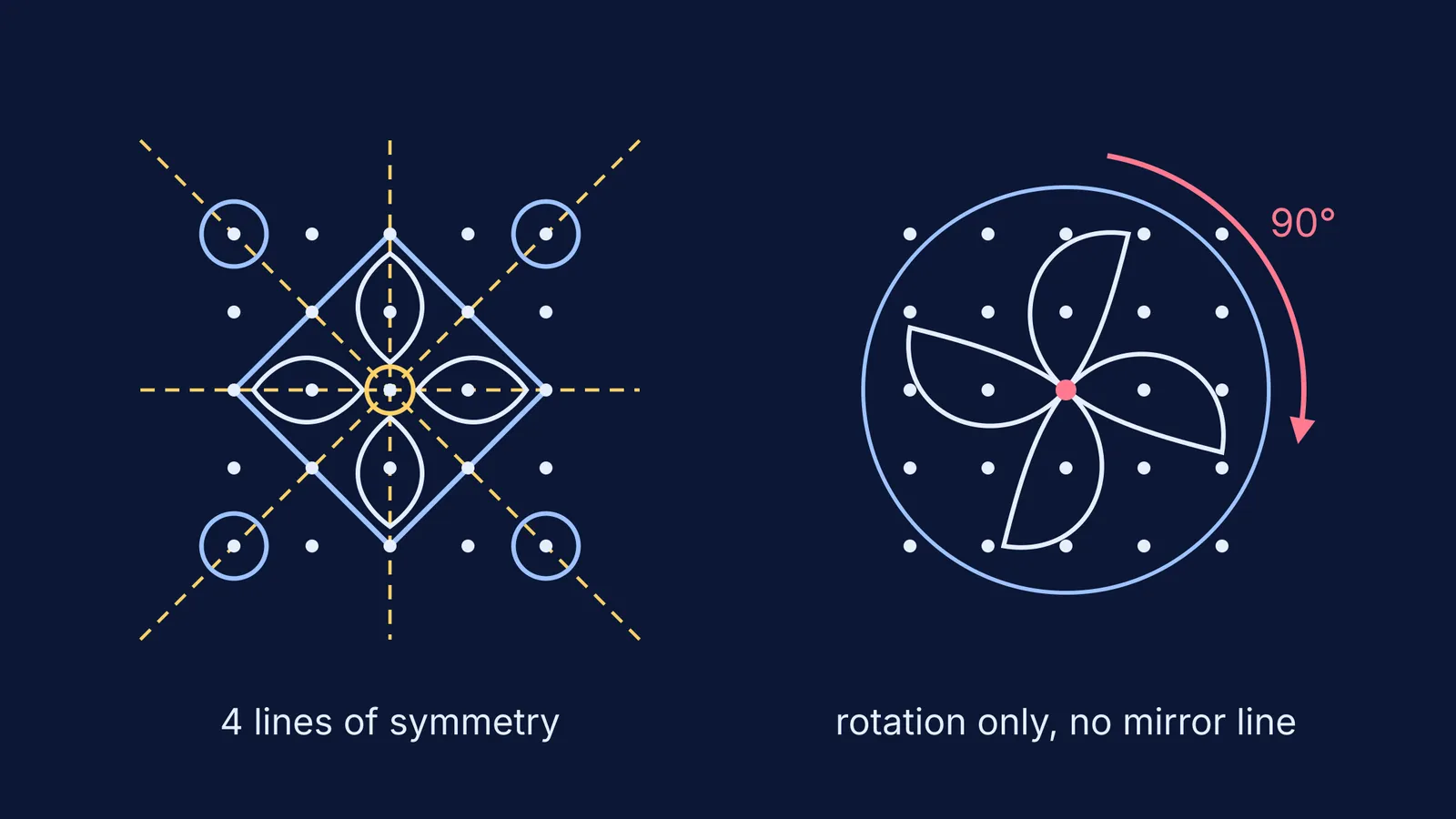
Use the NCERT definitions on the left design in the picture at the top: a diamond, four petals and a loop around each corner dot.
Lines of symmetry: 4. The vertical, the horizontal and both diagonals each split it into matching halves.
Angles of symmetry: 90°, 180°, 270° and 360°.
In the right design, each petal curls to one side like a comma.
Lines of symmetry: 0. Fold it any way and the curls point the wrong way.
Angles of symmetry: still 90°, 180°, 270° and 360°.
The NCERT chapter makes the same point with a paper windmill, which has rotational symmetry but no line of symmetry (NCERT). Children often think "symmetrical" means "the same on both sides"; their own rangoli shows it can also mean "the same after a turn".
Older children can spot that each angle is a multiple of the smallest. The chapter states that if the smallest angle of symmetry is a natural number of degrees, it is a factor of 360. So 8 identical petals repeat every 45°, while 7 petals would need 360/7 degrees, not a whole number.
What questions should you ask while your child draws?
A short script, by age:
Ages 6 to 8: "If I fold it here, will the two sides match?" "Which petal is the twin of this one?"
Ages 9 to 12: "How many fold lines can you find?" "How far must you turn it before it looks the same?"
Teenagers: "Why must the smallest angle divide 360?" "Can you design one with exactly 2 lines of symmetry?"
For repeating patterns, make a border: draw one motif, then slide it along by the same number of dots, again and again. Ask: "If this border went on forever, what move would take it onto itself?" That slide is a third kind of symmetry, after folding and turning; look for it on saree borders.
Where does rangoli symmetry lead in later maths?
Kolam takes the dot grid further. A 2026 paper in npj Heritage Science describes an algorithm that generates large one-stroke kolams, a single line traced around a grid of symmetrically laid out dots, to help preserve the tradition (Sivakumar and Sivakumar, npj Heritage Science). A teenager can try a small one by hand and check which symmetries survive.
Two angled mirrors make rangoli-like patterns too; see how a kaleidoscope makes patterns through multiple reflections. If folding suits your child better, try paper folding geometry at home. If they calculate fast but find shapes hard, read why children good at arithmetic struggle with geometry.
When a floor question becomes a school topic, the Fermi Concept Library gives each mathematics concept its own lesson and its place in the map, so you can see what comes next.
This festival, before the colours go down, ask one question: how many ways can this design move and still look the same?


