On this page
One sheet of paper holds most of primary-school geometry. Fold it once and your child has made a line of symmetry. Fold it again and they have a right angle, four quarters and a new shape. What matters is the question you ask just before your child opens the paper.
Why does paper folding help children learn geometry?
Folding trains spatial thinking: picturing in your head how a shape moves, turns or flips. A 2013 meta-analysis in Psychological Bulletin pooled 217 training studies and found an average effect size of 0.47 for spatial training compared with control groups (Uttal and colleagues, 2013). The gains held up after a delay and carried over to spatial tasks that were not directly trained. Read more in our guide to the Uttal meta-analysis on spatial skills training.
Folding has also been tested with this age group. In a programme called Think3d!, 92 students in Grades 3 to 6 at two rural US schools spent six weeks on origami and pop-up paper engineering (Burte and colleagues, 2017). They improved on two spatial tests and on real-world maths problems, and the older ones also improved on visual and spatial maths problems. The study had no control group, so treat it as a promising sign, not proof.
How do you teach geometry with paper folding?
Use the same three steps for every activity:
Predict. Before unfolding, ask what they think they will see.
Unfold and check. Open the paper together. Was the guess right?
Explain. Ask why. "Because the fold made two layers" is a real geometric reason.
A wrong prediction is the most useful moment: don't correct it, fold again and let the paper show them. Scrap paper or newspaper is enough.
What should you ask at each fold?
Activity 1: one fold for symmetry (ages 6 and up). Fold a square in half so the edges match. Draw half a heart along the fold and cut it out.
Before unfolding: "What will the whole shape look like?"
After: "Where is the fold now? What is the same on both sides?"
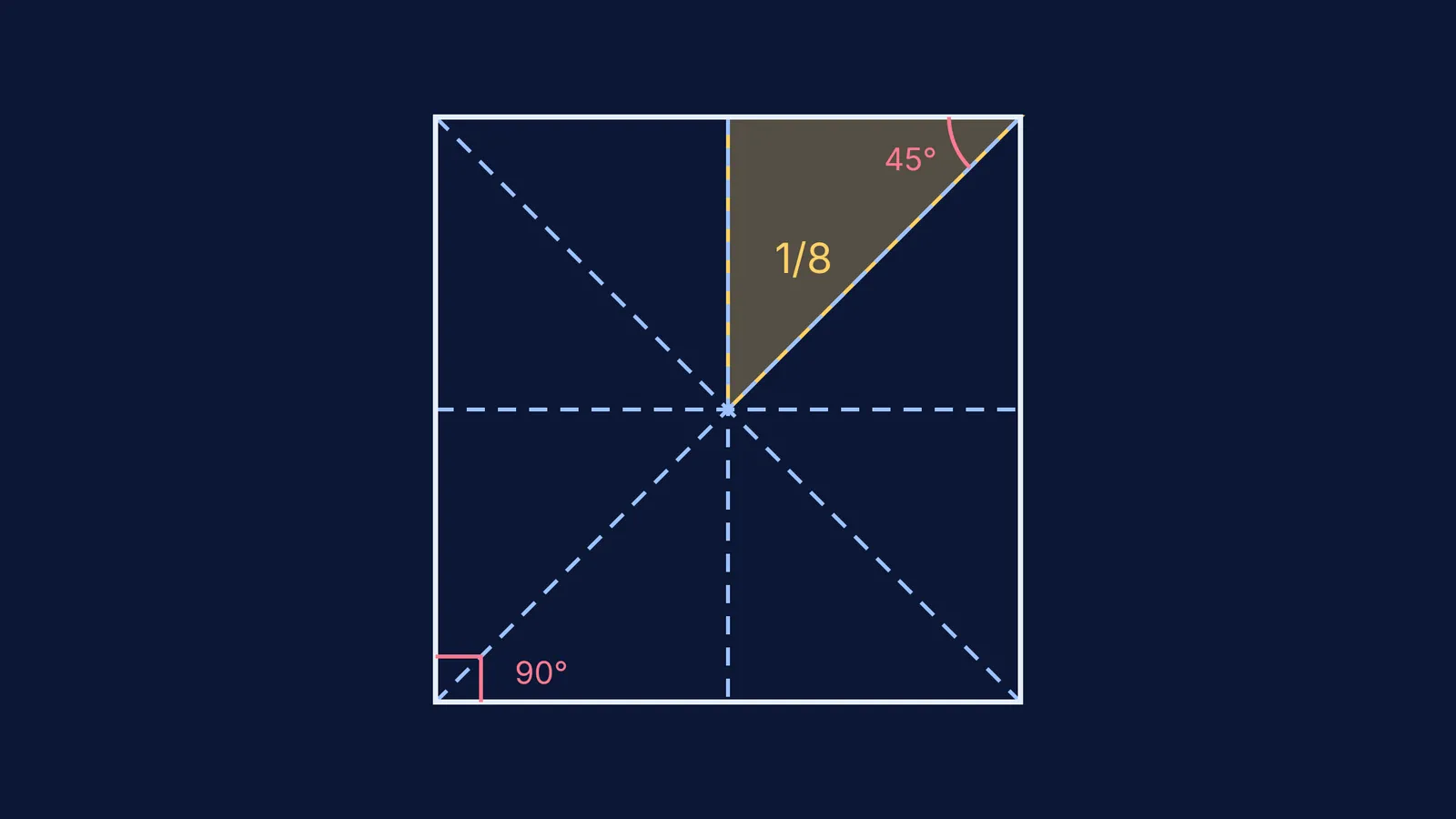
Stretch: "How many ways can you fold this square so the halves match exactly?" (Four: two through the middles of opposite sides, two along the diagonals.)
Activity 2: the paper right angle (ages 7 and up). Fold any scrap of paper to make a straight crease, then fold that crease back onto itself. The corner you have made is a right angle.
"Is this corner the same as the corner of a book? Check."
"Find three right angles in this room."
Ages 10 and up: fold the right angle in half again. "How many degrees is this?" (Half of 90, so 45.)
Activity 3: halves, quarters and eighths (ages 6 to 10). Fold a strip of paper in half three times, unfolding to count the parts after each fold.
"How many parts now? How many after one more fold?" (2, then 4, then 8: each fold doubles the parts.)
"Which is bigger, one half or one quarter? Show me with the paper."
"Colour two eighths. Which other fraction covers the same space?" (One quarter.)
If fractions are coming up at school, pair this with our explainer on equivalent fractions in Class 6.
Activity 4: the hole puzzle (ages 8 and up). Fold a square in half, then in half again. Punch or snip one small hole away from the folded edges.
Before unfolding: "How many holes will there be, and where?" (Four, one in each quarter, because you cut through four layers.)
"Where would you cut to get just one hole?" (At the corner where both folds meet. The hole lands in the centre.)
Activity 5: fold a triangle's corners together (ages 10 to 12). Cut any triangle from paper and put its longest side at the bottom. Fold the top corner down so its tip touches the bottom edge, keeping the crease parallel to the bottom. Then fold the other two corners in so all three tips meet at that point.
"What do the three corners make together?" (A straight line.)
"A straight line is 180 degrees. So what do the three angles of a triangle add up to?"
"Does it work for a long, thin triangle too?"
How do you match the activities to your child's age?
Ages 6 to 7: activities 1 and 3, with simple words: same, half, matching. Let them fold, even if the edges are messy.
Ages 8 to 9: add the right angle and the hole puzzle. Ask them to draw their prediction first.
Ages 10 to 12: use degrees and fraction names, try the triangle fold, and ask for a reason every time. Connect it to lines of symmetry and rotational symmetry in Class 6.
Stop while your child still wants one more fold.
For an older child who wants more on angles or symmetry, the Fermi Concept Library covers every concept in mathematics, each with its own lesson and its place in the map.
Tonight, take one sheet of paper and ask one question before you unfold it.