

On this page
It is a common frustration for parents: a child who can multiply large numbers in their head and fly through algebra suddenly hits a wall when they reach geometry. The formulas are memorised, but the child cannot see the relationships between the shapes.
This drop in performance is not just an individual struggle. The trend is widespread. According to the 2022 National Assessment of Educational Progress (NAEP), the average eighth-grade student's score in geometry fell by 11 points between 2011 and 2022. The gap between calculation and geometry happens because the two subjects rely on fundamentally different ways of thinking.
Why do children good at arithmetic struggle with geometry?
Arithmetic and algebra are largely procedural. A student learns a rule, follows a sequence of steps, and arrives at the correct answer. The process is linear, relying heavily on sequential working memory.
Geometry, on the other hand, requires robust spatial reasoning. A student must be able to mentally rotate figures, visualise three-dimensional objects, and understand how different parts of a shape relate to the whole. A child who is "good at calculation" often tries to survive geometry by relying on memorised formulas—such as knowing that the area of a triangle is half the base times the height—without developing an intuition for the shape itself. When a geometry problem asks them to prove a theorem, find a missing angle in an unfamiliar diagram, or mentally unfold a 3D net, their procedural rules fall short because they cannot picture the spatial relationships.
What are the van Hiele levels of geometric thought?
In the 1950s, educators Dina van Hiele-Geldof and Pierre van Hiele developed a model to explain how students learn geometry. The van Hiele model outlines sequential levels of geometric thinking:
Level 0 (Visualisation): Students recognise shapes by their overall appearance. They know a shape is a square because it looks like a box, but they cannot list its properties.
Level 1 (Analysis): Students begin to identify the properties of shapes. They understand that a square has four equal sides and four right angles.
Level 2 (Informal Deduction): Students see the relationships between properties and can reason through simple proofs. They realise that because a square has four right angles, it is automatically a type of rectangle.
A child who excels at calculation is often stuck at Level 0 in their spatial reasoning. They try to apply arithmetic to shapes they do not truly understand. To progress to Level 1 and beyond, they need physical experiences with geometry, not just more formulas.
How can paper cutting and drawing build spatial sense?
To bridge the gap between calculation and spatial reasoning, you have to move geometry off the textbook page and into the physical world.
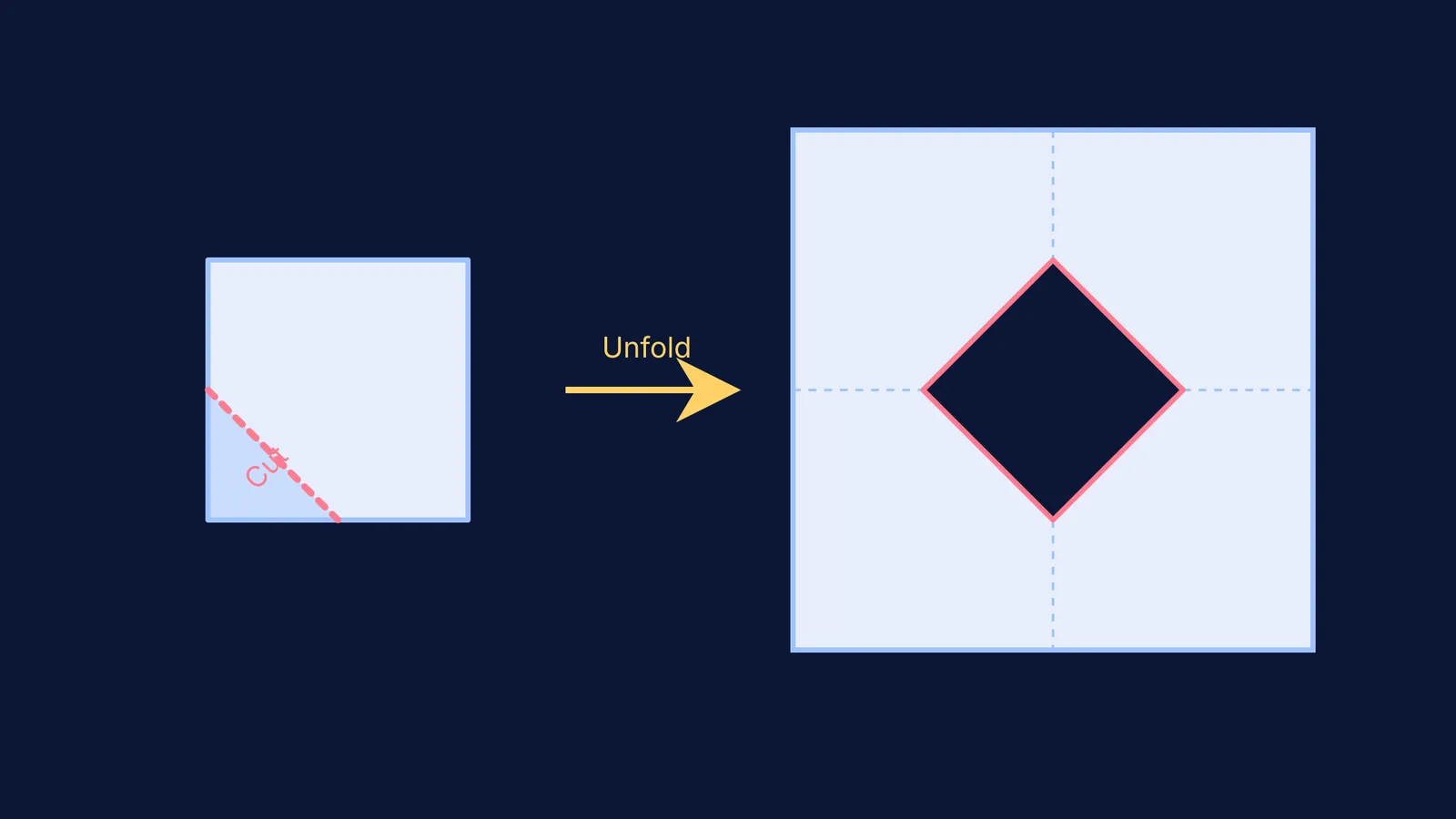
One of the most effective methods is the "fold and cut" technique, also known as Origametria. Have your child fold a piece of paper and cut out a shape. Before they unfold it, ask them to predict exactly what the resulting shape will look like. When a student cuts a shape out of folded paper, they are forced to consider symmetry, angles, and side lengths before the object even exists. This translates a purely visual exercise into a property-based analysis.
Practising geometric constructions slowly with a compass and straightedge also builds this vital spatial sense. Instead of just memorising equations, they can learn the steps to draw a circle through three given points: finding its centre and radius. Physical, hands-on constructions teach the hands and the eyes how geometric properties fit together in real time. The same spatial logic applies when tracing a ray through a glass slab; the student must see and predict the angles, rather than just computing them blindly.
What is a practical plan for geometry practice?
If your child is stuck in a calculation mindset, pause the standard textbook problems and try a more tactile approach to study habits.
Stop the formulas: Take a temporary break from calculating area and perimeter. Focus entirely on the visual properties of shapes, such as identifying congruent triangles or counting lines of symmetry.
Use real objects: Work with paper folding, scissors, and physical puzzles like tangrams. Ask your child to describe why a shape changes when it is cut or rotated, encouraging them to speak the language of geometry aloud.
Use interactive tools: When physical models are not enough, Fermi's AI tutor can draw figures and run simulations, checking your child's understanding as it goes rather than just giving away the answer. For abstract mathematical concepts that are difficult to visualise on a flat page, the Fermi Simulation Lab provides interactive models that are easier to see than to read.
By slowing down and building a physical intuition for shapes, a child who is strong in arithmetic can learn to see the spatial logic behind geometry.


