

On this page
Maybe the nearby school only takes four-year-olds, or the anganwadi timings do not fit. Either way, your 3-year-old is home this year, and you do not need a curriculum or worksheets. A three-year-old learns most by moving, talking, playing and being read to by someone paying attention.
What does preschool at home look like for a 3-year-old?
India's official curriculum for this age is built around play. NCERT's Jaadui Pitara user manual explains that the National Curriculum Framework for the Foundational Stage, released on 22 October 2022, covers children aged 3 to 8. It describes a move away from "merely learning from books" towards a "play-way and competency-based learning system". Jaadui Pitara itself is a box of play materials such as toys, games and picture books, not a workbook.
Research agrees. The American Academy of Pediatrics report The Power of Play by Michael Yogman and colleagues (2018, reaffirmed in 2025) says play with parents and peers promotes the social-emotional, thinking, language and self-control skills young children need.
How much play, outdoor time and sleep does a 3-year-old need?
The WHO guidelines for children under five give clear numbers for ages 3 to 4:
At least 180 minutes a day of physical activity at any intensity, including at least 60 minutes of moderate- to vigorous-intensity activity, spread through the day.
Not restrained for more than 1 hour at a time.
No more than 1 hour of sedentary screen time a day; less is better.
10 to 13 hours of good-quality sleep, which may include a nap, with regular sleep and wake-up times.
WHO also encourages reading and storytelling with a caregiver when a child is sitting still.
What does a sample day look like?
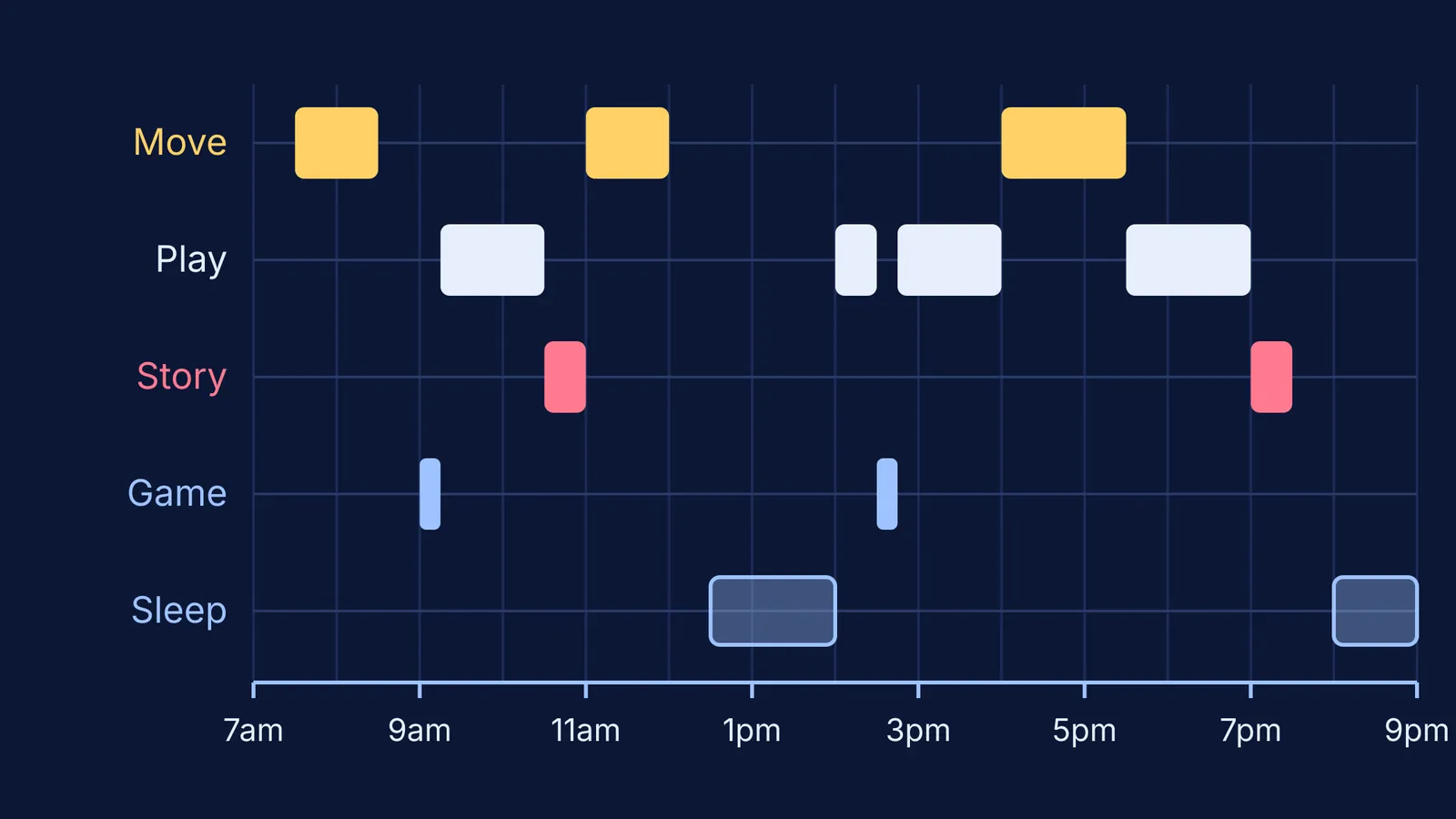
Here is the day drawn in the diagram above, built around the WHO numbers, for a child who wakes at 7 and sleeps at 8.
7:00 Wake up, breakfast, small jobs like pouring water.
7:30 Outdoors for an hour before the heat: park, terrace or a walk.
8:30 Bath and snack.
9:00 Learning game one, then free play with blocks or dough.
10:30 Story time: one picture book, read twice, with questions.
11:00 Indoor movement: dancing, ball games, a cushion obstacle course.
12:00 Lunch, then a nap from 12:30 to 2:00.
2:00 Quiet play; learning game two at 2:30.
4:00 Outdoors for 90 minutes as it cools.
5:30 Pretend play and helping with dinner.
7:00 Bedtime story, bath, lights out at 8:00.
Check it against the WHO guidance. The movement blocks add up to 210 minutes, above the 180-minute minimum. Eleven hours at night plus a 90-minute nap makes 12.5 hours of sleep, inside the 10 to 13 hour range. There is no screen time here; if you use some, WHO's ceiling is 1 hour. If the phone creeps into mornings, try our ideas for keeping a toddler busy without a phone in the morning.
Which learning games work for a 3-year-old?
Use guided play: you set up the activity with something to learn in mind, and your child leads. A 2022 meta-analysis by Skene and colleagues pooled 17 studies covering 3,893 children with average ages of 1 to 8. Guided play had a greater effect than direct instruction on early maths skills, shape knowledge and task switching, and a greater effect than free play on spatial vocabulary. No difference was found for other key outcomes, and studies defined guided play differently, so treat this as a direction, not a formula.
Keep each game short and stop while your child still wants more.
Sorting: sort mixed spoons and blocks into two baskets.
Stair counting: count steps aloud going up, and count down coming back.
Shape hunt: "Can you find something round?" A roti, a plate, the clock.
Feely bag: hide a spoon, a ball and a block in a cloth bag; guess by touch.
Where is it?: hide a toy and describe it with "under", "behind" and "next to".
What you say matters more than the materials:
Instead of "What colour is this?", say "I wonder which ones are red. Can you find them?"
When they get it wrong, say "Hmm, let's check together."
When they change the rules, follow them for a while. That is the play part.
What if the routine falls apart?
Some days it will. Keep the anchors (sleep, meals, some time outdoors, one story) and drop the rest without guilt. A story in your home language is an easy one to keep; see our guide on getting your child to read in their mother tongue. When school does start, see what changes from Nursery to LKG.
If an older sibling is studying at the same table, Fermi's AI tutor can work out what they already know and build a plan for their session, leaving you free for the preschooler's game.
If you are worried about your child's speech, movement or behaviour, talk to your paediatrician. If you feel low or overwhelmed yourself, Tele MANAS is a free, 24x7 national helpline on 14416.
Tomorrow, start with the anchors and one game.


