

On this page
A family trip already has the maths built in: money, distance, time and a choice to make. Hand those jobs to your child instead of doing them on your phone, and the sums become decisions the whole family will live with.
Why plan a family trip as a maths project?
Because doing maths for a real decision is a different skill from doing it in a notebook, and the gap is measurable. The ASER 2023 'Beyond Basics' survey tested 34,745 young people aged 14 to 18 in 28 rural districts across 26 states on tasks from daily life.
Close to 50% could do common calculations such as working out time, adding weights and using the unitary method.
Of those who could subtract, over 60% managed a shopping budget task, about 37% could apply a 10% discount, and only about 10% could calculate a loan repayment.
Of those who could bring a smartphone, a little over a third could use Google Maps to find how long a journey would take.
One ASER time question asked how long a girl slept if she went to bed at 8:30 PM and woke at 4:30 AM. That is the same reasoning your child needs to read an overnight train timetable.
Maths at home is linked to maths at school, though modestly. A 2021 meta-analysis in Psychological Bulletin by Mia Daucourt and colleagues pooled 64 studies and found a small positive correlation (r = .13) between the home maths environment and children's maths achievement. That is a link, not proof of cause. One trip will not change a report card. What it does is give maths a reason.
What maths jobs can a child do while planning a trip?
Give each child one job, sized to what they can already do.
Budget keeper: gets a total amount and a list of costs (tickets, food, entry fees) and must say what fits. Younger children can add and subtract; older ones can work out a discount or a per-person cost.
Route comparer: compares two ways of getting there on cost and door-to-door time, not just the ticket price.
Timetable reader: reads departure and arrival times in the 24-hour clock and works out the journey length, including trips that cross midnight.
Distance converter: turns kilometres into hours at an average speed, and checks the answer against the map app.
For more everyday maths of this kind, see how to show your teenager that maths is used in real life and our estimation games for kids.
Worked example: train or car for a 300 km trip?
The prices below are made up to show the method. Use your real fares, fuel price and mileage.
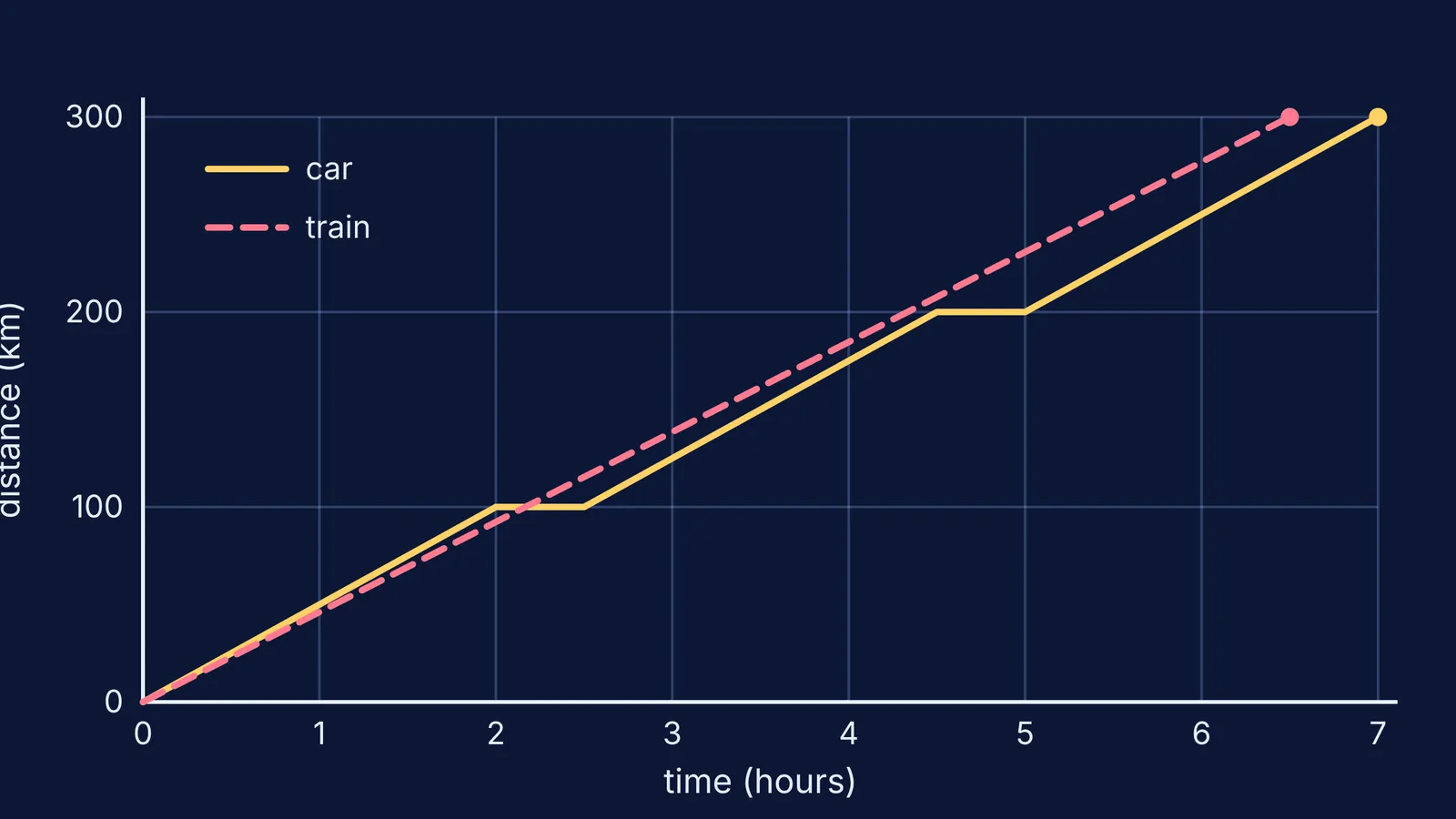
Car, time. 300 km at an average of 50 km/h is 300 ÷ 50 = 6 hours of driving. Add two 30-minute breaks: 7 hours in total.
Car, cost. If the car does 15 km per litre, it needs 300 ÷ 15 = 20 litres. At ₹100 a litre that is ₹2,000, plus ₹400 in tolls: ₹2,400, or ₹600 each for four people.
Train, time. It leaves at 22:45 and arrives at 05:15. From 22:45 to midnight is 1 hour 15 minutes; midnight to 05:15 is 5 hours 15 minutes. Total: 6 hours 30 minutes, an average of 300 ÷ 6.5, or about 46 km/h.
Train, cost. Four tickets at ₹500 is ₹2,000, plus ₹300 for autos to and from the stations: ₹2,300, or ₹575 each.
Decide. The train is ₹100 cheaper and 30 minutes quicker, and nobody has to drive. But you arrive at 5:15 in the morning. Ask your child for a one-line recommendation with a reason. There is no single right answer, which is the point.
How do you keep it from feeling like homework?
Try lines like these:
"You're in charge of the money for this trip. Here is the total. Tell us by Sunday whether we can afford the boat ride."
"Before you open Maps, guess how long the drive will take. Then check."
"Which option would you pick, and what would change your mind?"
"Walk us through your plan at dinner. We'll ask questions, not mark it."
Keep the plan on one page, and on the trip let your child track actual spending against it. If money talk is new in your house, our guide on teaching your child the value of money by age is a good place to start.
What if your child gets stuck on the maths?
Most trip sums come down to three ideas: the unitary method (cost per person, litres per kilometre), speed, distance and time, and percentages for discounts. If one is the sticking point, work a small example together on paper first. The Fermi Problem Library has worked problems with a step-by-step solver that explains the reasoning rather than printing an answer, so your child can see the method and then use it on their own plan.
Pick one job for your child before your next trip, and let them own it from the first quote to the last receipt.


