

On this page
Many families avoid the "what if JEE does not work" conversation because it feels like doubt. But a plan B made calmly in Class 12 is very different from one made in a panic on result day.
Why does a JEE backup plan make sense even for a strong student?
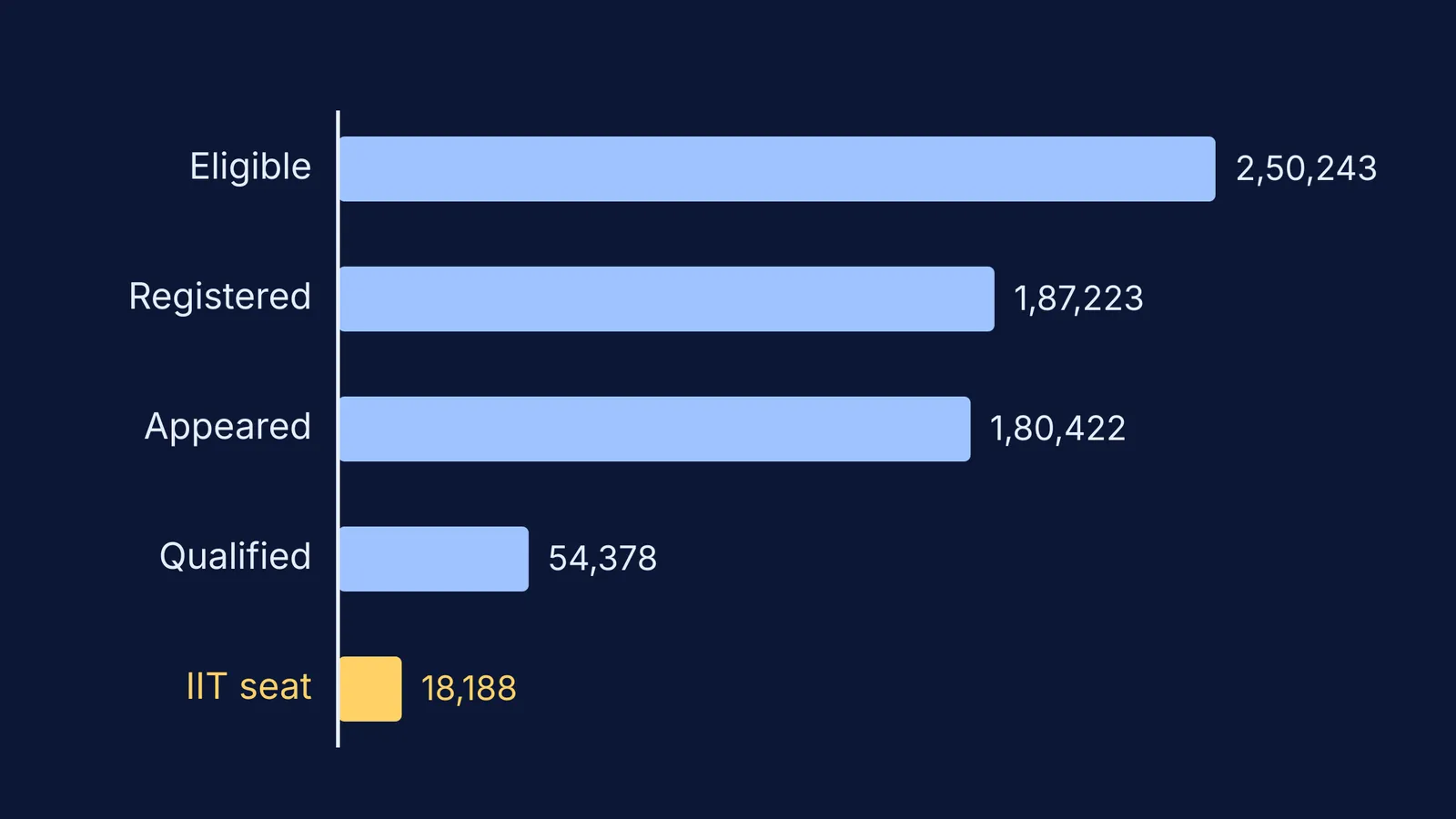
Because of the arithmetic, not your child's ability. The official JEE Advanced 2025 report from IIT Kanpur records that 1,80,422 candidates appeared for both papers. Of them, 54,378 qualified, and 18,188 IIT seats were allotted.
That is roughly one IIT seat for every ten candidates who sat the paper, according to the same report, and almost all of those candidates had already made the shortlist of 2,50,243 eligible candidates from JEE Main 2025.
"JEE not working" also rarely means "no engineering at all". The JoSAA website lists 138 participating institutes for 2026-27, including 23 IITs, 31 NITs and 26 IIITs. For many students, the first plan B sits inside the same counselling process.
How do you bring up plan B without sounding like you have given up?
The research on how parents support choices is useful here. A meta-analysis of 36 studies found that parent autonomy support was related to greater academic achievement, autonomous motivation and psychological health, with the strongest link to psychological health (Vasquez and colleagues, Educational Psychology Review, 2016; abstract on ERIC). In everyday terms: the conversation goes better when your child is a co-planner, not the subject of a plan.
Three habits help:
Pick a calm moment. A weekend months before the exam, not the night before a mock or the morning results come out.
Say "and", not "or". Plan B runs alongside full preparation for plan A. It does not replace it.
Ask before you suggest. Find out what your child actually wants from JEE before you list colleges.
What can you say to start the conversation?
You might open with: "I'm not asking because I doubt you. I want you to walk into the exam knowing that whatever happens, you have somewhere good to go."
Then ask: "What do you like about the IIT plan? The subject, the campus, the name, or the job after?"
And close with: "Let's each find two options this week and compare them on Sunday."
Phrases to avoid: "in case you fail", "let's be realistic", and any comparison with a cousin or a neighbour's child. If your hopes and your child's interests pull in different directions, read our guide on when a parent's dream career differs from the child's interest.
How can a family research alternatives together?
Treat it as a short project with a finish line. Here is a four-week plan:
Week 1, the why. Your child writes down what they want from JEE: a subject, a type of campus, a career, or the name. You write your own version separately. Compare the lists without arguing.
Week 2, the routes. List every route that keeps the thing they care about most: NITs and IIITs through JoSAA, your state's engineering counselling, and degrees through CUET (UG). The official CUET (UG) site says its scores are used for UG programmes in all Central Universities and participating state, deemed and private universities.
Week 3, the check. For each route, your child finds the official website, timeline, fees and what graduates do next.
Week 4, the paper. Write down plan A, plan B, the date you will decide, and every form deadline that must not be missed. Then put it in a drawer and go back to studying.
Here is a worked example. A student says in week 1, "I like building things with code." That one sentence opens several routes: computer science at an NIT or IIIT through JoSAA, a state engineering college through state counselling, or a B.Sc. in computer science or mathematics through CUET (UG). Exam dates and eligibility rules change every year, so check each one on its official site rather than a forwarded message.
Once plan B is on paper, it is time to return to plan A. If your child is unsure where to restart, Fermi's AI tutor can work out what they already know and build a plan for the session, so they sit down to a clear next step.
For routes beyond engineering, see why engineering is not the only option after PCM.
What if your child is already anxious about results?
If the topic brings tears or anger, pause. It is not the right moment, and the plan can wait a week. Our guide on talking to a child who is anxious about entrance results has gentler openers.
If worry starts affecting sleep, eating or daily life, speak to a doctor or counsellor. Tele MANAS, the government's tele-mental health service, runs a toll-free number, 14416, offering 24x7 counselling (Press Information Bureau).
This weekend, ask one question: "What do you want from engineering?" The rest of the plan starts from the answer.


