

On this page
A string of beads in red, blue, red, blue looks like a craft. For a four-year-old working out what comes next, it is also an early lesson in rules and prediction. Here are three pattern activities using things you already have, and a ladder for making each one harder.
Why do patterns matter for early maths?
Researchers define patterning as the ability to notice and use predictable sequences, and a repeating pattern as a sequence with a part that repeats, like ABABAB (Zippert and colleagues, Journal of Educational Psychology, 2021).
In a longitudinal study of 517 low-income American children followed from age 4 to age 11, patterning knowledge in preschool, along with counting and a sense of quantity, predicted maths achievement in fifth grade.
That link is not proof that pattern practice raises maths scores. When a Vanderbilt team randomly assigned 211 preschoolers to tutoring groups, the children who got 5 sessions on patterns and numbers improved most at patterns, but their general maths knowledge improved about as much as the other groups'. So treat pattern play as fun practice in looking for rules, not a shortcut to marks.
How do you teach patterns to a preschooler at home?
The same 2021 paper reviews what makes pattern tasks easy or hard. Copying a pattern is usually easier than extending it, and extending is easier than abstracting it, which means making the same pattern with different materials. The authors note that one of the main stumbling blocks is seeing the unit of repeat: the chunk, such as red-blue, that keeps coming back. Their review also notes that children begin to recognise repeating patterns, like the stripes on a shirt, from around age 3.
That gives you a four-step ladder:
Copy: your child builds the same pattern next to yours.
Extend: you stop part-way and your child adds what comes next.
Translate: your child makes the same pattern with something different, so beads become claps.
Find the unit: your child shows you the part that repeats, by circling it or breaking the string into chunks.
Which pattern activities work at home, and how do you make them harder?
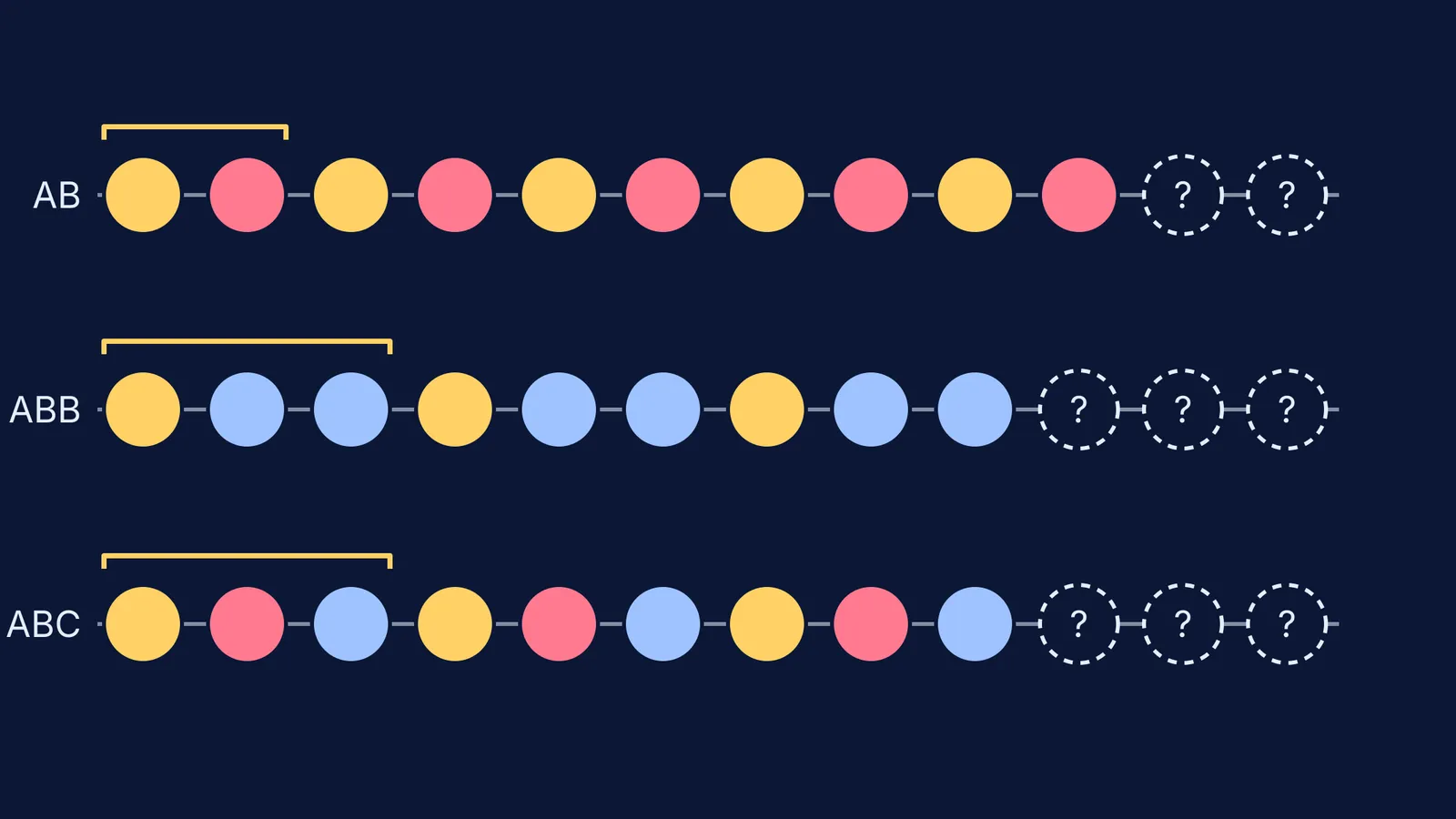
Bead strings. Use large beads, pasta tubes or big buttons on a shoelace, and stay nearby, because small pieces are a choking risk for young children. Start with two colours in an AB pattern: red, blue, red, blue.
Easier: you string four beads and your child copies them on their own lace.
Harder: move to ABB (red, blue, blue) or ABC (red, blue, yellow).
Hardest: make a string with one mistake in it and ask your child to find and fix it.
Clapping rhythms. Clap, clap, stomp; clap, clap, stomp is an AAB pattern your child can feel, and it suits children who would rather move than sit.
Easier: you clap a short rhythm and your child echoes it.
Harder: you clap two rounds and pause, and your child finishes the line.
Hardest: turn the rhythm into beads. "Clap is red, stomp is blue. Can you make our song on the string?" That is abstraction: the same rule in a new form.
Colour patterns. Coloured blocks, crayons, bangles, bottle caps or rangoli dots all work. Lay a colour row on the floor or draw one on paper.
Easier: two colours in an AB pattern, with big objects.
Harder: patterns that change on two features at once, such as big red, small red, big blue, small blue.
Hardest: a growing pattern, where each step adds one more (one blue, two blue, three blue).
Do not worry if growing patterns do not click yet: 4- and 5-year-olds score below chance on them, according to the 2021 paper.
If your child enjoys these, sorting games for young children use the same eye for rules, and maths while cooking with kids brings counting into the kitchen.
What should you say while you play?
A short script helps you ask rather than tell:
"What do you notice?"
"Say it with me: red, blue, red, blue. What comes next?"
"Which part keeps coming back? Show me with your finger."
"How did you know?"
"Now you make one for me to finish."
When the answer is wrong, read the whole pattern aloud together from the start. Saying it often lets your child hear the mistake for themselves.
How do you know when to move on?
Watch for three signs: your child gets the current step right on a few different days, explains the rule in their own words, or starts inventing patterns of their own. Then climb one rung. If they lose interest, stop. For what schools expect at this age, see our guide to the move from nursery to LKG.
Patterns later connect to number sequences and, eventually, algebra. When your child gets there, the Fermi Concept Library has a lesson for every concept in mathematics, each with its place in the map. For now, a shoelace and a handful of big beads is plenty.


