

On this page
You don't need worksheets to do maths with your child this weekend. A park or housing-colony compound has shapes, numbers, angles and distances everywhere. A scavenger hunt turns them into a game: things to find, a guess before every measurement, and a check. Below are three ready-made lists, for ages 5, 8 and 11.
Why do maths outdoors at all?
Early maths matters more than many parents expect. Analysing 6 longitudinal datasets, Duncan and colleagues found that school-entry maths skills predicted later achievement more strongly than reading or attention skills.
Estimation is a skill in its own right. Siegler and Booth (2004) found that how well young children placed numbers on a 0-to-100 line correlated strongly with their maths achievement scores, and that relevant experience tended to improve their estimates. Guessing "how many steps to that bench?" and then counting is a different task, but it practises the same habit of estimating and then checking.
Learning outside the classroom has some evidence behind it too. A systematic review of 13 studies on regular outdoor lessons found that 11 reported positive effects across social, learning or health outcomes, and seven of the 13 looked at learning. Most were case studies of modest quality, and the authors call for larger, more rigorous research. So treat the park as a good place to practise, not a magic fix.
How do you set up a maths scavenger hunt in a park?
Keep the kit small and the time short.
A card with 6 to 8 tasks, written before you leave home
A pencil, and a string or measuring tape (a dupatta or a 1-metre string tied with knots works)
One rule for every number task: say your guess out loud first, then check it
30 to 40 minutes, stopping while your child still wants more
The guess-then-check rule is the heart of it. For more games built on it, our post on estimation games for kids at home has indoor versions.
What can a 5-year-old look for?
At five, the work is spotting, counting and comparing.
Find three circles (a ball, the rim of a flowerpot, a clock).
Find a triangle and a rectangle, and trace them in the air.
Count the swings, then the slides. Which is more?
Find the numbers 1 to 5 on gates, benches or signboards.
Collect five leaves and line them up from smallest to biggest.
Guess how many big jumps to the gate, then jump and count.
What maths activities suit an 8-year-old?
At eight, add measuring and multiplying.
Count the steps across the park. Then use multiplication: if one step is about half a metre, how many metres is that?
Find something that comes in rows and columns (benches, windows, tiles) and count the total by multiplying rows by columns.
Guess how many seconds it takes to walk to the gate, then time it.
Find a right angle using the corner of a notebook, then find one angle smaller and one bigger.
How can an 11-year-old find a tree's height?
At eleven, move on to angles, area and indirect measurement.
Find two parallel lines and one pair of lines that meet at an angle. Estimate the angle in degrees.
Pace out a rectangular lawn and work out its area in square metres.
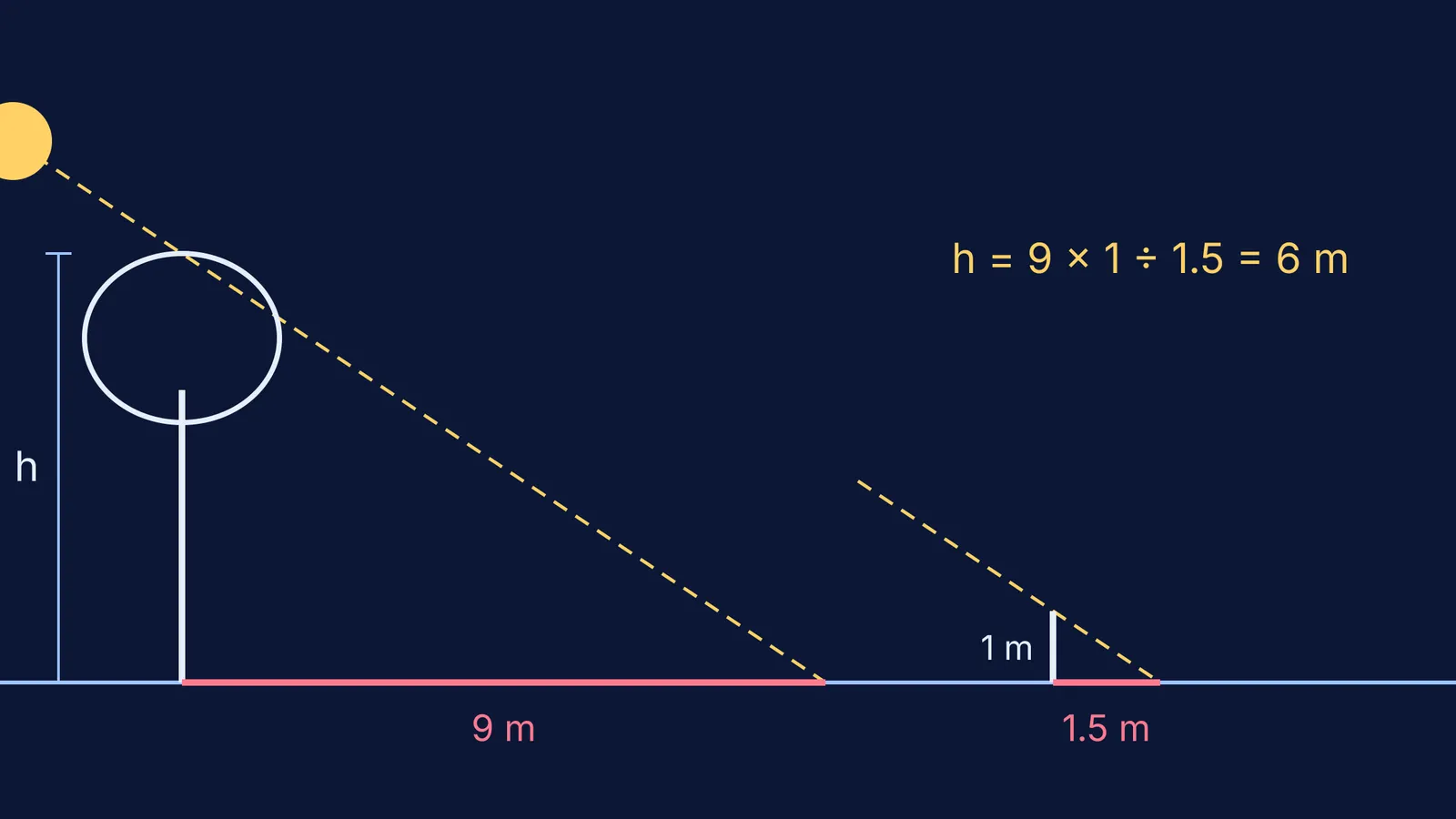
Work out the height of a tree without climbing it, using shadows.
Here is the shadow method, worked through. On a sunny day, stand a 1-metre stick upright on level ground and measure its shadow: say 1.5 m. At the same time, measure the tree's shadow from the base of the trunk to the tip: say 9 m. Because the sun's rays are parallel, the stick and its shadow make a triangle with the same shape as the tree and its shadow. So the tree's height divided by 9 equals 1 divided by 1.5, which gives 9 ÷ 1.5 = 6 m. Ask your child to guess the height first, then compare.
This is the same idea as similar triangles in Class 10 maths, and it leads straight into heights and distances. Our post where you can watch the angle of elevation grow is a good next step for an older child. If similar triangles come up in homework later and the idea is shaky, the Fermi Concept Library has a lesson on each concept in mathematics and shows where it fits in the map.
To keep it fun, let your child add one task of their own and set a challenge for you. For a rainy weekend, try maths while cooking with kids aged 5 to 11, which uses the same guess-then-check idea with cups and spoons.


