

On this page
Many Indian families have a young child taking a class on a screen: school, phonics, abacus or a hobby. The useful question is not whether screens are good or bad. It is which parts of learning work through a screen, which need the real world, and what your role is.
What can a Class 2 child learn through a screen?
The thing that matters most is whether the screen talks back. In a study by Sarah Roseberry, Kathy Hirsh-Pasek and Roberta Golinkoff, published in Child Development, 36 children aged 24 to 30 months learned new verbs from a live adult and from a live video chat, but not from a pre-recorded video of the same kind of chat. The researchers' explanation is social contingency: a teacher who responds to what the child just said or did.
That study was of toddlers, so treat it as a clue, not a rule. A live class where the teacher waits for your child's answer and reacts to it is different from a recorded lesson playing to nobody.
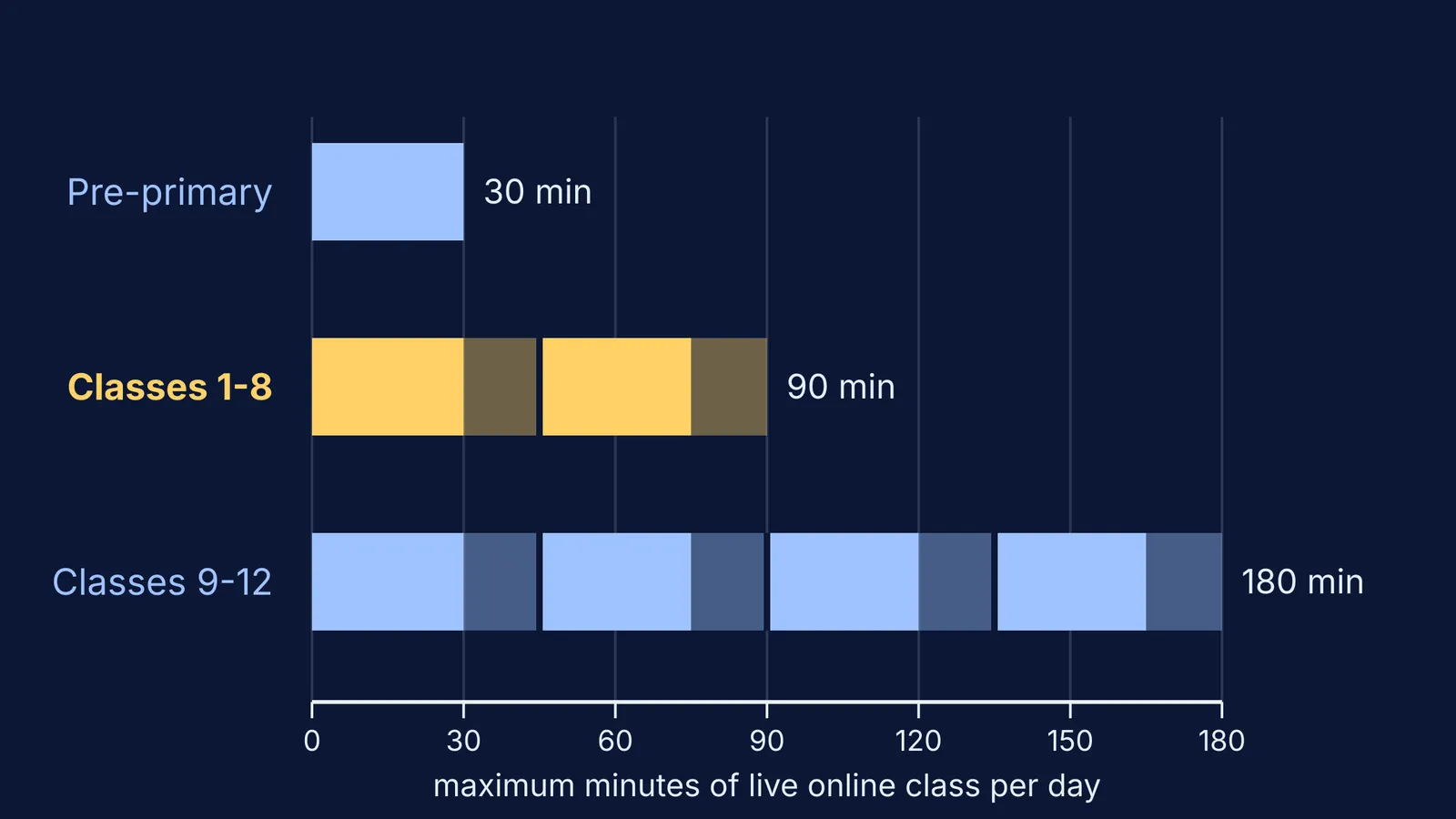
India's own advice also sets a limit on time. The PRAGYATA guidelines on digital education, released by the Union HRD Ministry (now the Ministry of Education) on 14 July 2020, say that for Classes 1 to 8, live online learning should be no more than two sessions of 30-45 minutes each on days when online classes are held. For pre-primary children the same release suggests no more than 30 minutes a day, used for interacting with parents and guiding them.
What does a screen not teach well at this age?
Some learning happens in the hands. In a brain-imaging study in Trends in Neuroscience and Education, Karin James and Laura Engelhardt had 15 pre-literate children print, type or trace letters. A brain network linked to reading became active when the children later saw letters, but only if they had printed them, not typed or traced them. If a class teaches writing, the writing still happens with a pencil, at your table. The same goes for measuring, cutting and building: a teacher on a screen can describe it, but your child has to do it.
Young children also find it hard to manage themselves in front of a screen. In a survey of 3,275 Chinese parents of children aged three to five during the 2020 lockdown, one reason parents gave for resisting online learning was young children's limited self-regulation. Another was that parents lacked the time and know-how to support it. A seven-year-old is older, but both problems can still apply.
How do you know if an online class suits your child?
Watch two or three classes before you decide. Signs it is working:
Your child answers questions aloud and the teacher responds to them by name.
The class asks your child to do something off-screen, such as draw, count objects or read aloud.
They can tell you one thing they learned at dinner without being prompted.
They come away calm, not wound up or teary.
Signs it is not:
The camera is off most of the time, or the teacher cannot see the children.
Your child drifts to other tabs or toys within ten minutes. Our guide on a child who watches YouTube during an online class has steps for that.
Total live time runs past the PRAGYATA limit above, once you add school and extra classes together.
Restlessness spills into homework time too. If that sounds familiar, read what to do when a Class 2 child cannot sit still for homework.
How should you sit in without taking over?
More help is not always better. A review by Eva Pomerantz and colleagues in Review of Educational Research argues that how parents get involved largely decides whether it helps. Support your child without becoming the student.
A three-week plan:
Week 1: sit beside. Help with the setup and the mute button. Do not answer for your child, even when the silence feels long.
Week 2: sit behind. Move your chair back. Step in only for technical problems.
Week 3: be in the room. Do your own work nearby and check in at the end.
When your child turns to you mid-class, say: "Ask your teacher. They want to hear it from you." After class, try "Show me one thing you made today" rather than "Did you pay attention?" If your child only works with you beside them, our post on a child who studies only when a parent sits beside them explains how to step back gradually.
The same question is worth asking when your child is older and studying science and maths: does the screen respond, or only play? That is the idea behind Fermi's AI tutor: it notices where a student is stuck and decides whether to explain, ask or show.
For now, keep live screen time short, keep the pencil work on paper, and move your chair back a little each week.


