

On this page
It is 7 pm. Your child opens the maths notebook only after you pull up a chair, and the pen stops when you get up to make tea. Many parents worry they will be sitting there until the board exams.
Sitting together is a sensible start. The trouble comes when it never changes. This plan helps you leave the chair a little at a time.
Why does my child only study when I sit with them?
Usually it is not laziness. Your presence does three jobs your child cannot yet do alone: getting started, staying on task, and knowing what to do when stuck. These are part of what psychologists call self-regulation. They grow with practice, which cannot happen while an adult does them every evening. The aim is to hand them over one at a time.
What does research say about sitting with children during homework?
How you help matters more than how much. A review by Pomerantz, Moorman and Litwack, subtitled "More is not always better", argues that the way parents get involved largely decides whether it helps.
A 2009 meta-analysis by Hill and Tyson of 50 studies found that parental involvement in middle school was linked to higher achievement, with one exception: helping with homework. Involvement reflecting what the authors call "academic socialization" had the strongest positive link.
An earlier synthesis by Patall, Cooper and Robinson looked at 14 studies in which parents were trained to help with homework. Their primary-school children completed more homework and had fewer homework problems. Across 22 samples from 20 correlational studies, parents setting homework rules showed a stronger link with achievement-related outcomes than other involvement strategies.
In a 2008 observation study by Moorman and Pomerantz, the more controlling mothers were in one minute, the less mastery-oriented their 4-year-olds were the next minute. These were very young children, so treat it as a hint, not proof about teenagers.
Our reading: keep the structure, ease off the hands-on supervision, and talk more about why the work matters.
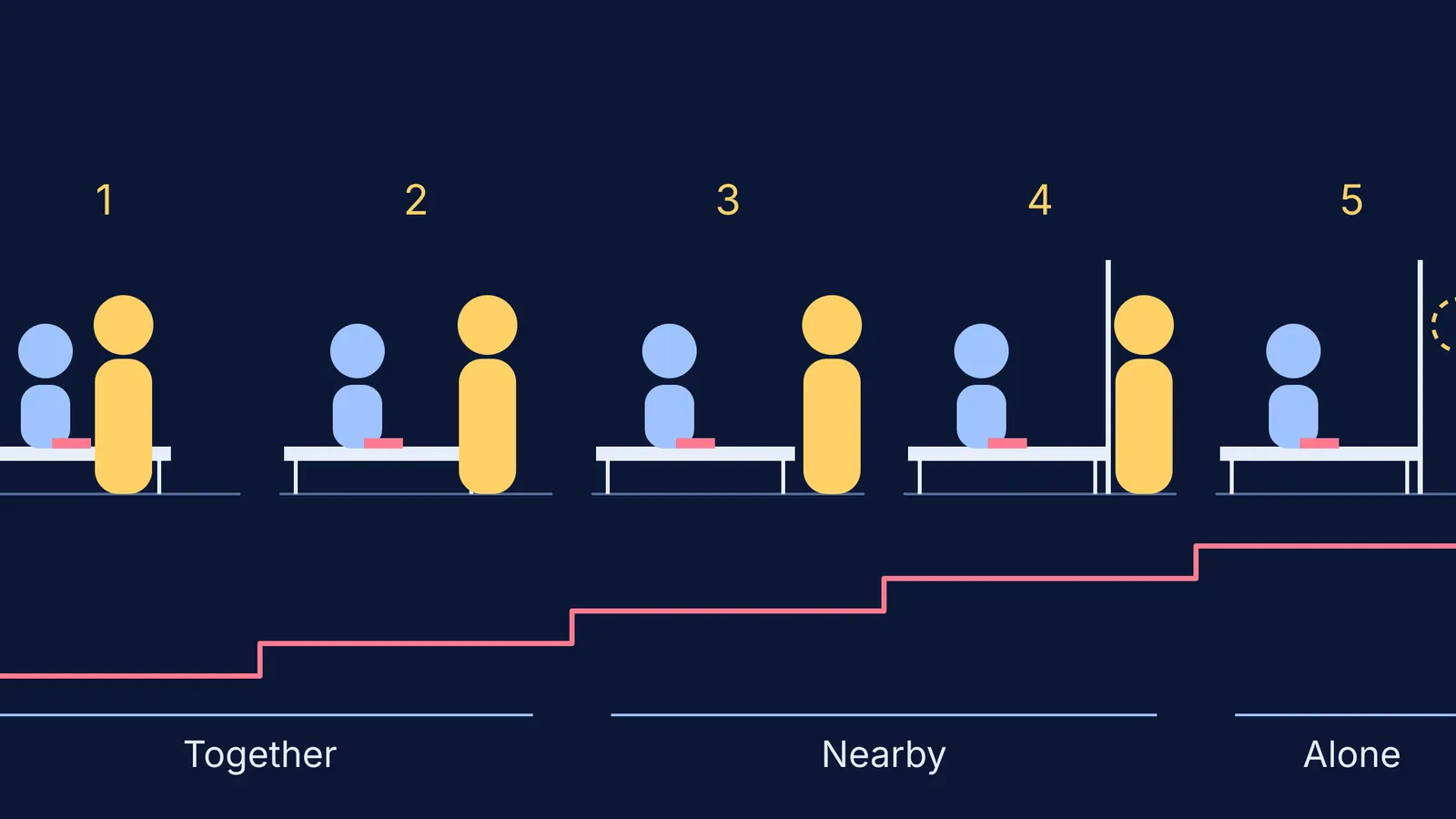
How do I step back gradually? A five-stage plan
Stay in each stage until your child manages it on most days for about a week. Share the plan in advance so each step feels like a promotion, not a punishment.
Together, side by side. You sit beside them, but they hold the pen. You ask questions ("What is the question asking?") and solve nothing. Your job: show how to get started.
Together, across the table. You sit at the same table with your own reading or work. They start on their own; you look up only when asked. Your job: calm company.
Nearby, same room. You move to the sofa or the kitchen. You agree on two check-ins: after the first task and at the end. Your job: check that work started, not how it was done.
Nearby, next room. They work alone with the door open, show you a written plan at the start and what they finished at the end. Your job: listen.
Alone, with a review. They plan, study and check their own work. A short chat after dinner covers what went well, what was hard and what's next. Your job: take an interest, not inspect.
Getting stuck is what usually pulls a parent back into the chair. If the problem is a method they cannot follow, the Fermi Problem Library has worked problems with a step-by-step solver that explains the reasoning rather than printing an answer.
Our guide to teaching your child to plan their time covers the written plan used in stages 4 and 5.
What should I say when I move to the next stage?
Short and agreed in advance beats a lecture. Lines to borrow:
Starting: "You've got good at this. Each week I'll move a bit further away, and you'll be in charge of more."
Moving up: "You started on your own every day this week. From Monday I'll be on the sofa, and we'll check in after your first task."
At a check-in: "Show me what you planned and what you finished." Not: "Why did that take so long?"
When they ask you to sit back down: "I'll sit with you for the first question, then I'm going back to the kitchen."
Real choices, such as the order of subjects, also help; our piece on choice and autonomy in parenting explains why.
What if my child slides back?
Expect it during exam weeks, illness or a hard new topic. Go back one stage, not to the start, and name a date to try again. A bad evening is information, not failure.
For free mental-health support in India, call Tele MANAS on 14416.
For which moments still need you, see when to help with homework and when to step back. Pick tonight's stage, tell your child the plan, and move your chair a little further away.


