

On this page
Rhymes look like play, but they do a specific job: they teach a child to hear the pieces inside words. That ear for sounds is what a child later matches to letters.
Do nursery rhymes really help children learn to read?
The best-known evidence is a study by Bryant, Bradley, Maclean and Crossland in the Journal of Child Language (1989). They followed 64 children from 3 years 4 months to 6 years 3 months of age.
Early knowledge of nursery rhymes was strongly linked to success in reading and spelling over the next three years, and the link held after the researchers accounted for IQ, social background and the children's starting sound skills. Their explanation: rhymes make children more sensitive to sounds, first to rhymes and later to single sounds (phonemes), and that sensitivity makes reading easier.
A fair caveat: this was an observational study of English-speaking children. It shows a strong link, not proof that rhymes alone cause better reading. Children who hear plenty of rhymes probably also hear plenty of talk and stories, which may help too; our guide to building vocabulary at home covers the talk side.
How do rhyme and rhythm build sound awareness?
Phonological awareness is a child's ability to notice and play with the sounds in spoken words, apart from their meaning.
Differences between children in phonological awareness predict reading and spelling development across languages, according to a review by University of Cambridge psychologist Usha Goswami in Current Directions in Psychological Science.
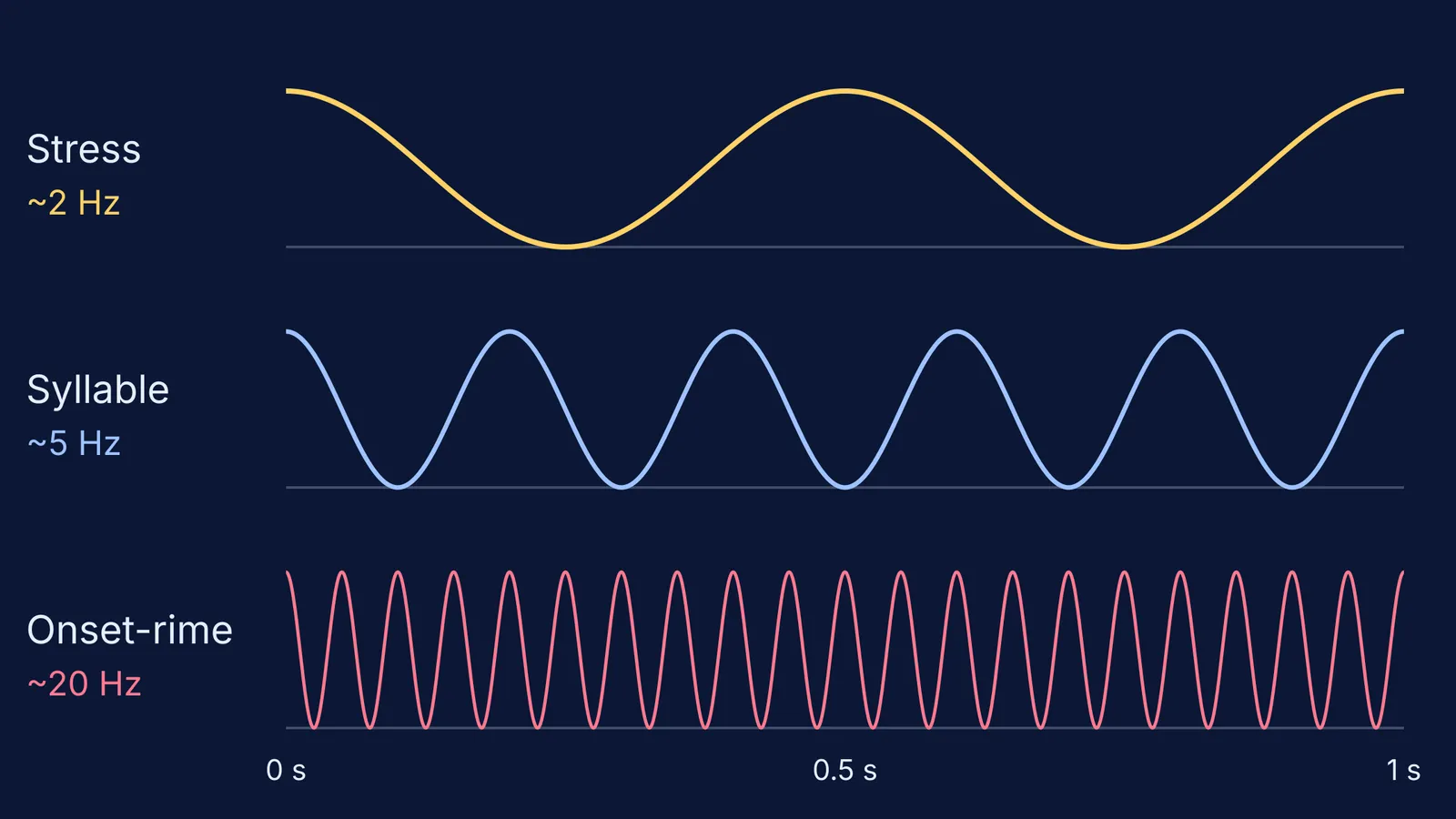
Rhythm matters as much as rhyme. In a 2015 PLOS ONE study, Victoria Leong and Usha Goswami analysed nursery rhymes read aloud to children and found nested beats at roughly 2 per second (stressed syllables), 5 per second (syllables) and 20 per second (onset and rime, the c- and -at of cat).
Their computer model picked out stress patterns, syllables and onset-rime units 90-98% of the time in a nursery rhyme spoken in time to a metronome, against 72-82% in nursery rhymes read freely (Leong and Goswami, 2015). That was a computer, not a child, but it suggests a steady beat makes sound units easier to pick out, so clap, tap or bounce as you chant.
Does the rhyme have to be in English?
No. In Goswami's review, sound awareness predicts reading across languages, and the rhythm of stressed syllables may give sound development a "skeleton" in every language. A rhyme in Tamil, Bengali or Marathi has a beat you can clap too.
India's National Curriculum Framework for the Foundational Stage 2022 says the medium of instruction will be the home language in the Foundational Stage to the extent possible, and that decoding (matching sounds to written symbols) will be developed through games and interactive exercises. It also suggests rhymes, chants and songs in different languages for the classroom.
So sing in the language you sing best, and see our post on reading in your mother tongue at home.
Which rhyme games can you play at home?
These go roughly from easiest to hardest. Move on when one feels easy.
Clap the beat. Chant a rhyme and clap on the strong beats. Then clap names by syllable: Ar-jun (two claps), A-nan-ya (three).
Finish the line. Pause before the rhyming word and let your child supply it: "Twinkle, twinkle, little ..."
Odd one out. Say three words and ask which one does not rhyme: "billi, dilli, aam" or "cat, hat, sun".
Silly rhyme chains. Start from a name and keep going with real or nonsense words: "Raju, kaaju, baaju, taaju".
First-sound spy. "I spy something that starts with mmm." This moves your child from hearing rhymes to hearing first sounds.
How do you move from rhymes to letters?
Once your child can hear rhymes and first sounds, link those sounds to written symbols in small steps.
Ear only. Keep playing the games above with no print at all.
One sound, one symbol. Pick a sound from a word your child loves, often the first sound of their own name, and show the letter or akshara for it.
Find it everywhere. Spot that symbol on cereal boxes, shop signs and book covers.
Rhyme families in print. Write cat, hat, mat in a column and change only the first letter. The rhyme your child already hears becomes a spelling pattern they can see.
A script for step 2: "Listen: ball, bat, bus. They all start with b. This is how we write b. Can you find it on this page?"
Worried about Class 1? Read our post on the UKG to Class 1 reading gap.
For older siblings, the beats in this research are a nice way into frequency and waves. Fermi's Simulation Lab has interactive simulations for the ideas that are easier to see than to read.
Tonight, clap out one rhyme from your own childhood and leave the last word for your child.


