

On this page
Most parents want their children to have a strong vocabulary, knowing it makes school and reading comprehension much easier. The temptation is to use flashcards or educational apps, but research points to a simpler, more effective method: reading aloud and talking about the words you find.
The million-word gap: why reading aloud works
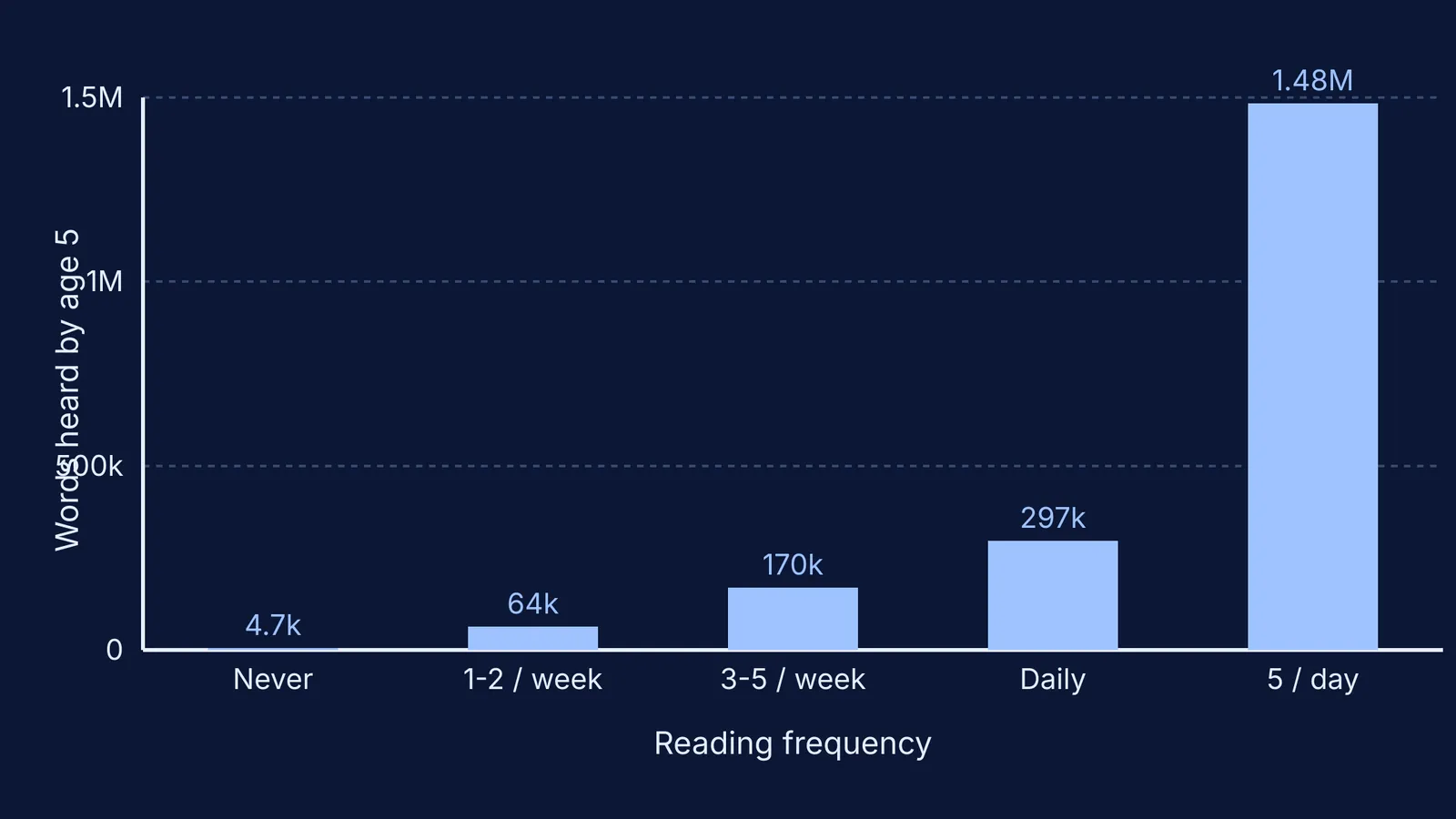
The sheer volume of words a child hears at home dictates how prepared they are for school. A 2019 study by The Ohio State University found that a child read to five times a day enters kindergarten having heard 1.4 million more words than a child who is never read to [\[1\]](https://news.osu.edu/a-million-word-gap-for-children-who-arent-read-to-at-home/). Even reading just one book a day exposes a child to 296,660 words by age five [\[2\]](https://news.osu.edu/a-million-word-gap-for-children-who-arent-read-to-at-home/).
This is known as the "million-word gap", and it shows why a daily reading habit is one of the strongest predictors of a child's later academic success. You can help your child by building a study routine that includes time for books every day.
Why are books better than conversation?
You might wonder if simply talking to your child is enough. While conversation is essential, it tends to rely on the same common words and focuses on the "here and now." Books, on the other hand, take children to new worlds and introduce complex language.
Children's picture books contain about 31 rare words per 1,000 words, compared to only 10 rare words per 1,000 in parents' spoken conversation [\[3\]](https://pubmed.ncbi.nlm.nih.gov/3209647/). When you encounter a rare word like "enormous" or "hustle" in a book, pausing to explain it gives your child context they cannot get from fast-paced speech. It also opens up a natural dialogue. You can ask what they think the word means based on the pictures, or relate it to something they have experienced. This kind of active engagement deepens their understanding far more than just reading the word and moving on.
Will learning our home language confuse them?
In many Indian homes, families speak a regional language or mother tongue alongside English. Parents sometimes worry that teaching the home language will confuse the child or limit their English vocabulary.
Research shows the opposite is true. A child's conceptual vocabulary spans both languages, meaning if they know the word for "water" in Hindi (*pani*), they already understand the concept and only need the new label in English. A strong foundation in a home language provides a linguistic framework that actually helps children acquire a second language faster. You can build vocabulary in both languages and help children learn without pressure.
How to play the "Word of the Day" game?
If you want a concrete way to build vocabulary, try introducing a "word of the day" game. This turns learning into a family habit rather than a chore.
Pick a word from a book you read together or a subject they are curious about. If they are learning about the solar system, the word might be "orbit" or "gravity."
Define it simply: "An orbit is the invisible path a planet takes as it travels around the Sun."
Use it in a sentence: "The Earth is in orbit around the Sun."
See who can use the word correctly in conversation at dinner. Make it a fun challenge rather than a test. The goal is to naturally weave these new words into your family's daily life, reinforcing the vocabulary outside of dedicated reading times.
If they are struggling to picture the concept, Fermi Simulation Lab lets them play with interactive models, such as watching how gravity actually creates an orbit.
By making words part of your daily routine and encouraging curiosity, you give your child a vocabulary rich enough to handle any subject they study.


