On this page
Half of NEET-UG is biology. The NEET (UG)-2026 Information Bulletin from NTA lists 90 Biology (Botany and Zoology) questions out of 180, worth 360 of the 720 marks. NTA can change the pattern, so check the current bulletin each year.
You do not need to know biology to help. You need your child's NCERT textbook, a pencil and a timer, and the job of quiz-master.
Why is quizzing better than re-reading for NEET biology?
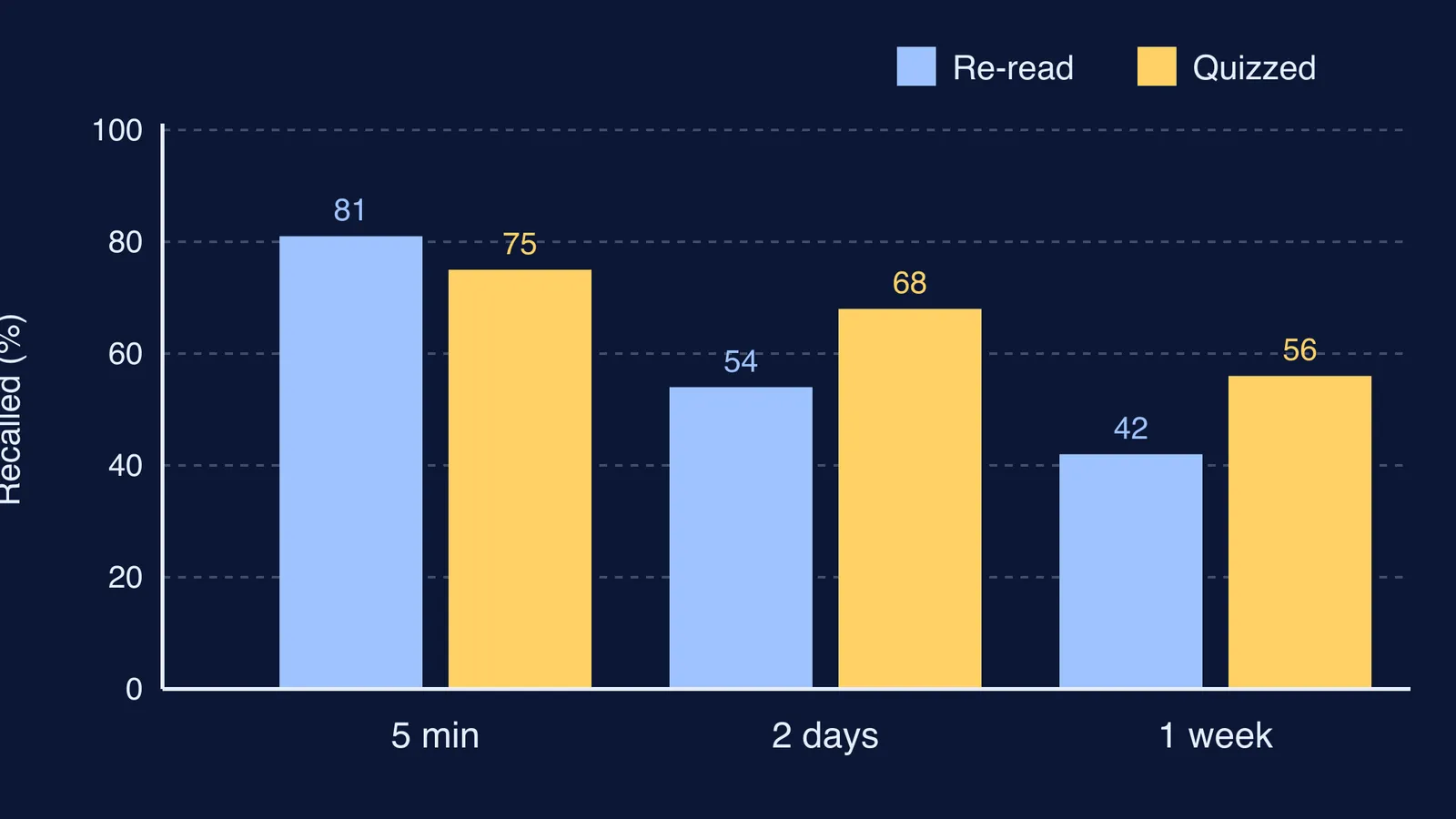
In a 2006 study by Henry Roediger and Jeffrey Karpicke, students read short prose passages, then either read them again or wrote down all they could recall. Five minutes later, re-studying looked better: 81% recalled against 75%. One week later the result flipped: the tested group remembered 56% and the re-study group 42%.
In the same paper's second experiment, students who read a passage once and recalled it three times remembered 61% after a week. Students who read it four times remembered 40%, even though they predicted they would remember it better.
A 2013 review of ten study techniques by John Dunlosky and colleagues rated practice testing and spaced practice as high utility, and rereading and highlighting as low utility.
There is a lesson about parents too. A meta-analysis of 50 studies by Nancy Hill and Diana Tyson found that parental involvement in middle school was linked with higher achievement, with one exception: direct help with homework. Those students were younger than NEET aspirants, but we take it as a reason to ask rather than re-teach.
How can I quiz from NCERT lines if I don't know biology?
Let your child choose a section they have already studied. Read a line silently and turn it into a question in one of three ways:
Blank it: hide one key word and ask for it.
Flip it: give the term and ask what it does or where it is.
Neighbour it: ask what comes next, or for the example the book gives.
Here is a worked example. Suppose the line says the tricuspid valve guards the opening between the right atrium and the right ventricle. You could ask:
"Which valve sits between the right atrium and the right ventricle?"
"The tricuspid valve: which two chambers does it separate?"
"What is the matching valve on the left side called?" Your child answers first; you check the next few lines of the book.
Your child answers aloud before you look. Missed lines get a pencil dot, and the next session starts with them. Ten to fifteen questions is plenty. For which lines tend to matter, see our guide to reading NCERT biology line by line for NEET.
How do I help with NEET biology diagrams?
Use a blank-page check:
Name a figure from the chapter, such as the human heart, a nephron or a dicot root.
Your child draws and labels it from memory in about three minutes.
Open the NCERT figure together. Your child adds missing labels in a different colour.
The coloured labels go on the dot list for next time.
Research by Jeffrey Wammes, Melissa Meade and Myra Fernandes found, across seven experiments, that words people drew were recalled better than words they wrote out. Those were word lists, not textbook figures, but drawing from memory also shows both of you what is missing. Our post on NEET biology diagrams covers which figures to practise.
If a label is missing because the idea behind it is unclear, that is a concept gap. The Fermi Concept Library has a lesson for each concept in biology, so your child can read the idea properly before the next quiz.
How long should a NEET biology revision session be?
Keep it to 15 to 20 minutes. No study sets a perfect length; short sessions are simply easier to repeat across days. A review of 317 experiments by Nicholas Cepeda and colleagues found that the best gap between study sessions grows with how long the material needs to be remembered.
A simple weekly rhythm:
Day 1: quiz on the chapter your child studied this week.
Day 3: dotted lines only, plus one diagram.
Day 7: a mixed quiz across this chapter and an older one.
Every few weeks: a round on old chapters.
If your child is unsure where to begin a chapter, Fermi's AI tutor can work out what they already know and build a plan for the session.
What if revision turns into stress?
These sessions should feel like a short game, not a verdict. If a quiz ends in tears or an argument, stop for the day and try again with fewer questions. Our post on helping children learn without pressure has more on keeping the tone light.
If worry about NEET shows up in sleep, appetite or mood, talk with your child and consider a counsellor or doctor. Tele MANAS, the Ministry of Health and Family Welfare's free 24x7 mental-health helpline, is on 14416.
Tonight, pick one studied page, ask ten questions and dot the misses. That is the first session done.