

On this page
If your Class 3 child counts on fingers for 8 + 7, or freezes at 52 − 47, they have plenty of company. In the ASER 2024 national findings, a household survey of rural India, 33.7% of Class 3 children could at least do a two-digit subtraction with borrowing, up from 25.9% in 2022. Five relaxed minutes a day at home is a good place to start.
What should a Class 3 child be able to do in maths?
The Ministry of Education's NIPUN Bharat mission presentation says that by the end of Grade 3, every child should read and write numbers up to 9999 and solve simple multiplication problems, with the goal set for 2026-27.
The same document defines foundational numeracy as "the ability to reason and to apply simple numerical concepts in daily life problem solving." It also expects children to perform simple computations "in her/his own way" up to three-digit numbers. So mental maths in Class 3 is about flexible ways of thinking, not raw speed.
Why skip timed drills and flash-card races?
Anxiety gets in the way of thinking. In a study of 154 first- and second-graders, Ramirez and colleagues (2013) found that maths anxiety was linked to lower maths achievement, but only among children with stronger working memory. The authors suggest these children rely on memory-heavy strategies, and worry uses up the memory they need.
Parents' feelings travel too. Maloney and colleagues (2015) found that when parents anxious about maths often helped with maths homework, their first- and second-graders learned less maths across the school year and grew more anxious. When those parents helped less often, the link disappeared.
Home practice can help. In Berkowitz and colleagues (2015), families used an app to bring short maths activities into the home, and children's maths improved within months, most of all where parents reported being anxious about maths.
How do you run a five-minute number talk at home?
A number talk is one problem, done in the head, followed by a conversation about how. Do it at breakfast, in an auto or at the bus stop.
Say one problem aloud. No paper.
Give thinking time. Your child shows a thumb up when ready.
Hear the answer, then ask: "How did you work it out?"
Share your own way, as one more idea, not the right one.
Stop at five minutes, while it is still fun.
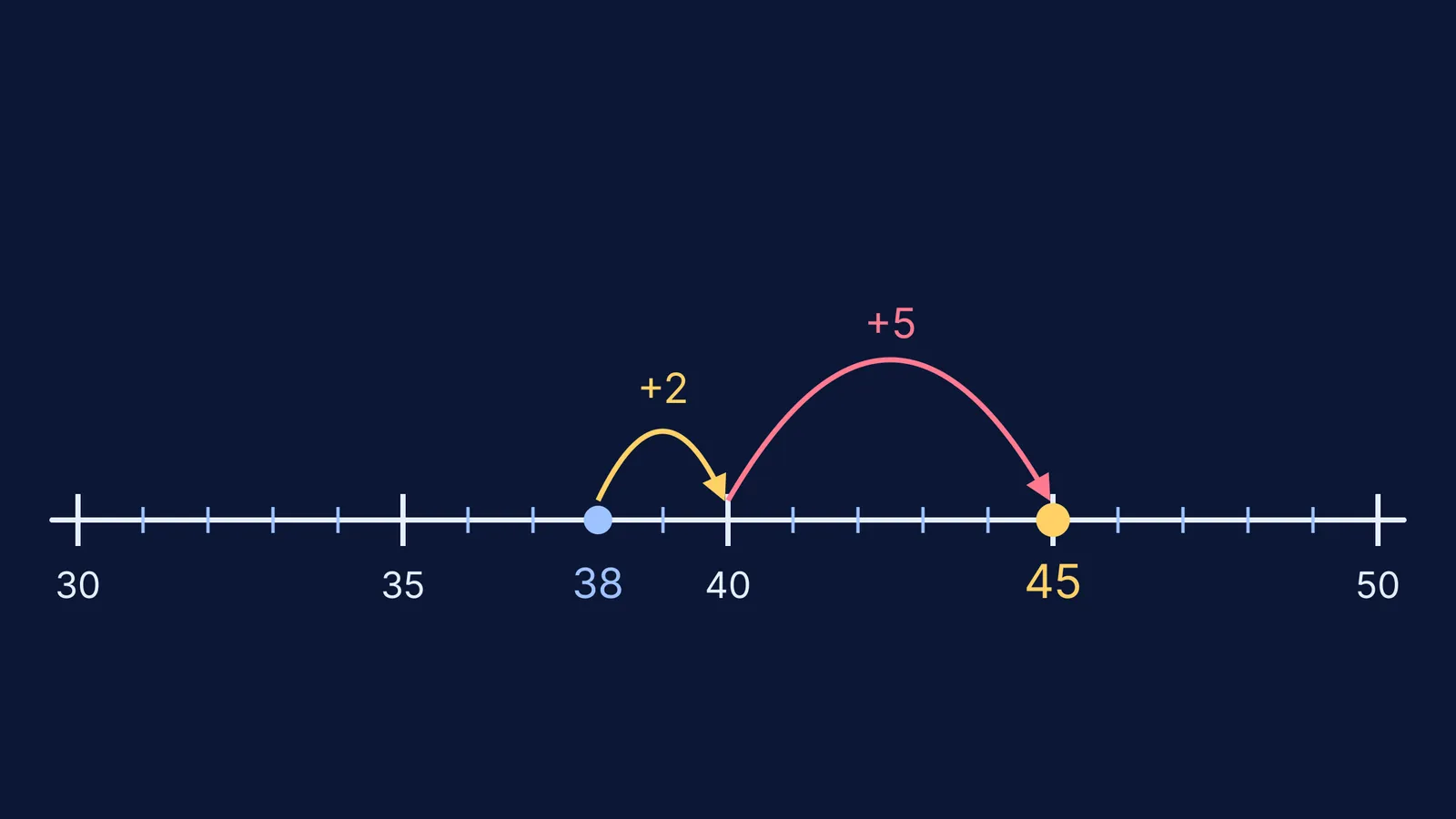
Worked example: 38 + 7. One child counts on seven fingers. Another says, "38 to 40 is 2, and 5 more is 45." Both reach 45, but making a ten scales up to 68 + 7 or 380 + 70. Praise the explaining, then ask, "Can you try the make-a-ten way on 47 + 6?"
Phrases that keep it calm:
"Tell me what was in your head."
"Is there another way?"
"You were close. Which step slipped?"
Avoid "That's easy" and "Quick, quick." Both can tell a stuck child they are failing.
Which games build quick calculation?
Make ten: 9 + 6 becomes 10 + 5. Then 29 + 6 becomes 30 + 5.
Doubling ladder: 3, 6, 12, 24, 48. Then double 15, 25 and 35.
Near doubles: 7 + 8 is double 7, plus 1.
Halving: half of 30, 50, 120. Share rotis or laddoos to check.
Double and halve: 5 × 16 is the same as 10 × 8, which is 80. 4 × 15 is 2 × 30, which is 60.
Count on to subtract: for 52 − 47, count up from 47 to 50 (3), then to 52 (2). The answer is 5.
Shopkeeper change: an item costs ₹68 and you pay ₹100. Count up: 68 to 70 is 2, 70 to 100 is 30, so the change is ₹32.
Our guide to maths while cooking with kids has more ideas. If you are weighing a paid course instead, read what abacus and Vedic maths classes teach and what they miss first.
A two-week plan you can start tomorrow
Week 1, one strategy a day: Monday make ten, Tuesday doubles, Wednesday near doubles, Thursday halving, Friday counting on to subtract. Weekend: one shopkeeper-change game.
Week 2: Monday and Tuesday double and halve, Wednesday mixed problems where your child picks the strategy, Thursday your child sets you a problem, Friday their favourite. Stick each strategy on the fridge in your child's words.
Our after-school homework routine for Class 3 shows where five minutes can go. To refresh your own understanding of why a trick works, such as why doubling one number and halving the other keeps the product the same, the Fermi Concept Library has a lesson for every concept in mathematics.
Start with one problem at breakfast tomorrow, and ask how, not how fast.


