

On this page
A long drive or a six-hour train ride is full of numbers: number plates, kilometre stones, platform boards, the time on the ticket. You don't need a worksheet or a phone to turn them into maths. You need a question, a bit of patience and a rule that nobody gets laughed at for a wrong guess.
Why play maths games on a journey at all?
Spoken number games are a kind of "number talk", which seems to matter early. In a 2010 study in Developmental Psychology, Susan Levine and colleagues followed 44 children and found that how much their main caregiver talked about numbers between 14 and 30 months predicted the children's grasp of what number words mean at 46 months, even after controlling for socioeconomic status and other measures of talk.
Games with a number line help too. In Ramani and Siegler's 2008 study in Child Development, preschoolers from low-income families who played a numbered board game for roughly one hour improved on four number tasks, and the gains were still there nine weeks later. Classmates who played the same game with coloured squares instead of numbers did not improve.
Estimation is its own skill. Siegler and Booth (2004) found that how accurately children from kindergarten to second grade (about 6 to 8 years old) placed numbers on a line correlated strongly with their maths achievement test scores.
India's National Education Policy 2020 (paragraph 4.25) says maths should be taught through a variety of methods, "including the regular use of puzzles and games that make mathematical thinking more enjoyable and engaging".
None of these studies tested car or train games directly, so treat them as a reason to try, not a promise of higher marks.
Which maths games suit which age?
Ages 4 to 6: count, compare, find
Number hunt: find a 1 on a number plate, then a 2, then a 3, all the way to 9.
More or less: "Are there more red cars or white cars before the next bridge?" Count both.
Which is bigger? Read two numbers off plates and say which is more.
Ages 7 to 10: number-plate sums
Plate sum: add the four digits of the number on a plate. 3, 4, 7 and 1 make 15.
Odd or even: the first person to say whether the total is odd or even wins the round.
Make ten: find two digits on one plate that add up to 10.
Ages 11 to 14: targets and distance guesses
Make 24: use all four digits once with +, −, × and ÷. For 3, 4, 7, 1: 3 × 7 + 4 − 1 = 24. Some plates can't make 24; spotting that counts too.
Kilometre-stone guess: when a stone says 48 km to the next town, everyone guesses the arrival time. Check who was closest.
Count and scale: count electric poles for one minute, then estimate how many you will pass in an hour.
Ages 15 and up: timetable questions
Teenagers can work with the ticket or the timetable. These are the same average-speed and relative-motion questions they meet in school physics, only with a real train attached.
What does a timetable question look like?
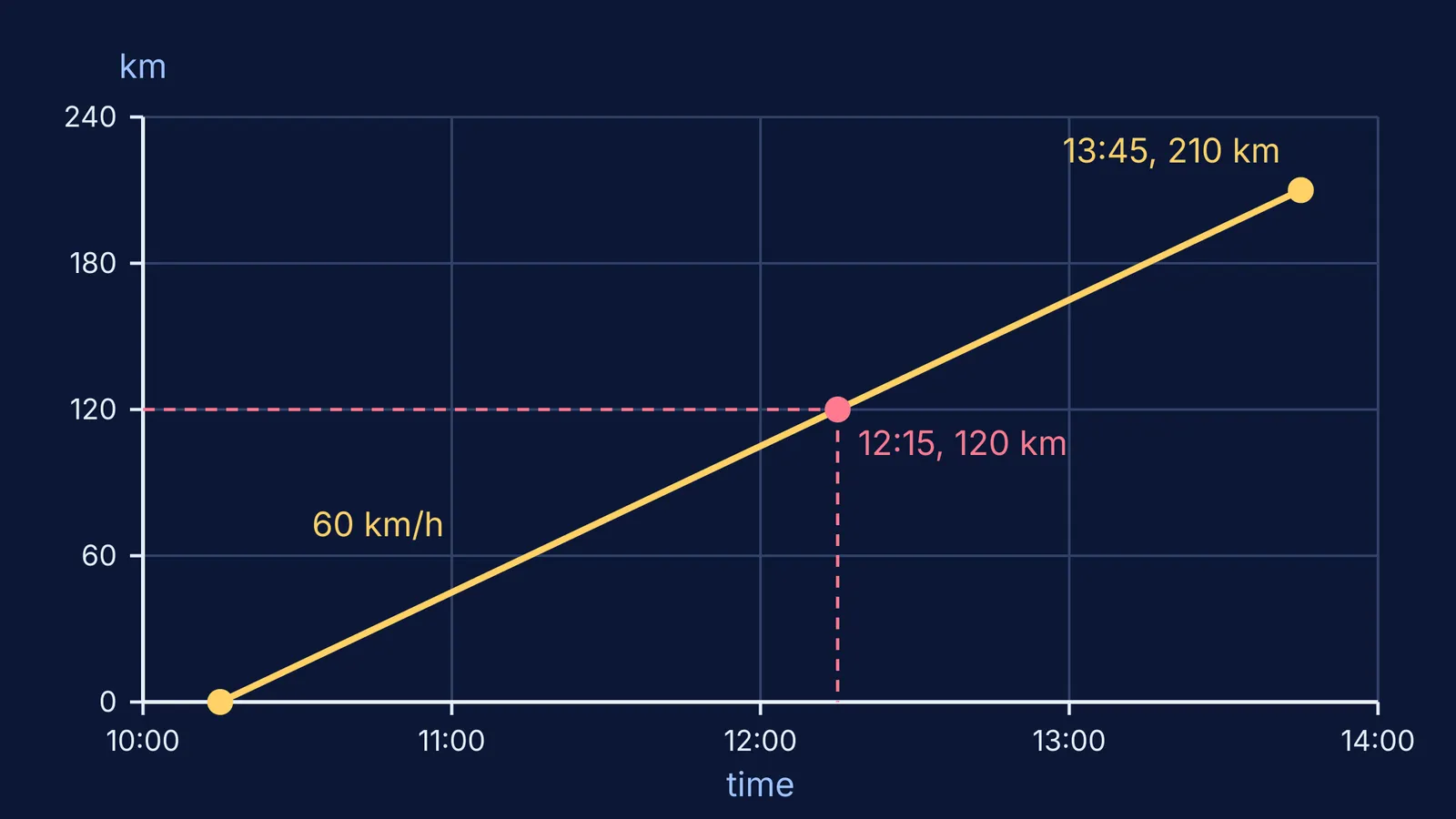
Here is a worked example with made-up numbers.
The train leaves at 10:15 and arrives at 13:45. How long is the journey? Answer: 3 hours 30 minutes, or 3.5 hours.
The ticket says 210 km. What is the average speed? 210 ÷ 3.5 = 60 km/h.
At 12:15, how far have we come if the speed stays steady? 2 hours × 60 km/h = 120 km.
We were 20 minutes late leaving. To arrive on time, what average speed would we need? 210 km in 3 hours 10 minutes, about 66 km/h.
A train passes us the other way. If it runs at 80 km/h and we run at 60 km/h, how fast does it seem to pass? 140 km/h.
Question 5 is relative velocity, an idea that is easy to get muddled on paper. If a journey question opens up a gap like that, Fermi's Concept Library covers every concept in physics, chemistry, biology, mathematics and computing, each with its own lesson, and the Fermi Problem Library has worked problems with a step-by-step solver that explains the reasoning. Save both for after the trip.
How do you keep it fun and not a test?
Let the child set questions. Checking your answer is maths too.
Keep rounds short. Five minutes, then look out of the window again.
Play on the same team. "Can we beat our guess from the last stone?" works better than ranking siblings.
Say your thinking aloud. "Two hours at 60, so about 120 km" shows a method without a lecture.
Stop while it is still fun. Travel sickness, hunger and tiredness beat any game.
For more ideas, see our train journey learning activities for kids, our guide to measurement and estimation games, and how to show teenagers maths in daily life.


